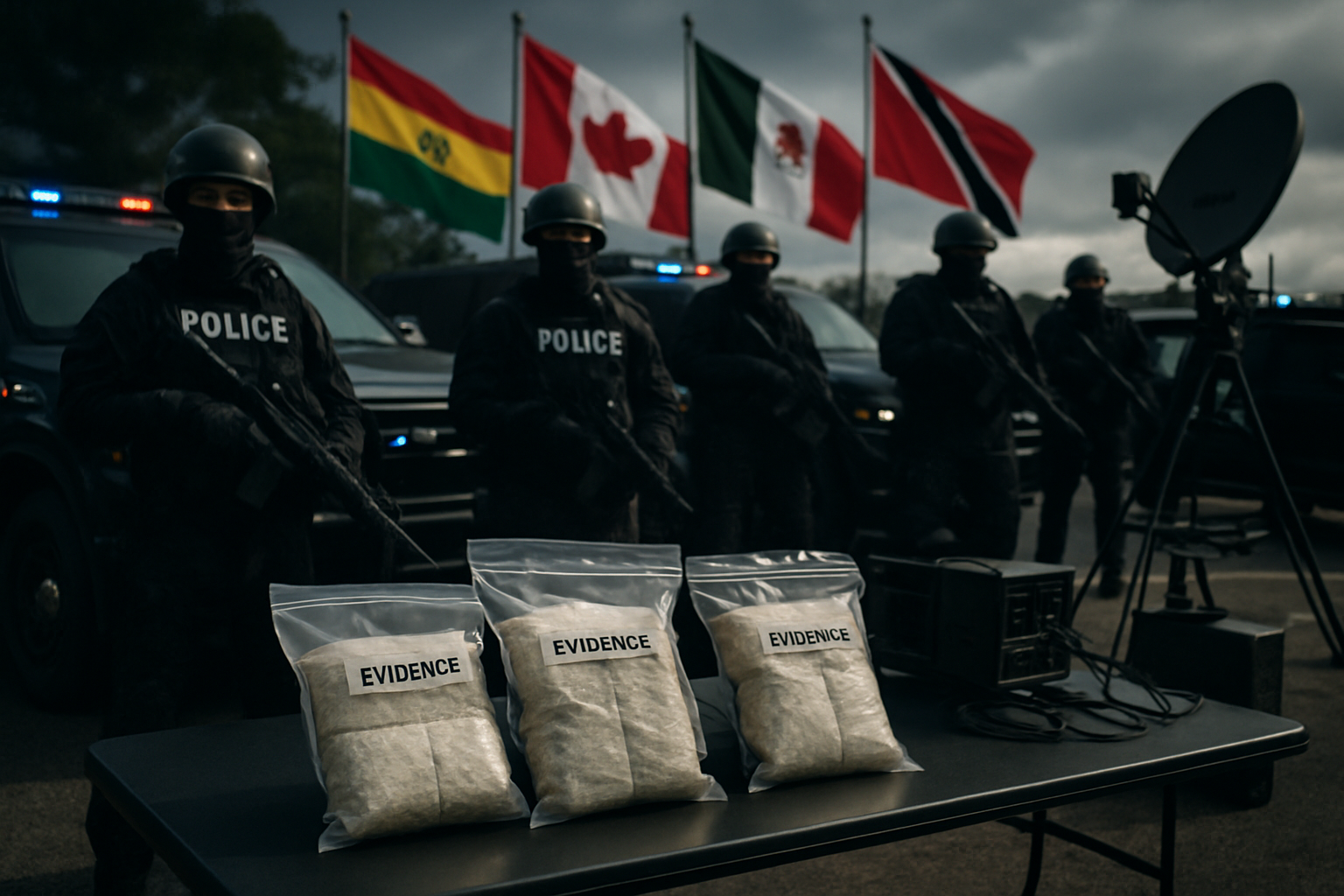
A coordinated wave of international law enforcement operations across the Americas has delivered significant blows to drug trafficking networks, with major seizures and arrests spanning from Bolivia's satellite surveillance initiatives to Trinidad and Tobago's $23 million drug bust, marking a new era of multilateral cooperation against transnational organized crime.
The latest operations, documented across multiple countries between March 5-7, 2026, represent a sophisticated evolution in anti-drug enforcement, combining cutting-edge technology with traditional investigative methods to dismantle criminal organizations that have grown increasingly complex and internationally coordinated.
Bolivia's Technological Leap Forward
In a groundbreaking development, Bolivia's Defense Minister Marcelo Salinas announced plans to establish the country as a regional "sovereign information and security hub" during the inaugural Conference of the Americas against Cartels held at U.S. Southern Command headquarters in Doral, Florida. The initiative, presented to representatives from 14 countries, envisions Bolivia leveraging its strategic geographic position to deploy advanced satellite and drone surveillance systems against transnational organized crime.
Salinas warned that organized criminal networks have evolved into "increasingly complex structures with the capacity to operate beyond borders and, in some cases, weaken the effective sovereignty of states." This assessment reflects the growing recognition among law enforcement agencies that traditional domestic approaches are inadequate against organizations with state-like capabilities.
"Transnational organized crime has developed structures that challenge our traditional understanding of criminal organizations. They now operate with military-grade technology and intelligence capabilities that rival state operations."
— Defense Minister Marcelo Salinas, Bolivia
U.S.-Ecuador Joint Military Operations
Simultaneously, the United States and Ecuador conducted what U.S. officials termed "lethal kinetic operations" targeting drug trafficking infrastructure in the South American nation. These operations represent a significant escalation from traditional law enforcement cooperation to direct military intervention, highlighting the extent to which criminal organizations have forced governments to adopt increasingly aggressive countermeasures.
The joint operations occurred against the backdrop of Ecuador's ongoing security crisis, where criminal organizations have demonstrated unprecedented boldness in challenging state authority. The willingness of both nations to engage in military-style operations reflects the severity of the threat posed by these sophisticated criminal networks.
Mexico's Judicial Victories Against Cartel Connections
In Mexico, the Second Collegiate Appeals Court delivered a significant blow to the Jalisco New Generation Cartel (CJNG) by denying an amparo petition from former Teuchitlán mayor José Ascención Murguía Santiago. The former municipal president faces charges of organized crime connections related to alleged operations at the Izaguirre ranch, which authorities identified as a potential training facility for the powerful criminal organization.
The court's decision represents more than a single judicial ruling—it demonstrates Mexico's continued effort to prosecute high-level officials suspected of facilitating cartel operations, even as these organizations have grown in sophistication and territorial control following the February 2026 elimination of CJNG leader Nemesio Oseguera Cervantes, known as "El Mencho."
The denial of the amparo petition ensures Murguía Santiago will remain in prison while facing charges that could establish important precedents for holding elected officials accountable for their alleged roles in facilitating organized crime activities.
Record-Breaking Caribbean Seizure
Trinidad and Tobago achieved one of the largest drug seizures in its recent history, with police confiscating narcotics valued at over $23 million during a coordinated operation in the Fyzabad district. The operation, conducted by specialist units of the Trinidad and Tobago Police Service in cooperation with the Inter-Agency Task Force and Southern Division Task Force, targeted what authorities described as a sophisticated drug trafficking network operating within the South Western Division.
Intelligence reports indicated the network had successfully imported substantial quantities of narcotics from South America, highlighting the Caribbean's continued role as a critical transit point for drugs destined for North American and European markets. The seizure occurred as part of coordinated exercises conducted simultaneously in the Southern and South Western Divisions, demonstrating the multi-jurisdictional nature of modern anti-drug operations.

Evolution of Criminal Networks
The recent operations reveal the extraordinary sophistication that criminal organizations have achieved. These networks now employ advanced technology including encrypted communications, satellite surveillance, and compartmentalized operational structures that span multiple countries. Their ability to adapt to law enforcement tactics has forced authorities to develop correspondingly sophisticated responses.
Historical context from previous operations documented throughout 2026 shows criminal organizations have consistently evolved faster than law enforcement adaptation. The February 2026 elimination of El Mencho, for instance, led not to reduced criminal activity but to organizational splintering and increased violence as multiple factions competed for territorial control.
International Cooperation Breakthroughs
The current wave of operations builds on enhanced international cooperation frameworks developed throughout 2026. Previous major successes, including the coordinated maritime interdiction operations that seized over 7.5 tonnes of cocaine valued at approximately $200 million in February, established templates for the kind of multilateral coordination now being implemented across the Americas.
The Conference of the Americas against Cartels represents a formalization of cooperation mechanisms that have been developing organically as law enforcement agencies recognize that criminal networks operate without regard for national boundaries. Bolivia's proposal to serve as a regional intelligence hub reflects this understanding that effective responses require sustained, coordinated international effort.
Technological Arms Race
One of the most significant developments in this ongoing conflict has been the technological sophistication achieved by criminal organizations. The need for countries like Bolivia to propose satellite and drone surveillance systems reflects the reality that these organizations now possess capabilities that were once exclusive to state actors.
Recent incidents, including the Mexican cartel drone operations that temporarily forced the closure of El Paso International Airport in February 2026, demonstrate that criminal organizations have acquired military-grade technology and are willing to use it against civilian infrastructure. This escalation has forced law enforcement agencies to rapidly develop countermeasures and adopt technologies typically associated with military operations.
"The criminal networks we face today operate with technological capabilities and organizational sophistication that exceed many legitimate businesses. Our response must evolve to match this threat level while preserving democratic values and civil liberties."
— Regional Security Expert, University of Miami
Economic and Social Impact
The operations documented across these four countries represent more than law enforcement victories—they demonstrate the massive economic stakes involved in anti-drug efforts. The $23 million Trinidad and Tobago seizure alone represents significant criminal revenue eliminated from circulation, while the disruption of trafficking networks affects legitimate economic activities including tourism, shipping, and international trade.
The Caribbean region, in particular, faces unique challenges as criminal organizations exploit legitimate maritime infrastructure for trafficking operations. The intersection of criminal activity with legal commerce creates complex enforcement challenges that require careful coordination to avoid disrupting legitimate economic activities while targeting criminal operations.
Challenges Ahead
Despite recent successes, law enforcement agencies acknowledge that criminal organizations continue to adapt and evolve. The splintering of major cartels following leadership eliminations has created multiple smaller but potentially more violent organizations, each competing for territorial control and trafficking routes.
The technological arms race between criminal organizations and law enforcement continues to accelerate, with criminals often adopting new technologies faster than legal authorities can develop countermeasures. This dynamic requires sustained investment in both technology and training, as well as continued international cooperation to share intelligence and best practices.
Resource constraints remain a significant challenge, particularly for smaller countries that serve as transit points for international trafficking operations. The success of operations like those in Trinidad and Tobago depends on sustained political commitment and adequate funding for specialized units capable of confronting sophisticated criminal networks.
Looking Forward
The current wave of operations represents a critical test of international cooperation mechanisms against transnational organized crime. Success will depend on maintaining the enhanced coordination demonstrated in recent months while addressing the underlying conditions that enable criminal recruitment and operations.
Bolivia's proposal to establish a regional intelligence hub reflects the recognition that effective responses require institutional innovation and sustained commitment beyond traditional bilateral cooperation. The willingness of countries to share intelligence and coordinate operations in real-time represents a significant evolution in international law enforcement cooperation.
As criminal organizations continue to demonstrate state-like capabilities and international reach, the international community faces the challenge of developing correspondingly sophisticated responses while preserving democratic governance principles and civil liberties. The operations documented in recent days provide both a template for success and a reminder of the ongoing nature of this challenge.
The March 2026 operations across Bolivia, Canada, Mexico, and Trinidad and Tobago mark a significant moment in the evolution of international anti-drug cooperation, demonstrating both the achievements possible through coordinated effort and the continued adaptation required to confront criminal organizations that operate without regard for national boundaries or legal constraints.