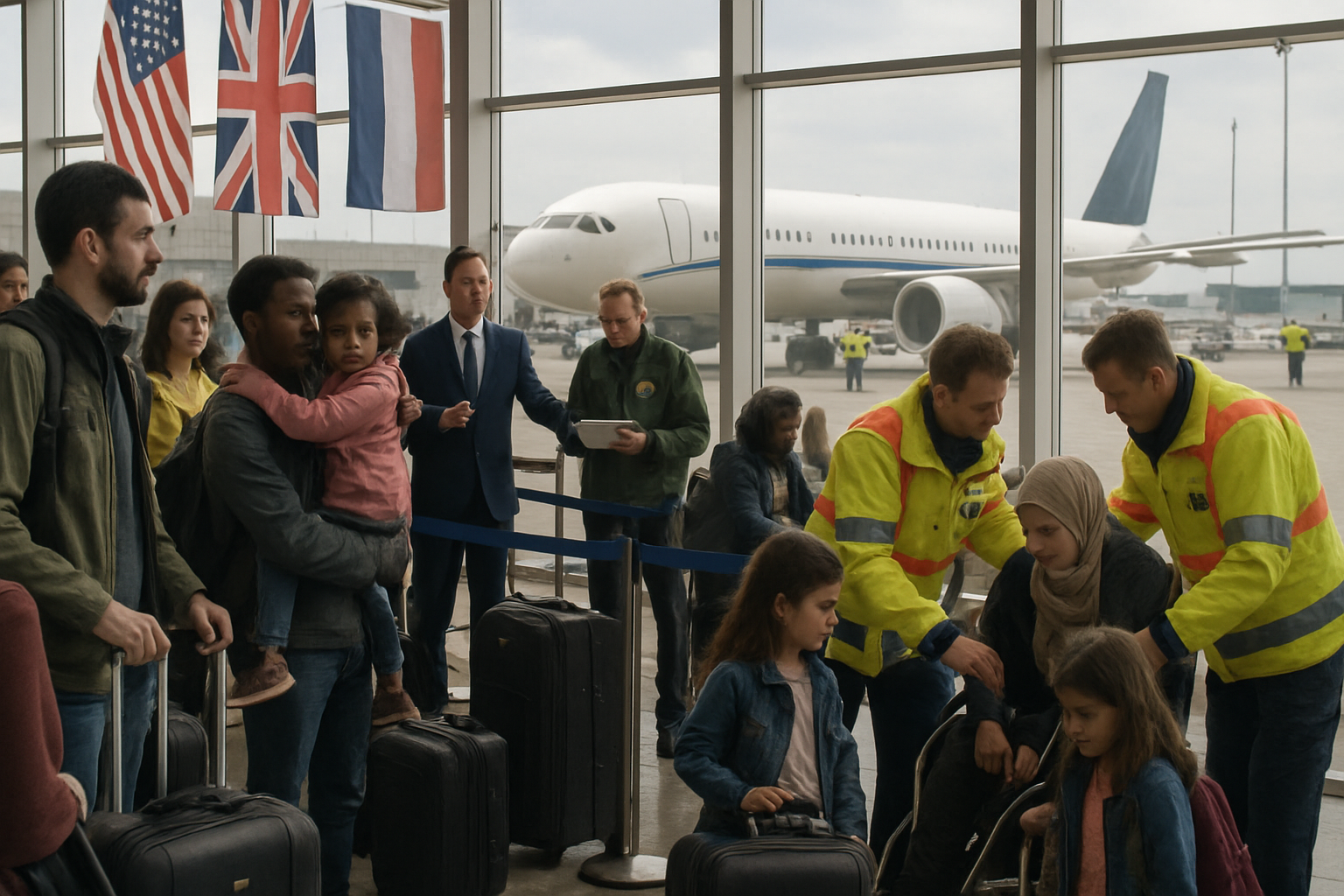
Countries worldwide are organizing emergency evacuation flights and repatriation operations to extract hundreds of thousands of citizens stranded in Middle East conflict zones, marking the largest coordinated international evacuation since the Arab Spring of 2011.
As the Middle East crisis enters its sixth day, nations are scrambling to bring home their nationals trapped in the region following widespread airspace closures and the suspension of commercial aviation. The evacuation effort represents an unprecedented test of international crisis management capabilities in the modern era.
Scale of Evacuation Operations
The numbers paint a staggering picture of the humanitarian challenge. Australia has 115,000 nationals trapped in the region, while Germany is working to evacuate 30,000 tourists stranded across Gulf states. Estonia has opened ticket sales for three additional flights from Dubai, giving Estonian citizens and residents a chance to return home over the weekend.
Kuwait Airways Chairman Abdulmohsen Al‑Faqan announced that around 2,000 requests have been received from citizens and residents currently stranded abroad seeking repatriation. Meanwhile, South Korea successfully completed its first direct flight from Dubai since the crisis began, bringing home 372 citizens in what officials called a critical breakthrough in evacuation efforts.
Latvia's national airline airBaltic has announced operations for a third repatriation flight from Dubai to Riga, with both previous evacuation flights having successfully departed from Dubai Al Maktoum International Airport.
European Coordination Efforts
The European Union has activated unprecedented coordination mechanisms to manage the crisis. Cyprus implemented its ESTIA evacuation plan for the first time in the nation's history, coordinating the extraction of over 2,000 nationals from UAE territories. The plan serves as a template for European crisis management during large-scale international emergencies.
Norway's Foreign Ministry has arranged flights from Oman to Oslo, with Prime Minister Jonas Gahr Støre stating: "It is difficult for Norwegian citizens to come home, and we have therefore decided to set up a flight from Oman to Oslo." The government is prioritizing families with children, pregnant women, and people with medical needs for the initial evacuations.
Portugal has successfully repatriated nearly 300 people, though Portuguese citizens in Qatar have complained of "disrespect" from authorities due to lack of viable evacuation solutions. The frustration highlights the complex logistics involved in coordinating evacuations during active regional conflicts.
Aviation Crisis Context
The massive evacuation effort is taking place against the backdrop of the most severe aviation crisis since the COVID-19 pandemic. Over 18,000 flights have been cancelled worldwide as eight countries—Iran, Iraq, Israel, UAE, Qatar, Syria, Kuwait, and Bahrain—simultaneously closed their airspace following the escalation of regional conflicts.
Dubai International Airport, the world's busiest with over 86 million passengers annually, remains completely shut down after sustaining missile damage. This has eliminated a critical Europe-Asia transit hub, forcing airlines to implement complex alternative routing strategies at dramatically increased costs.
Major carriers including Emirates, Air France-KLM, Wizz Air, and Bulgaria Air have suspended their Middle East operations indefinitely, affecting hundreds of thousands of passengers globally. The disruption represents the most comprehensive regional aviation shutdown in modern history.
Individual Stories of Resilience
Behind the statistics lie personal stories of resilience and adaptation. An Icelandic woman who has lived in Bahrain for 14 years with her son Sebastian reported that air raid sirens had not sounded for more than a day, providing some hope of improved safety conditions, though uncertainty remains high.
"You just hope this will start to ease"
— Guðlaug Ólöf Sigfúsdóttir, Icelandic resident in Bahrain
A Norwegian family was eventually evacuated by Italian authorities when Norway's Foreign Ministry was unable to provide immediate assistance. The incident highlights both the challenges individual nations face and the importance of international cooperation during crisis situations.
Passengers aboard the cruise ship Mein Schiff 5 remain stranded in Qatar's Doha port, with one passenger describing the psychological toll: "The windows shake. It makes us afraid." The cruise passengers represent another dimension of the evacuation challenge, as maritime routes become alternative pathways home.
Energy and Economic Implications
The crisis has created parallel disruptions in global energy markets, with oil prices surging 10% past $80 per barrel as Iran declared the Strait of Hormuz—through which 40% of global seaborne oil transits—"unsafe" for shipping operations.
Natural gas prices have spiked 24% in Europe and 78% in the United States, while major shipping companies Maersk and MSC have suspended operations in the Persian Gulf, leaving over 150 tankers stranded with billions of dollars in cargo.
The economic disruption extends far beyond energy markets, affecting automotive, electronics, and textile industries that depend on Gulf logistics networks. Stock markets have crashed worldwide, with Pakistan's KSE-100 index experiencing its largest single-day decline in history.
Diplomatic Breakdown Context
The current evacuation crisis stems from the complete collapse of nuclear diplomacy between the US and Iran, despite what had been described as "broad agreement on guiding principles"—the most progress since the JCPOA collapse in 2018. The fundamental disagreement proved insurmountable, with Iran excluding ballistic missiles and proxy forces from negotiations while the US demanded a comprehensive approach including human rights concerns.
The diplomatic breakdown has been compounded by the broader nuclear governance crisis, as the New START treaty expired on February 5, marking the first time in over 50 years that the United States and Russia have operated without nuclear constraints. UN Secretary-General António Guterres has warned that nuclear risks are at their "highest in decades."
Template for Future Crisis Management
The current evacuation operations are serving as a template for 21st-century crisis management, demonstrating both the strengths and limitations of international cooperation mechanisms. The success of multilateral coordination in sharing resources and flight schedules provides a framework for future international crises.
However, the varying levels of preparedness among different nations have exposed gaps in unified coordination mechanisms for mass civilian protection during regional conflicts. The crisis represents the greatest test of multilateral cooperation in crisis management in the modern era.
Recovery timelines remain uncertain, as unlike weather-related disruptions, the current crisis depends entirely on military operations resolution and diplomatic tensions normalization. Airlines are conducting daily reviews but cannot make long-term scheduling decisions, with industry experts predicting weeks will be required to clear passenger backlogs once normal operations resume.
Looking Forward
The international evacuation operations continue to evolve as the regional crisis develops. The European Union has demonstrated unprecedented coordination capabilities, while individual nations have revealed both rapid response strengths and the limitations of existing international frameworks.
The crisis has forced the aviation industry to fundamentally reconsider route planning, risk assessment, and enhanced contingency planning to navigate geopolitical instability. Over-dependence on Middle Eastern hubs has been exposed as a critical vulnerability, accelerating discussions about route diversification and enhanced resilience planning.
As evacuation flights continue to operate under challenging conditions, the international community faces decisions that will reverberate through diplomatic and crisis management approaches for decades to come. The success or failure of current operations will determine whether this crisis provides a framework for future emergency responses or fundamentally reshapes international approaches to geopolitical risk management in an increasingly interconnected world.