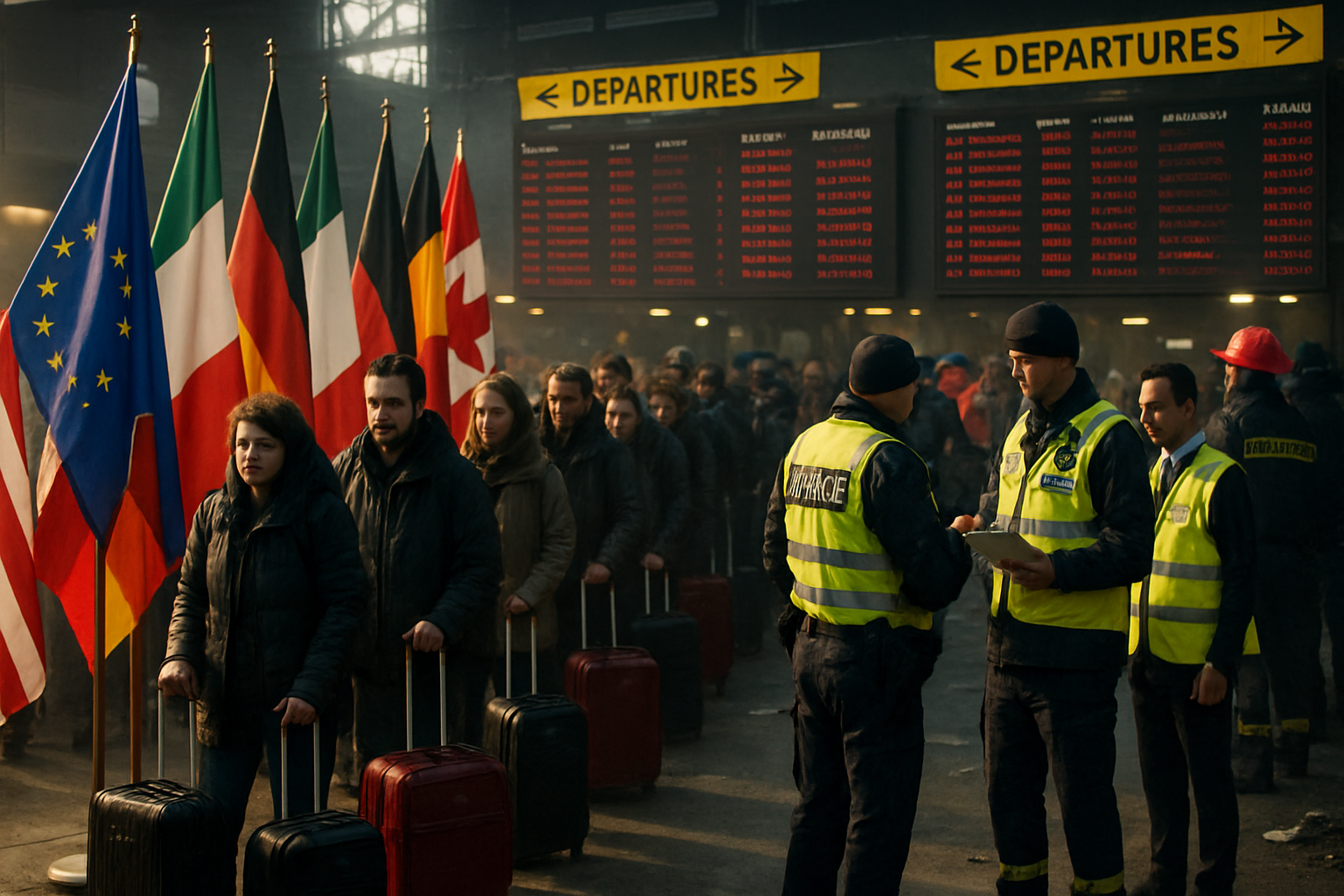
Nations across the globe are conducting the largest international evacuation operations since the Arab Spring of 2011, with hundreds of thousands of citizens stranded across Middle Eastern countries following the escalation of the Iran conflict and resulting regional instability.
As the crisis enters its fourth day, governments from Canada to Sierra Leone are implementing emergency protocols to extract their nationals from an increasingly volatile region, where commercial aviation has collapsed and diplomatic tensions continue to rise.
Unprecedented Scale of Global Response
The scope of the current evacuation efforts rivals the largest humanitarian operations in modern history. Defence Minister David McGuinty confirmed that Canadian military personnel in the Middle East are "out of harm's way," while multiple European nations have activated emergency repatriation protocols.
Germany has announced its first major repatriation flight, with Foreign Minister Wadephul declaring that a Lufthansa aircraft would depart tomorrow to bring home thousands of stranded tourists. An Emirates flight has already arrived in Frankfurt, carrying German nationals from Dubai, while an estimated 30,000 German tourists remain stranded across the Gulf region.
France is preparing charter flights and deploying state aircraft for what Foreign Minister Jean-Noël Barrot described as a mission to "repatriate the most vulnerable citizens from the Middle East." The government is examining various options to reach French nationals across the affected region.
"We are employing all available means, both terrestrial and aerial, that each country's circumstances permit, to repatriate as quickly as possible the largest number of Spanish nationals who wish to return."
— Spanish Foreign Ministry Statement
European Union Coordination
The European Union has activated unprecedented coordination mechanisms, with Cyprus implementing its national ESTIA evacuation plan for the first time. The plan encompasses not only Cypriot nationals but also European and third-country citizens requiring emergency assistance.
Estonia's Foreign Minister Margus Tsahkna has urged Estonian citizens in the Middle East region to "remain in the towns they have been staying in, where their safety can be ensured," while advising approximately 3,000 nationals to contact authorities immediately.
Slovakia has already conducted successful repatriation flights, with over 100 citizens returning to Bratislava on Tuesday aboard state-operated emergency flights. Additional repatriation operations are being planned for Slovak nationals still in the region.
Global Aviation Crisis
The evacuation efforts are severely complicated by the most comprehensive aviation crisis since COVID-19, with over 18,000 flights cancelled worldwide. Iran, Iraq, Israel, UAE, Qatar, Syria, Kuwait, and Bahrain have simultaneously closed their airspace, creating unprecedented logistical challenges.
Dubai International Airport, the world's busiest with over 86 million passengers annually, remains completely shut down after sustaining missile damage. This has created a cascading effect throughout global aviation networks, as the facility serves as a critical Europe-Asia hub.
Major airlines including Air France-KLM, Wizz Air, and Bulgaria Air have suspended all Middle Eastern operations, while Emirates and Etihad Airways face operational crises that affect hundreds of thousands of passengers globally.
Individual Nations' Responses
The United Kingdom is planning evacuation operations for approximately 76,000 nationals, with Foreign Secretary Yvette Cooper announcing that charter flights from Oman would prioritize vulnerable British nationals. The government described the situation as "fast-moving" due to ongoing airspace closures and security threats.
Russia has organized one of the largest single-day evacuations, with around 4,500 Russians expected to return from the UAE and Oman via special evacuation flights. The Russian Transportation Ministry coordinated these operations as part of a broader effort to extract citizens from the conflict zone.
Sierra Leone successfully evacuated 24 nationals and embassy staff from Iran, relocating them safely to Armenia. The group included 14 students, diplomatic personnel, and locally recruited embassy staff, demonstrating how even smaller nations are conducting complex international rescue operations.
Nordic and Baltic Coordination
Nordic countries have implemented coordinated response strategies, with Sweden and Serbia ordering immediate evacuations from Iran due to "extremely uncertain" security conditions. Finland has families seeking return routes, with one family from Vaasa driving to Saudi Arabia by taxi to find alternative transportation home.
The Netherlands Ministry of Foreign Affairs is actively coordinating repatriation efforts through their crisis website, urging Dutch citizens and residents in the Middle East to register for evacuation information.
African Nations' Efforts
Uganda has successfully evacuated 43 students from Iran to Turkey, with the students transported by road from Tehran to Istanbul over the weekend. They are currently awaiting final repatriation to Uganda, highlighting the complex logistics involved in extracting citizens from the conflict zone.
Kenya is coordinating evacuation efforts for over 66,000 nationals in Qatar and an estimated 23,000 to 40,000 in the UAE, representing one of the largest single-nation evacuation challenges currently underway.
Energy and Economic Implications
The evacuation crisis occurs against the backdrop of a severe global energy emergency, with oil prices surging 10% to over $80 per barrel as Iran has effectively closed the Strait of Hormuz, which handles 40% of global seaborne oil transit.
Major shipping companies Maersk and MSC have suspended operations through the strategic waterway, with over 150 tankers currently anchored in Persian Gulf waters. Natural gas prices have increased by 24% in Europe and 78% in the United States, creating additional economic pressure on evacuation operations.
Diplomatic Breakdown Context
The current crisis stems from the complete collapse of nuclear diplomacy between the United States and Iran, despite recent Geneva talks that had achieved what negotiators described as "broad agreement on guiding principles" - the most progress since the 2018 JCPOA collapse.
However, fundamental disagreements over scope proved insurmountable, with Iran excluding ballistic missiles and regional proxies as "red lines" while the US demanded comprehensive agreements covering missiles, armed groups, and human rights issues.
Historical Significance
The scale and coordination of current evacuation efforts mark a watershed moment in international crisis management. Multiple nations are simultaneously activating emergency protocols across numerous Middle Eastern countries, testing the capacity of international frameworks to protect civilians during rapidly evolving conflicts.
Unlike previous Middle Eastern crises that affected specific countries or regions, the current situation has created a template for 21st-century crisis management in an interconnected world where regional conflicts instantly become global humanitarian challenges.
Recovery Timeline Uncertain
Unlike weather-related travel disruptions that have predictable timelines, the current crisis depends entirely on military operations resolution and diplomatic tensions normalization. Aviation industry officials can only conduct daily operational reviews without making long-term scheduling decisions.
The success or failure of current diplomatic efforts to contain the regional confrontation will determine whether this remains a manageable evacuation crisis or escalates into a broader Middle Eastern conflict with global implications extending far beyond the current emergency.
As nations continue coordinating the largest international evacuation effort in over a decade, the crisis serves as a sobering reminder of how quickly regional conflicts can affect civilian populations worldwide and the critical importance of robust international cooperation mechanisms in protecting citizens during global emergencies.