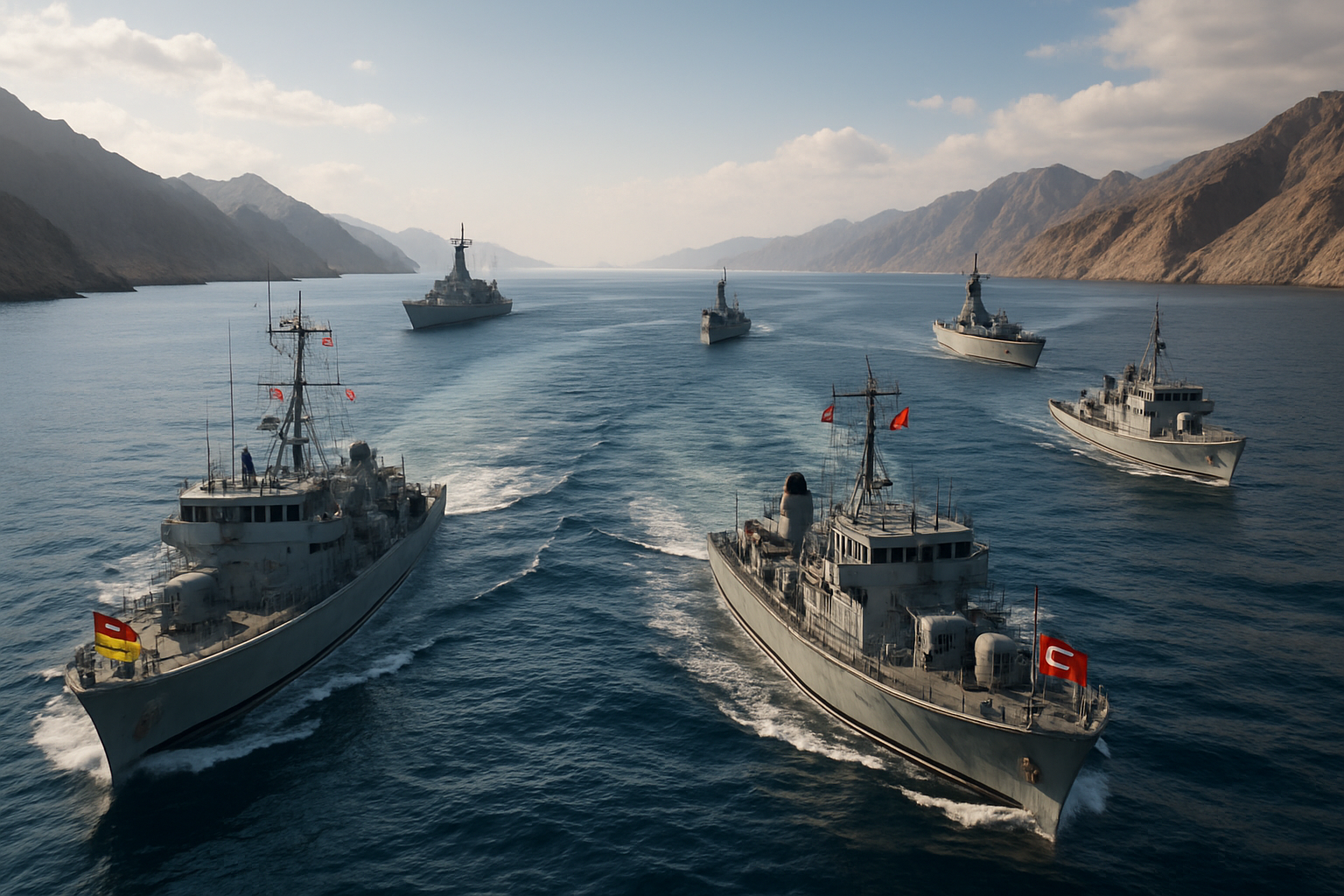
An unprecedented international naval coalition is mobilizing to clear mines and restore security to the Strait of Hormuz, with Germany confirming deployment of a minesweeper to the Mediterranean for a potential mission in the strategic waterway following the recent Iran-US ceasefire extension.
The coordinated effort represents the largest multinational maritime security operation since World War II, as nations worldwide prepare to address the dangerous naval mining legacy left from weeks of conflict that saw Iran's Revolutionary Guard deploy an estimated 2,000-6,000 mines throughout the 21-mile chokepoint handling 40% of global oil transit.
German Minesweeper Deployment
A German defense ministry spokeswoman confirmed to AFP Saturday that Germany will "soon send a minesweeper to the Mediterranean for a possible mission in the Strait of Hormuz after the end of the US-Iran war." The deployment requires specific conditions including a sustainable ceasefire, legal framework based on international law, and authorization from the German Bundestag.
According to German Defense Minister Boris Pistorius, the preconditions for any deployment include "a sustainable ceasefire, a legal framework based on international law and a mandate from the lower house of the German parliament, the Bundestag."
Turkey's Diplomatic Positioning
Turkish Foreign Minister Hakan Fidan welcomed the recent two-week ceasefire, noting that it has "helped reduce tensions in the region." Turkish officials have indicated Ankara's willingness to participate in mine clearance operations, representing a significant diplomatic opening following the Pakistan-mediated ceasefire framework.
Turkey's strategic position controlling access between the Black Sea and Mediterranean gives Ankara unique capabilities for supporting Hormuz operations, with Turkish naval assets potentially providing crucial logistics support for the international mission.
Multinational "Neutral" Mission Framework
Multiple countries have expressed readiness to participate in what sources describe as a "neutral" mission to secure the Strait of Hormuz. The coalition represents unprecedented international cooperation to address a single-chokepoint crisis that has affected global energy markets for weeks.
The mission framework builds on previous diplomatic breakthroughs, particularly Pakistan's innovative mediation that achieved the historic "Islamabad Accord" - a ceasefire reached just 88 minutes before President Trump's April 8 deadline that had threatened catastrophic escalation.
Technical Challenges and Timeline
The mine clearance operation faces extraordinary technical challenges. Pentagon officials estimate a six-month timeline for complete clearance of the waterway, given the sophisticated mining operation that Iran's Revolutionary Guard executed using small vessels and various mine types throughout the strategic chokepoint.
Iran had deployed naval mines ranging from simple contact mines to more sophisticated pressure and magnetic mines, creating a complex clearance challenge requiring specialized equipment and international coordination.
Energy Market Impact
The crisis has devastated global energy markets, with oil prices surging to historic levels - Brent crude peaked at $119.50 and WTI reached $108.15 in the worst single-day jump on record (+18.98%). The International Energy Agency deployed the largest strategic petroleum reserve release in its 50-year history, releasing 400 million barrels from 32 countries.
"The situation exposed the most severe energy security crisis in decades, with single-chokepoint vulnerabilities that require fundamental transformation of global energy architecture."
— Samuel Ciszuk, Energy Security Analyst
Major shipping companies Maersk and MSC suspended all Persian Gulf operations, leaving over 150 oil and LNG tankers stranded with cargo worth billions. The closure affected not just energy shipments but critical supply chains for automotive, electronics, and textile manufacturing worldwide.
Pakistan's Expensive LNG Arrangements
The Strait's closure has forced countries into expensive alternative arrangements. Pakistan LNG Limited approved a revised bid of $18.4 per million British thermal units from TotalEnergies for delivery between April 27 and 30, while rejecting all other bids for May delivery, "anticipating the reopening of the Strait of Hormuz."
The pricing represents significant premiums over normal market rates, illustrating the economic pressure the crisis has created for energy-importing nations. Pakistan authorities rejected lower-priced bids for later delivery periods, betting on the success of international mine clearance efforts.
Iranian Naval Capabilities Demonstrated
Italian intelligence reports document swarms of Iranian Revolutionary Guard assault boats operating in the Gulf during recent days, described as a "mosquito fleet" inspired by historical Persian naval tactics. This demonstration of asymmetric naval warfare capabilities has influenced international planning for future Gulf security arrangements.
The Iranian tactics, reminiscent of operations in 2019, showcased how relatively small vessels could effectively challenge much larger conventional naval forces through coordination and numbers, fundamentally altering regional maritime security calculations.
Legal and Diplomatic Framework
The upcoming naval mission operates under complex international legal frameworks. The UN maritime agency has declared that no country has the right to block navigation through the Strait of Hormuz, establishing the legal basis for international intervention to restore commercial shipping.
However, Iran maintains that any military vessels entering what it considers its territorial waters without coordination would violate the ceasefire agreement, creating delicate diplomatic challenges for the international coalition.
Regional Coalition Dynamics
The crisis has tested traditional Middle Eastern alliances, with Saudi Arabia, UAE, Qatar, and Egypt maintaining unprecedented unity despite Iranian attacks on their territories during the conflict. Egyptian President Sisi's warnings about "comprehensive chaos affecting sisterly countries" proved prescient as the crisis evolved.
The regional coalition's preservation represents a diplomatic victory for maintaining Gulf security cooperation, even as Iranian operations caused casualties in Abu Dhabi, Kuwait, and Qatar during the peak crisis period.
Congressional and Allied Concerns
The international mission faces domestic political challenges in participating countries. In the United States, Congressional support for Operation Epic Fury reached historic lows of 25%, with Senator Blumenthal expressing concerns about potential ground troop deployment.
European allies have shown measured support for defensive mine clearance operations while rejecting broader military escalation. The UK's Prime Minister Starmer emphasized that Britain "won't be dragged into an Iran war," while supporting necessary maritime security measures.
Nuclear Diplomacy Context
The naval mission unfolds against the backdrop of collapsed nuclear diplomacy between the United States and Iran. The fundamental sticking point remains Iran's 60% uranium enrichment program and 400kg+ stockpile of weapons-grade material, which Iran refuses to abandon despite U.S. demands.
The crisis occurred as the New START Treaty expired in February 2026, creating the first 50+ year period without U.S.-Russia nuclear constraints, adding urgency to global nuclear governance concerns.
Template-Setting Significance
UN Secretary-General Antonio Guterres has called the crisis "the greatest test of multilateral cooperation in the modern era," with implications extending far beyond the immediate maritime security challenge.
"Success in restoring navigation provides a framework for nuclear crisis resolution and strengthens diplomatic precedents. Failure could accelerate military solutions for decades, encouraging proliferation and undermining diplomatic credibility worldwide."
— UN Diplomatic Sources
The international response represents innovative middle-power diplomacy, with Pakistan's mediation framework demonstrating how smaller nations can bridge major adversaries when traditional mechanisms fail. The success or failure of this approach will influence crisis management approaches for decades.
Economic Recovery Timeline
Financial markets have responded positively to news of international mine clearance preparations, but experts warn that full recovery requires sustained cooperation addressing underlying geopolitical tensions. The Strait's reopening represents only the first step in restoring global energy market confidence.
The crisis exposed catastrophic vulnerabilities in global energy architecture, with the 21-mile Strait representing a dangerous single-point failure in modern logistics. Alternative routing through the Red Sea and around Africa lacks adequate capacity for the massive volumes normally transiting Hormuz.
Future Security Architecture
The unprecedented international naval cooperation emerging from this crisis may establish new frameworks for maritime security in critical chokepoints worldwide. The coalition represents the largest coordinated maritime security effort since World War II, potentially serving as a template for future energy security challenges.
Energy security experts emphasize that while mine clearance addresses immediate dangers, fundamental transformation of global energy systems remains necessary to reduce dependence on volatile geopolitical regions and strategic chokepoints.
Looking Ahead
As international naval forces prepare for complex mine clearance operations, the stakes extend far beyond restoring shipping routes. The success of this multinational effort will determine whether diplomatic innovation can triumph over military confrontation in an increasingly volatile world.
The coming months will test whether the international community can maintain the unprecedented cooperation needed to address 21st-century security challenges, with implications for global energy security, nuclear governance, and international law enforcement extending decades beyond current events.
The Hormuz crisis of 2026 may be remembered as either a watershed moment when diplomacy prevailed over conflict, or as the beginning of a more dangerous era where military solutions replace cooperative approaches to global challenges.