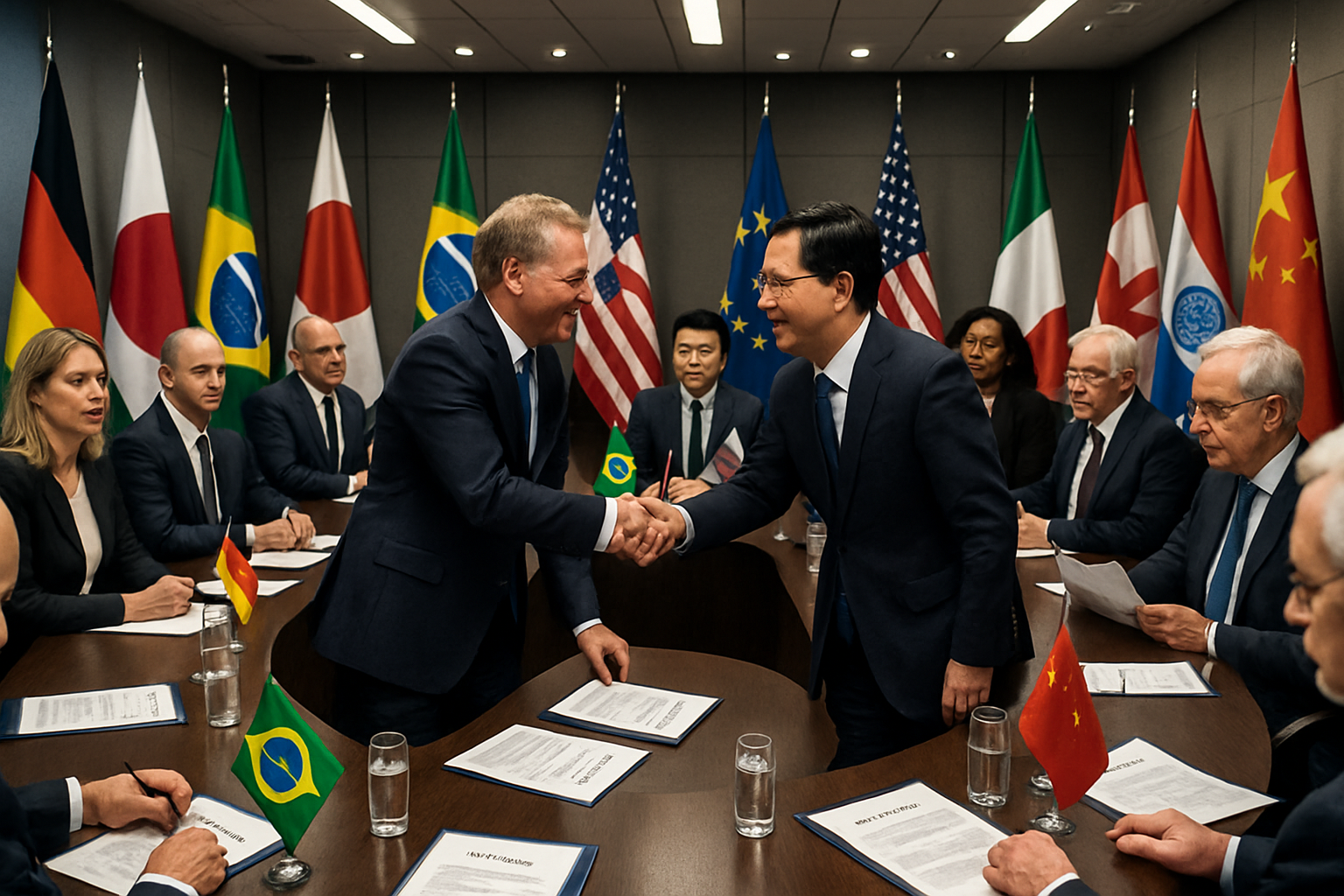
International trade relationships are undergoing a fundamental transformation as nations prioritize strategic partnerships over traditional multilateral frameworks, with three major developments this week highlighting the shift toward bilateral economic cooperation and security-focused commerce.
Australia is on the verge of securing what officials describe as a "mega trade win" with the European Union, potentially making European cars, trucks, and appliances significantly cheaper for Australian households. The breakthrough comes after extensive negotiations that have cleared the way for an official pact, representing one of the most significant trade agreements in the Asia-Pacific region in recent years.
Australia-EU Trade Partnership Breakthrough
The Australia-EU trade agreement represents a dramatic shift in international commerce patterns, moving away from the complex multilateral frameworks that have dominated global trade since the end of World War II. European exports, including high-end automobiles, commercial vehicles, and household appliances, could see substantial cost reductions for Australian consumers once the agreement is formally ratified.
This development comes as part of a broader trend where nations are increasingly seeking direct bilateral relationships to achieve specific economic and strategic objectives. The Australia-EU deal demonstrates how modern trade partnerships extend far beyond traditional tariff reductions to encompass technology transfer, regulatory harmonization, and strategic supply chain coordination.
US-South Korea-Japan Maritime Cooperation
In a parallel development, the Trump administration has unveiled a comprehensive maritime plan that codifies what officials describe as "historic" shipbuilding cooperation between the United States, South Korea, and Japan. This trilateral partnership represents a significant evolution in defense-industrial cooperation, moving beyond traditional arms sales to encompass joint development and production capabilities.
The maritime cooperation framework addresses critical supply chain vulnerabilities in naval construction while strengthening alliance relationships in the Indo-Pacific region. The agreement encompasses advanced shipbuilding technologies, shared research and development initiatives, and coordinated production schedules that could reshape global naval industry dynamics.
"This partnership represents a fundamental shift toward security-based supply chain coordination rather than purely market-driven arrangements."
— Senior Defense Industry Analyst
The strategic implications extend far beyond commercial considerations. As China continues expanding its naval capabilities and asserting territorial claims in the South China Sea, the US-South Korea-Japan maritime partnership provides a coordinated response that combines economic cooperation with enhanced regional security architecture.
China-Pakistan Partnership Milestone
The 75th anniversary of diplomatic relations between China and Pakistan was marked by elaborate celebrations in Karachi, highlighting one of the world's most enduring strategic partnerships. The commemorative events, organized by the Ministry of Foreign Affairs Liaison Office, showcased the deep historical, cultural, and economic bonds that have defined China-Pakistan cooperation for three-quarters of a century.
Chinese Consul General Yang Yundong's participation in the anniversary celebrations underscored Beijing's continued commitment to the relationship, which has evolved from Cold War-era strategic cooperation to comprehensive economic partnership under the China-Pakistan Economic Corridor (CPEC) framework.
Broader Trade Transformation Context
These developments occur within a broader transformation of international trade patterns, as documented in our comprehensive analysis of recent trade agreements. The Trump administration's bilateral approach has already yielded significant results with India, Argentina, and Venezuela, demonstrating a systematic preference for direct partnerships over multilateral frameworks.
Recent memory analysis reveals that the US-India framework potentially expanding trade from $50 billion to $500 billion over five years, while the Argentina agreement eliminated over 1,600 US tariffs on Argentine goods. These precedents suggest that bilateral approaches can achieve rapid results while addressing specific national priorities that might be diluted in multilateral negotiations.
Strategic Supply Chain Coordination
The evolution toward security-based supply chain coordination represents a fundamental shift from the market-driven globalization that characterized the late 20th and early 21st centuries. Nations are increasingly prioritizing supply chain resilience and strategic autonomy over pure cost efficiency.
This trend is particularly evident in critical minerals cooperation, where the US-EU-Japan partnership involving 55 countries aims to challenge China's dominance in rare earth production and processing. Similarly, the maritime cooperation between the US, South Korea, and Japan addresses vulnerabilities in naval shipbuilding capabilities.
Regional Integration Patterns
The simultaneous development of multiple bilateral partnerships creates new patterns of regional integration. Rather than broad multilateral agreements that require consensus among many parties, nations are building overlapping networks of bilateral relationships that can be more easily negotiated and implemented.
This approach allows for more flexible arrangements that can address specific national priorities while maintaining broader strategic coordination. The Australia-EU deal, for example, can proceed independently of broader Asia-Pacific trade negotiations while still contributing to regional economic integration.
Economic and Geopolitical Implications
The shift toward bilateral trade partnerships has profound implications for global economic governance. Traditional institutions like the World Trade Organization face challenges as nations increasingly pursue direct relationships that bypass multilateral frameworks.
However, this trend also creates opportunities for more rapid and targeted cooperation. Bilateral agreements can be negotiated and implemented more quickly than complex multilateral frameworks, allowing nations to respond more effectively to changing economic and security conditions.
Implementation Challenges
Despite their advantages, bilateral trade partnerships face significant implementation challenges. Coordination between multiple bilateral agreements can create complexity, particularly when nations are involved in overlapping partnerships with different terms and conditions.
The success of these agreements depends on sustained political commitment across electoral cycles, effective monitoring mechanisms, and the ability to adapt to changing circumstances. Technical capacity building and regulatory harmonization remain essential components of successful implementation.
Future Trade Architecture
The current wave of bilateral partnerships may be laying the foundation for a new global trade architecture characterized by flexible, overlapping networks rather than rigid multilateral frameworks. This evolution reflects the reality of 21st-century geopolitics, where nations must balance economic cooperation with security considerations.
The success or failure of current bilateral initiatives will likely determine whether this trend continues or whether nations return to more traditional multilateral approaches. Early indicators suggest that the bilateral model is delivering results, but long-term sustainability remains to be tested.
As nations continue to navigate the complex intersection of economic cooperation and strategic competition, the partnerships announced this week represent important precedents for how international trade relationships may evolve in the coming years. The emphasis on security-focused cooperation and strategic supply chain coordination suggests that purely economic considerations will increasingly be balanced against broader national security objectives in future trade agreements.