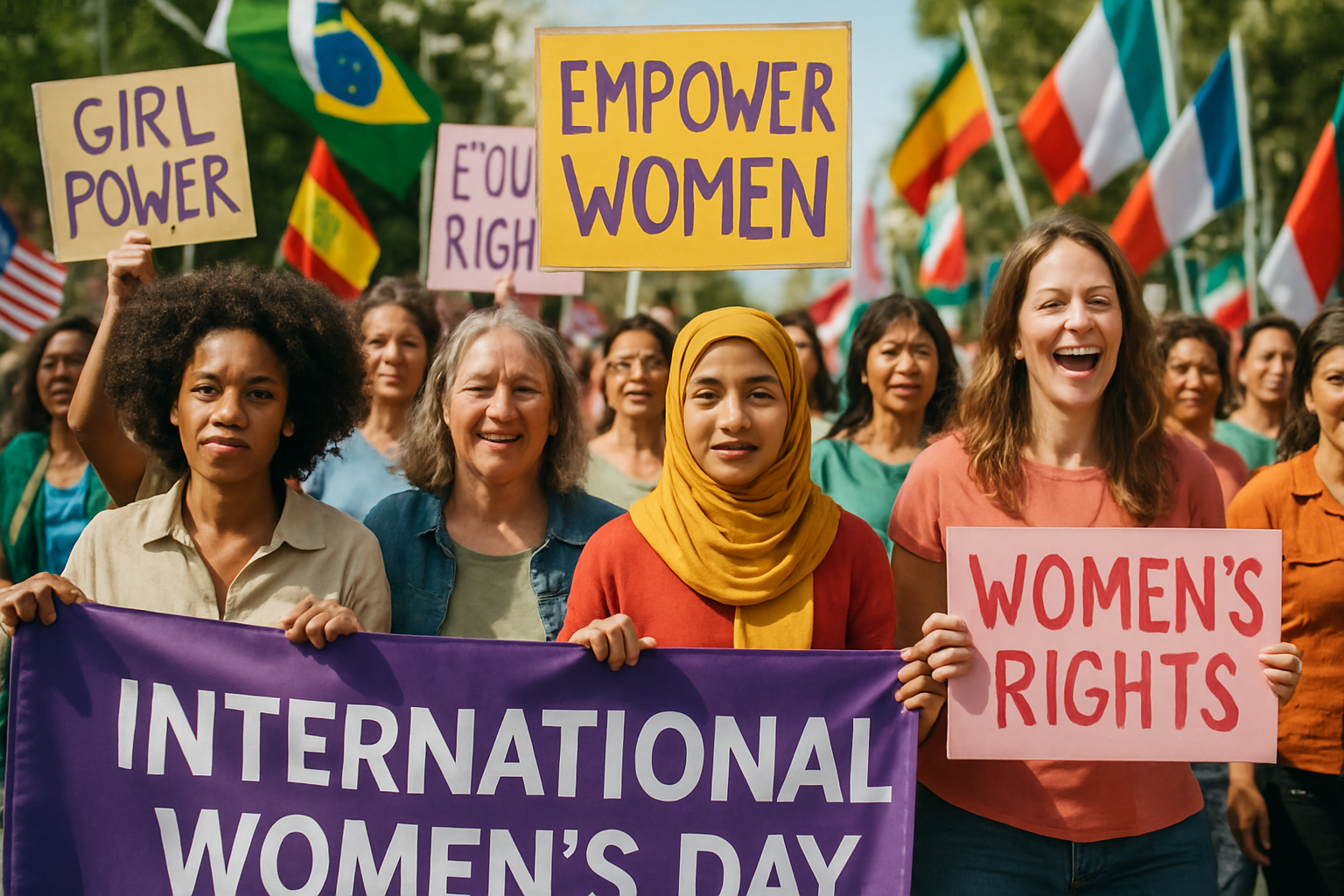
Millions of women and supporters worldwide marked International Women's Day 2026 on March 8 with unprecedented solidarity, as marches, protests, and commemorations spanned six continents despite facing significant challenges including activist detentions and political resistance in several nations.
From Paris to Pakistan, Malta to Myanmar, the global observance of the UN's 2026 theme "Rights. Justice. Action. For ALL Women and Girls" demonstrated both remarkable progress in women's rights and the persistent struggles that define the ongoing fight for gender equality.
Europe Leads Massive Demonstrations
France witnessed some of the largest demonstrations, with tens of thousands gathering across 150 locations nationwide. In a powerful symbolic moment, Gisèle Pelicot, whose rape trial became a defining moment for women's rights in 2025, led the Paris march declaring "On ne lâchera rien!" ("We won't give up anything!").
The French demonstrations united over 100 organizations in a coordinated effort that President Emmanuel Macron acknowledged, stating that women's rights are "never definitively acquired" and are "the fruit of constant battles, victories won through courage, and vigilance that must never falter."
Spain saw thousands rally in major cities with a distinctly international focus, combining calls for gender equality with strong anti-war messaging. Protesters denounced both domestic violence and the ongoing Middle East conflict, reflecting the intersectional nature of contemporary feminist movements.
In Finland, approximately 20,000 people marched demanding action against gender-based violence, with activists highlighting that 20 women died from violence in 2025 and six had already been killed by early March 2026.
Activism Under Pressure
The day was marked by significant challenges to women's rights activism, most notably in Pakistan where authorities detained dozens of Aurat March activists, including prominent human rights defender Dr. Farzana Bari and her two daughters, ahead of their planned rally in Islamabad.
"Several women's rights activists, including Aurat March members, were detained by police in Islamabad ahead of a rally they planned to hold on the occasion of International Women's Day,"
— Dawn newspaper report
The detentions, which took place near Super Market in Sector F-6, drew international condemnation and highlighted the ongoing restrictions on women's rights advocacy in various parts of the world.
Government Recognition and Policy Advances
Several nations marked the day with significant governmental recognition and policy announcements. In Algeria, government officials provided unprecedented recognition of women's contributions, with multiple ministers organizing ceremonies and praising women's institutional presence.
Burkina Faso demonstrated practical support for women's economic empowerment, with President Ibrahim Traoré receiving the Relwende Teel Taba women's cooperative, which thanked him for establishing modern agricultural facilities that have enhanced their economic autonomy.
Malta's political parties used the day to address persistent gender inequalities, with the Nationalist Party hosting panel discussions focused on ongoing challenges faced by women and girls.
Workplace Equality Remains Elusive
New data released around International Women's Day revealed persistent workplace inequality across developed nations. In Denmark, male executives earn an average of €100,393 monthly compared to women's €88,200 - a gap of over €12,000 per month.
Italy showed particularly stark statistics, with female employment at just 53.3% compared to the European average of 70.8%, while women earn approximately 25% less than men. Economic modeling suggests bringing female employment to male levels could boost Italy's GDP by 11-12%.
However, some positive developments emerged. Austria achieved a historic milestone with women's enrollment in higher education surpassing men's for the first time, with officials calling it a "decisive factor for societal transformation."
Global Commemorations and Cultural Celebrations
Armenia showcased cultural recognition through "The Medz Mamas Podcast," celebrating Armenian grandmothers and their contributions to preserving cultural heritage and family traditions.
Papua New Guinea saw high-level political participation, with Prime Minister James Marape and NCD Governor Powes Parkop leading an International Women's Day Unity Walk, demonstrating government commitment to women's rights.
The Philippines saw President Ferdinand Marcos Jr. and Vice President Sara Duterte pledge stronger protection for women, citing their crucial role in national progress.
Addressing Violence Against Women
The theme of combating gender-based violence resonated across multiple countries. Latvia's march adopted the powerful slogan "We don't want flowers, we want safety," organized by the association "Centrs Marta."
Uganda highlighted serious challenges with school-age girls, with new research revealing that guardians, parents, relatives, and teachers are among the primary perpetrators of violence against schoolgirls, according to Ministry of Education data.
In Cameroon, celebrations sparked controversy when analyst Koupit Adamou questioned the constitutional basis for First Lady Chantal Biya's role in presiding over official ceremonies.
International Cooperation and Solidarity
The day demonstrated remarkable international solidarity, with movements like Malta's "Women's Day Every Day" emphasizing the need for sustained attention to gender equality rather than annual symbolic recognition.
Netherlands Mayor Femke Halsema of Amsterdam called for greater empowerment of women, arguing that despite progress, a "war against women" continues globally.
Organizations from Haiti to Honduras connected local struggles with global movements, emphasizing that women's rights remain universal human rights requiring international support and cooperation.
Economic Empowerment Initiatives
Beyond protests and ceremonies, many countries announced concrete economic empowerment initiatives. Pakistan's Punjab province honored female polio workers for their crucial role in public health, while Kuwait announced expanded opportunities for women in defense forces.
Trinidad and Tobago saw both government and opposition leaders emphasize women's contributions to national development, with Prime Minister Kamla Persad-Bissessar and Opposition Leader Pennelope Beckles issuing statements recognizing women's leadership across all sectors.
Looking Forward: From Annual Recognition to Daily Commitment
A recurring theme across global commemorations was the need to transform International Women's Day from an annual symbolic gesture into sustained daily commitment to gender equality.
As evidenced by the diverse approaches taken worldwide - from political recognition and policy reforms to grassroots activism and cultural celebrations - the path toward gender equality requires multifaceted strategies adapted to local contexts while maintaining universal commitments to women's rights.
The events of March 8, 2026, demonstrated both the remarkable progress achieved through decades of advocacy and the extensive work that remains. From celebrations of government recognition to protests against systematic oppression, the day showcased a global movement that continues to evolve, showing resilience in the face of challenges while demanding justice, equality, and action for all women and girls worldwide.