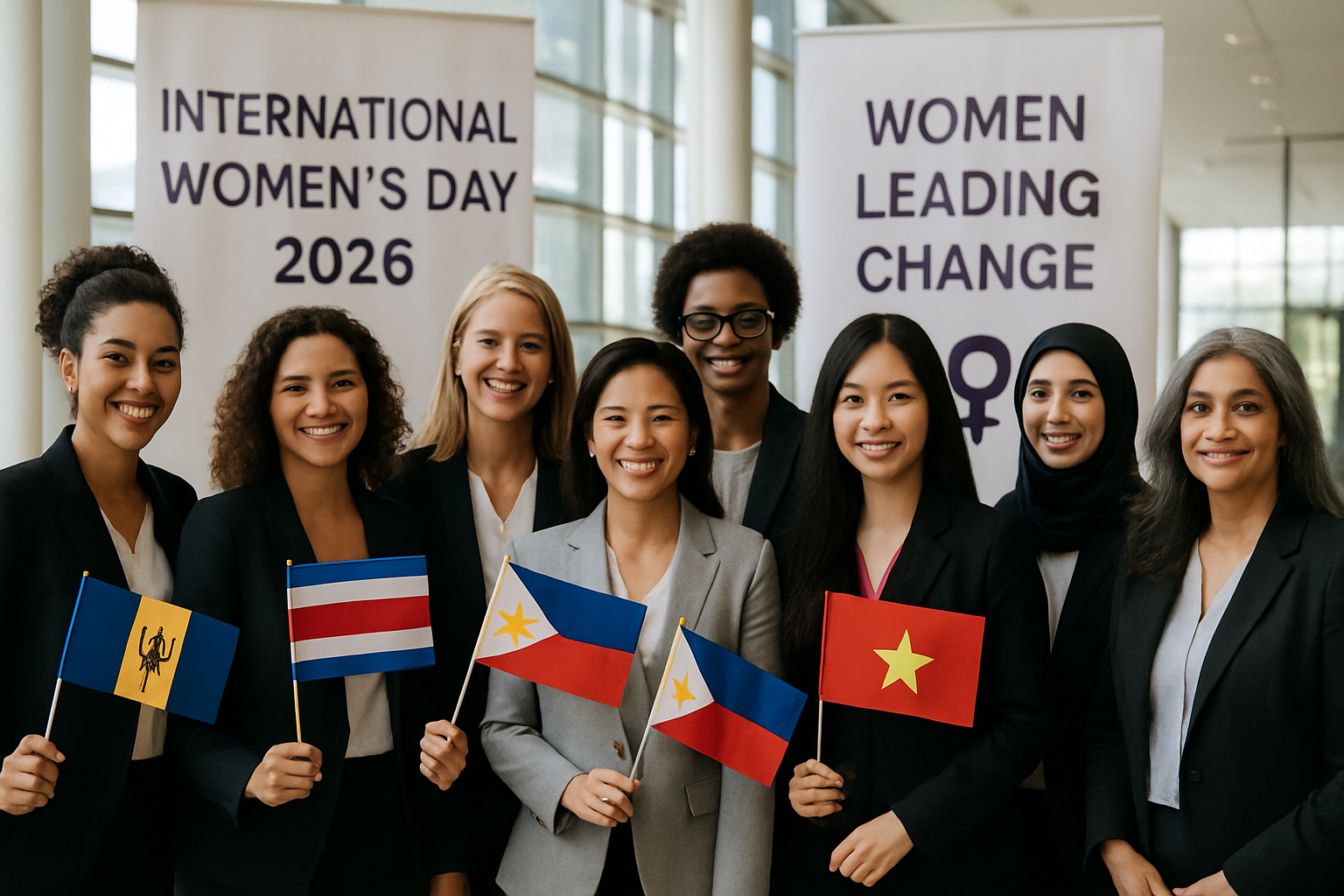
As International Women's Day 2026 approaches on March 8, countries across multiple continents are launching comprehensive celebrations that extend far beyond symbolic recognition, marking a transformative period for women's rights and leadership globally.
From the Caribbean islands to Southeast Asia, nations are implementing substantial programs that combine cultural celebration with concrete policy initiatives, representing what advocates are calling the most coordinated international women's empowerment effort in recent history.
Caribbean Leadership in Women's Economic Empowerment
In Barbados, Republic Bank hosted a significant pre-International Women's Day event encouraging women to "invest in themselves while supporting others along the way." The initiative, covered by the Caribbean Broadcasting Corporation, reflects a growing regional emphasis on women's economic independence and mutual support networks.
The message resonated particularly strongly in the context of broader Caribbean economic development, where women increasingly play central roles in both traditional sectors and emerging industries. Financial institutions across the region are recognizing women's economic participation as fundamental to sustainable development rather than merely a social imperative.
Latin American Cultural and Political Recognition
Colombia's Antioquia region launched its second annual comprehensive commemoration, extending what began as a single-day observance into a sustained campaign running through the current governmental mandate. The Secretaría de las Mujeres organized events combining cultural recognition with practical advocacy, featuring art exhibitions, leadership forums, and the continuation of the "Es Normal" campaign designed to guarantee women's fundamental rights.
This approach reflects a sophisticated understanding that meaningful change requires sustained engagement rather than annual symbolic gestures, aligning with international best practices in gender equality advocacy.
Central American Educational and Institutional Transformation
Costa Rica has emerged as a regional leader in demonstrating how female leadership transforms educational institutions and national development. The Costa Rica News highlighted how women's presence in decision-making positions is "no longer just an aspiration" but an active reality reshaping institutional governance and knowledge generation.
For decades, conversations about women in leadership focused primarily on inclusion and expanding participation. Today, Costa Rican institutions showcase women not merely present in decision-making spaces, but actively driving transformation in educational methodology, institutional management, and national development planning.
"Female leadership in Costa Rica is no longer just an aspiration. Today, it is a reality that is helping to transform the way institutions are run, knowledge is generated, and the country's development is planned."
— The Costa Rica News
Global Policy Framework and UN Women's Assessment
UN Women Executive Director Sima Bahous delivered a comprehensive assessment highlighting both unprecedented progress and emerging challenges. In her official statement for International Women's Day 2026, Bahous noted that "we have never been so close to achieving gender equality, and never closer to losing it."
The UN analysis identifies significant advances including stronger domestic violence legislation globally, record numbers of girls in educational systems, and more connected, visible women's movements than ever before. However, Bahous warned of concerning counter-trends including rising online violence, organized backlash against women's rights, and "rights being reversed in real time and at unprecedented speed."
The 2026 theme "Rights. Justice. Action for All Women and Girls" reflects this complex reality, emphasizing that progress requires active protection rather than passive maintenance of achieved gains.
Massive Cultural Programming in Central America
Nicaragua announced an extraordinary scale of cultural engagement with over 65,000 activities planned nationwide for International Women's Day celebrations. These events span cultural performances, sports competitions, and community gatherings, representing one of the most extensive national coordination efforts documented for the observance.
The scope demonstrates how International Women's Day has evolved from a primarily political observance to a comprehensive cultural celebration that engages entire communities in recognizing women's contributions across all sectors of society.
Asian Artistic Excellence and University Leadership
The Philippines showcased women's creative leadership through the "Babae at Kulay" exhibition, featuring 60 artworks by women artists from across Calabarzon region. Organized by the Provincial Board Members League of the Philippines in collaboration with the Blanco Family Museum, the exhibition proves that "women's voices and creativity deserve center stage."
Featured artists include Precy de Guzman-Brady, Marivel Mari-Galang, and Joy Blanco-Alejan, whose work represents diverse perspectives and experiences through vibrant artistic expression. The initiative demonstrates how cultural programming can simultaneously celebrate achievement and create platforms for continued professional advancement.
Vietnam contributed significant data on women's advancement in higher education, with reports showing that women now lead nearly one-third of the world's top universities, including prestigious institutions like Oxford and MIT. This milestone represents gradual but substantial progress toward gender equality in higher education leadership, according to Times Higher Education data.
African Technology and Digital Future Leadership
Zimbabwe's government issued a direct challenge for increased women's participation in the information and communication technology sector, recognizing digital literacy and leadership as essential for strengthening the country's digital economy.
The call reflects broader African trends toward positioning technology as a fundamental tool for women's economic empowerment rather than a secondary consideration. As digital economies expand across the continent, women's equal participation in technology development, implementation, and leadership becomes increasingly critical for comprehensive national development.
Historical Context: Building on 2026 Momentum
These 2026 celebrations build upon significant momentum established earlier in the year. Previous International Women's Day observances demonstrated remarkable global coordination, with countries from Kazakhstan to Lithuania, Chad to Austria implementing comprehensive recognition programs that combined presidential ceremonies with grassroots cultural initiatives.
The 2026 approach appears more sophisticated in integrating economic empowerment with cultural celebration, policy advocacy with institutional transformation, and local authenticity with international cooperation. This evolution suggests a maturing understanding of how sustainable change requires multifaceted approaches rather than single-intervention strategies.
Persistent Challenges and Emerging Solutions
Despite celebrations, significant challenges persist globally. Recent research indicates concerning attitudinal regression among Generation Z men, with substantial portions believing "enough has been done for gender equality" and "men are being discriminated against." These attitudes span multiple countries and challenge assumptions about automatic generational progress.
Economic inequality remains a critical barrier, with data showing 40% of women in some countries consider leaving employment due to inadequate compensation. Migrant women face additional obstacles within families where traditional gender roles limit economic opportunities.
However, innovative solutions are emerging through prevention-focused healthcare strategies, comprehensive professional development programs, and international cooperation networks that share resources and expertise through peer-to-peer collaboration rather than traditional top-down approaches.
Technology Integration and Digital Empowerment
The 2026 celebrations demonstrate sophisticated technology integration that enhances rather than replaces human connections and traditional advocacy methods. Digital platforms enable women entrepreneurs to access global markets, data analytics help organizations identify and address systemic inequalities, and social media amplifies diverse voices across geographic and economic boundaries.
Success stories emphasize technology as a tool for increasing accessibility while maintaining the fundamental human relationships essential for sustained empowerment and professional development.
Economic Implications and Development Impact
Countries investing in comprehensive women's empowerment programs report substantial economic benefits extending beyond gender equality metrics. Research consistently demonstrates that societies with greater female economic participation achieve stronger economic growth, increased innovation capacity, and more resilient community structures.
The 2026 celebrations reflect growing recognition that women's equal participation in economic life, including scientific and technical fields, benefits entire societies through improved healthcare delivery, enhanced environmental management, and more effective sustainable development strategies.
International Cooperation and Future Directions
The global scope of 2026 celebrations demonstrates unprecedented international coordination despite funding challenges facing traditional multilateral organizations. Countries are developing bilateral partnerships and regional collaboration networks that enable flexible, culturally responsive approaches while maintaining evidence-based standards and universal human rights commitments.
This distributed cooperation model allows for innovative solutions to persistent challenges while ensuring that medical advances, educational opportunities, and economic empowerment benefit diverse populations regardless of geographic or economic constraints.
Looking Forward: Sustained Commitment Beyond March 8
The most significant aspect of International Women's Day 2026 may be its emphasis on sustained, year-round commitment rather than annual symbolic recognition. Countries implementing comprehensive programming report superior outcomes when gender equality is treated as fundamental community infrastructure requiring daily attention rather than crisis management.
Success factors identified across multiple countries include sustained political commitment to healthcare and education investment, comprehensive professional training in prevention-focused approaches, robust community engagement strategies, and continued international cooperation for knowledge sharing and resource coordination.
As UN Women's Sima Bahous noted, this moment represents both reasons for optimism and urgent calls for action. The convergence of evidence-based prevention strategies, technological innovation opportunities, and unprecedented international cooperation provides a foundation for comprehensive women's empowerment promotion that could determine whether societies organize around human flourishing or merely address periodic crises.
International Women's Day 2026 thus serves as both recognition of remarkable progress achieved and a strategic planning moment for the extensive work that remains. The path forward requires vigilance against backsliding, innovative solutions to persistent challenges, and the transformation of annual recognition into sustained daily commitments toward creating more equitable societies globally.