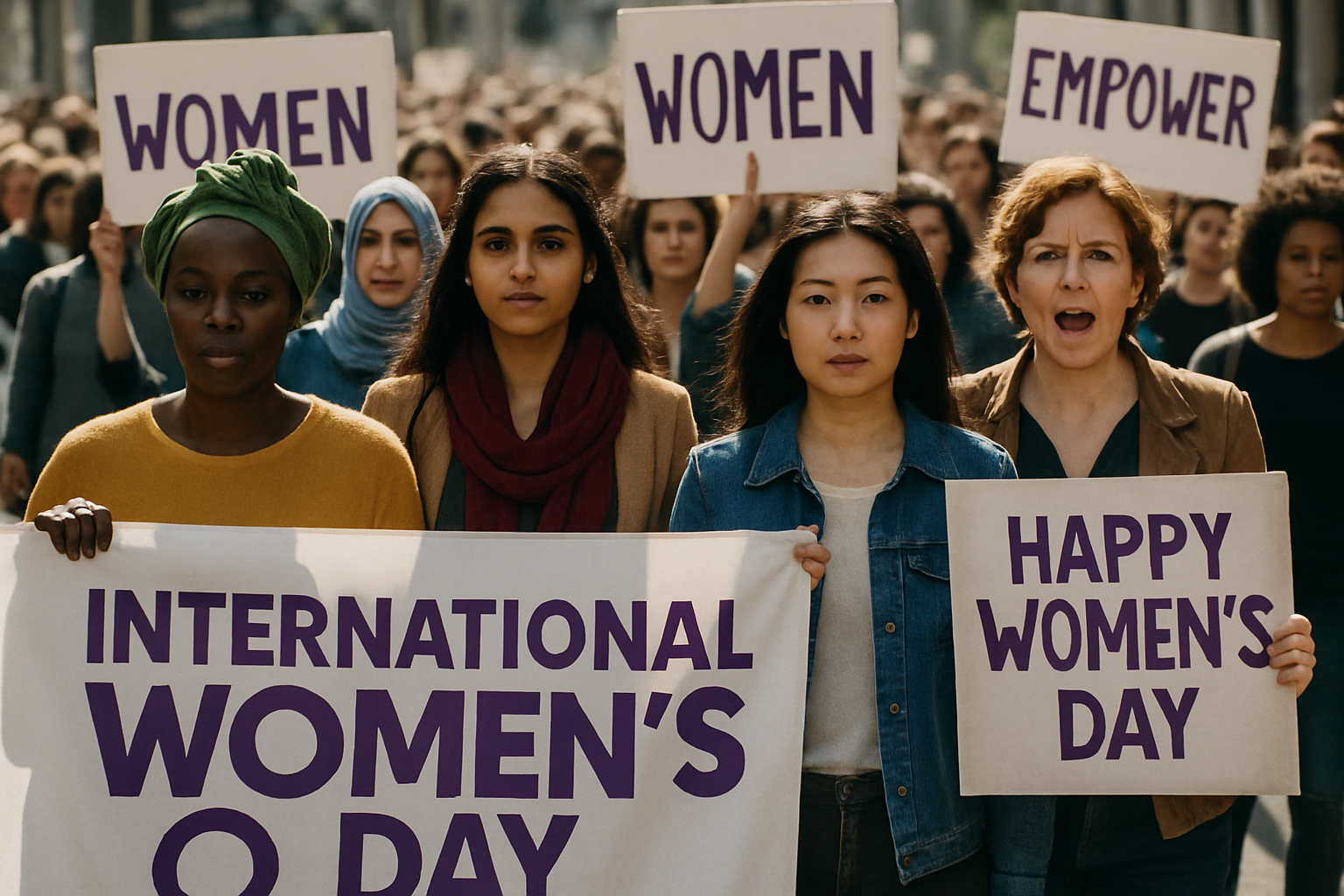
Thousands of demonstrators across the globe took to the streets on March 8, 2026, transforming International Women's Day into a powerful expression of both celebration and resistance, demanding women's rights, gender equality, and an end to violence against women.
From the ceremonial halls of Algeria to the marching streets of Paris, from the corporate boardrooms of Cameroon to the protest squares of Bosnia and Herzegovina, the 41st International Women's Day showcased the complex global landscape of women's rights – highlighting both remarkable progress and persistent challenges that women face worldwide.
Government Recognition Reaches Unprecedented Heights
Algeria led the charge in official recognition, with Prime Minister Seyfi Ghareeb representing President Abdelmadjid Tebboune at a ceremony honoring Algerian women under the theme "Algerian Women: Excellence and Leadership." The event demonstrated unprecedented governmental acknowledgment of women's contributions, with multiple ministers organizing parallel ceremonies celebrating women's institutional presence and national development contributions.
The scale of official recognition extended beyond Algeria. In Cameroon, telecommunications giant Camtel celebrated the "power of women in digital technology" at their Yaoundé headquarters, with the company's female Director General delivering a speech emphasizing women's strategic role in the digital transformation. This corporate celebration reflected broader trends across Africa, where women's economic empowerment is increasingly recognized as essential for national development.
European Protests Focus on Daily Struggles
In stark contrast to ceremonial recognition, European demonstrations emphasized the urgent need for daily commitment to women's rights rather than annual symbolic gestures. Bosnia and Herzegovina witnessed particularly poignant protests, with demonstrators marching from Sarajevo to Mostar carrying banners declaring: "Fight, not celebration. Women no longer want to remain silent."
"We protest against violence in the home, at work, on the streets..."
— Bosnian Women's Rights Activists
Malta's activists adopted the powerful slogan "Women's Day Every Day," emphasizing that true progress requires sustained daily attention rather than annual acknowledgments. The march in Valletta, organized by Moviment Graffitti, began at Triton Fountain and concluded at St George's Square, with participants chanting: "Whatever we wear, wherever we go, yes means yes, no means no."
France Witnesses Massive Mobilization
France saw some of the day's largest demonstrations, with tens of thousands marching in Paris against what organizers termed the "patriarchal system of oppression." The march drew particular attention due to the exclusion of the far-right identitarian collective Némésis, with feminist groups maintaining that genuine feminist struggle cannot be separated from anti-fascist resistance.
According to reports from RFI and Mediapart, the demonstrations also served as platforms for denouncing ongoing conflicts, particularly the war in the Middle East, connecting women's rights to broader issues of peace and justice.
Workplace Inequality Remains Central Challenge
Italy's participation highlighted persistent workplace inequalities, with Laura Mattarella, daughter of President Sergio Mattarella, delivering a personal intervention noting that gender parity remains "only on paper" with "much road ahead." Her comments reflected broader European concerns about the gap between legal equality and lived reality.
Recent data from the Planet News investigation reveals stark disparities: Danish male executives earn €100,393 monthly compared to women's €88,200 – a gap of over €12,000 per month. Italy shows female employment at just 53.3% versus the European average of 70.8%, with economic modeling suggesting that achieving gender parity could boost Italy's GDP by 11-12%.
Violence Against Women Takes Center Stage
Colombia's commemoration took a somber turn, with authorities reporting 18 women murdered in Atlántico department during the first months of 2026. Feminist collectives demanded institutional examination of protection failures, calling for genuine gender-focused approaches to violence prevention.
This focus on violence prevention emerged as a dominant theme across multiple countries, with Latvia adopting the slogan "We don't want flowers, we want safety" and Uganda research revealing disturbing patterns where guardians, parents, relatives, and teachers were identified as primary perpetrators of violence against schoolgirls.
Cultural Celebrations Amid Crisis
Despite global tensions, cultural celebrations continued. Cyprus hosted moving musical evenings in Paphos, while Eritrea celebrated across the Central, Southern Red Sea, and Northern Red Sea regions under the theme "Our Values – Our Armour."
The celebrations in Eritrea, held at the Expo Compound in Asmara with government and PFDJ officials present, demonstrated how women's rights movements adapt to local contexts while maintaining universal principles of equality and empowerment.
Economic Empowerment Gains Momentum
Japan reported that female executives in mid-sized firms reached 21.5% – a 3.1% increase that, while showing progress, still ranked the country 34th out of 35 surveyed nations. These mixed results highlight the global nature of gender equality challenges and the need for sustained effort across all sectors.
Luxembourg's march specifically addressed women's health issues, including endometriosis and menstrual disorders, with activists noting that "women are not always taken seriously" regarding health concerns – pointing to ongoing medical gender bias that affects women's workplace participation and economic security.
International Solidarity and Future Directions
The 2026 International Women's Day demonstrated remarkable international solidarity, with movements across diverse political and cultural contexts sharing coordinated messaging and mutual support. From government ministers in Algeria acknowledging contributions to grassroots activists in Malta demanding daily justice, the day showcased a global movement continuing to evolve despite facing both old and new challenges.
Looking Beyond March 8
Perhaps the most significant development of 2026 was the widespread adoption of the "daily commitment" paradigm – moving beyond annual symbolic recognition toward sustained engagement with gender equality issues. As demonstrated by Malta's "Women's Day Every Day" and similar movements across Europe, the contemporary women's rights movement has matured beyond reactive protests to proactive policy engagement while maintaining vigilance against setbacks.
The day revealed both remarkable progress achieved through decades of advocacy and extensive remaining work. From ceremonial recognition in government halls to grassroots demands for safety in the streets, March 8, 2026, served as both celebration of achievements and renewed commitment to creating more equitable societies worldwide.
As one Maltese activist noted, the question is no longer why Women's Day exists, but why the underlying inequalities it addresses persist. The answer, demonstrated across dozens of countries on March 8, 2026, lies in transforming annual observance into sustained daily commitment to justice, equality, and women's fundamental rights.