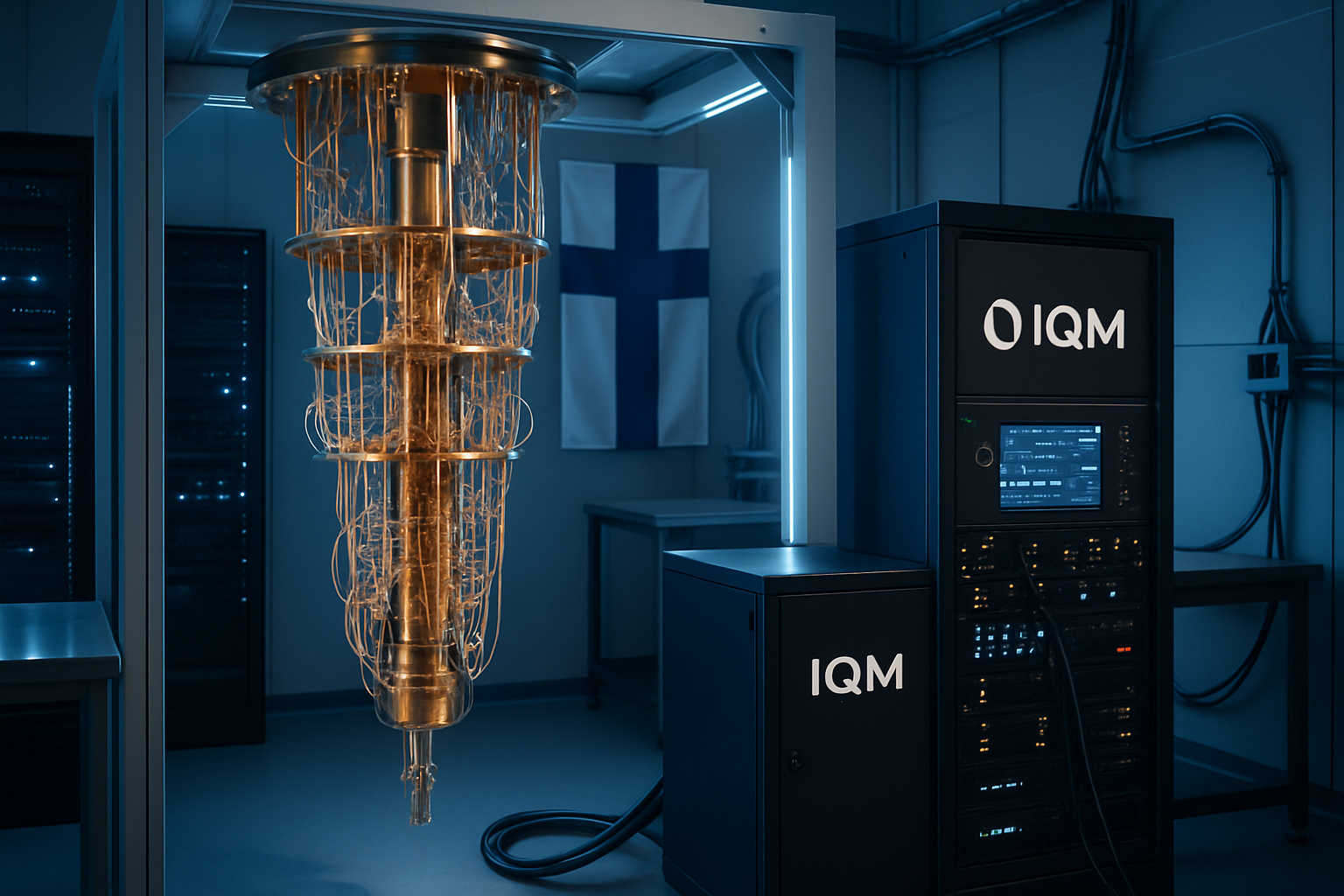
Finnish quantum computing company IQM has achieved a historic milestone by becoming the first European quantum technology firm to list on a United States stock exchange, marking a watershed moment for Europe's quantum industry ambitions and the global race for quantum supremacy.
The announcement, confirmed by multiple European sources on February 23, 2026, represents not just a corporate milestone but a strategic victory for European technological sovereignty in one of the most critical emerging technologies of the 21st century. IQM's decision to pursue US markets reflects both the company's global ambitions and the current reality of quantum technology financing.
Revolutionary Quantum Technology at the Core
IQM has positioned itself at the forefront of quantum computing development, creating systems whose computational speed represents what industry analysts describe as "exponential multiplication" of traditional computing power. The company's quantum computers leverage the fundamental principles of quantum mechanics to process information in ways that classical computers simply cannot match.
Unlike conventional computers that process information in binary bits (0 or 1), quantum computers utilize quantum bits or "qubits" that can exist in multiple states simultaneously through a phenomenon called superposition. This allows quantum systems to perform certain calculations exponentially faster than even the most powerful classical supercomputers.
"The company has been involved in developing quantum computers whose computing speed multiplies calculation speed by thousands of times."
— Finnish Industry Source
The applications for such computational power span numerous industries, from pharmaceutical drug discovery and financial modeling to cryptography and artificial intelligence. As quantum computing matures from laboratory curiosity to commercial reality, companies like IQM are positioning themselves to capture enormous market opportunities.
European Quantum Leadership Under German Direction
One of the most intriguing aspects of IQM's story is its international leadership structure. The Finnish company operates under the guidance of a German CEO, reflecting the increasingly cross-border nature of European technology development. This multinational approach extends to IQM's operational footprint, with significant operations anchored in Munich, Germany, alongside its Finnish headquarters.
According to German industry reports, the company represents "Europe's quantum hope" in an increasingly competitive global quantum landscape dominated by American tech giants and Chinese state-funded initiatives. The dual Finnish-German identity positions IQM to leverage both Nordic technological innovation and German engineering expertise.
The timing of IQM's IPO aligns with broader European Union initiatives to achieve technological sovereignty in critical sectors. EU policymakers have identified quantum computing as a strategic technology requiring European leadership to avoid dependence on foreign suppliers for critical computational infrastructure.
Market Timing and Capital Requirements
Industry analysts note that the quantum computing sector is particularly capital-intensive, requiring massive investments in research and development, specialized facilities, and highly skilled personnel. The "race for future supercomputers" demands resources that often exceed the capabilities of private funding alone.
German financial media emphasizes that capital intensity drives companies like IQM toward public markets. The quantum sector's development timeline means companies must invest heavily in research and development years before generating significant revenue, creating a funding gap that public markets are better positioned to fill than traditional venture capital.
The summer 2026 IPO timing positions IQM to capitalize on growing investor interest in quantum technologies while quantum computing transitions from experimental to practical applications. Recent breakthroughs in quantum error correction and increased qubit stability have convinced investors that commercial quantum computing is approaching viability.
Global Quantum Competition Intensifies
IQM's historic listing comes amid intensifying global competition in quantum technologies. China has achieved significant quantum breakthroughs, including a February 2026 advancement where Chinese scientists using the "Chuang-tzu 2.0" superconducting processor successfully observed and manipulated quantum decoherence processes. Meanwhile, partnerships like the Kazakhstan-Singapore Center for Quantum Technologies demonstrate how even smaller nations are investing in quantum capabilities.
The United States maintains significant quantum research leadership through companies like IBM, Google, and startups like Rigetti, while also investing heavily in quantum research through government initiatives. This three-way competition between the US, China, and Europe has created urgency for European quantum companies to secure adequate funding for development and scaling.
Technical Innovation and Commercial Applications
IQM's technology focuses on superconducting quantum processors, which operate at extremely low temperatures to maintain the delicate quantum states necessary for computation. These systems require sophisticated cryogenic systems and precise control mechanisms, representing significant engineering challenges that IQM has successfully addressed.
The company's quantum systems are designed for both research applications and practical problem-solving across industries. Potential applications include:
- Drug discovery and molecular modeling for pharmaceutical companies
- Financial risk analysis and portfolio optimization
- Cryptographic security and communications
- Artificial intelligence and machine learning acceleration
- Materials science and chemistry simulations
- Logistics and supply chain optimization
As quantum computers mature, they are expected to solve certain categories of problems that are practically impossible for classical computers, even with unlimited time and resources. This potential has attracted significant interest from corporations and governments worldwide.
European Technological Sovereignty Implications
IQM's public listing represents more than a corporate milestone—it symbolizes Europe's determination to maintain competitive position in quantum technologies. European policymakers have expressed concerns about technological dependence on non-European suppliers for critical infrastructure, particularly in emerging technologies like quantum computing and artificial intelligence.
The European Union's Digital Decade strategy explicitly identifies quantum technologies as a priority area for European leadership. IQM's success could catalyze additional European quantum ventures and encourage broader private investment in European quantum research.
Finland's role as a quantum innovation hub reflects the country's broader strength in technology development, from mobile communications leadership through Nokia to current innovations in areas like gaming and clean technology. The success of companies like IQM reinforces Finland's position as a key contributor to European technological leadership.
Investment and Market Outlook
Financial analysts project that the global quantum computing market will grow dramatically over the next decade as practical applications emerge. Current market estimates suggest the quantum computing sector could reach tens of billions in value by the early 2030s, driven by enterprise adoption and government procurement.
IQM's IPO provides investors with exposure to European quantum innovation while potentially benefiting from both technological advances and favorable regulatory treatment within the European Union. The company's dual presence in Finland and Germany positions it advantageously within the European single market.
However, quantum computing investments carry significant risks. The technology remains in early commercial stages, competition is intense, and technical challenges could delay widespread adoption. Investors must balance the enormous potential returns against the substantial uncertainties inherent in emerging technology sectors.
Future Prospects and Challenges
Looking ahead, IQM faces both significant opportunities and substantial challenges. The company must continue advancing its quantum technology while scaling manufacturing and developing practical applications that demonstrate clear advantages over classical computing approaches.
Competition from well-funded American and Chinese quantum initiatives means IQM cannot rely solely on technological innovation—the company must also execute effective business strategy, forge strategic partnerships, and build sustainable competitive advantages.
The quantum computing industry faces broader challenges including the need for specialized talent, complex supply chains for exotic materials, and the requirement for entirely new software ecosystems optimized for quantum algorithms.
Despite these challenges, industry observers remain optimistic about quantum computing's long-term prospects. As quantum systems become more stable and practical applications emerge, companies positioned at the forefront of quantum innovation stand to benefit enormously from first-mover advantages.
Historical Significance for European Technology
IQM's historic IPO marks a defining moment for European quantum ambitions and technological sovereignty more broadly. As the first European quantum company to access US public markets, IQM has blazed a trail that other European quantum ventures may follow.
The success of this listing could encourage additional European quantum companies to pursue public funding, potentially creating a virtuous cycle of investment, innovation, and market development. It also demonstrates that European quantum companies can compete globally for both talent and capital.
For investors, policymakers, and technology enthusiasts, IQM's public debut represents a tangible milestone in the quantum revolution—a technology that promises to transform industries and reshape global competitive dynamics in the coming decades. As quantum computing transitions from laboratory curiosity to commercial reality, Europe's ability to participate as an equal partner rather than a dependent customer may well depend on the success of pioneers like IQM.