Iran's Revolutionary Guard launched a coordinated campaign of missile and drone strikes targeting oil tankers and energy facilities across the Gulf region, effectively closing the Strait of Hormuz and triggering the most severe global energy crisis in decades.
The attacks, part of Iran's "Operation True Promise 4" retaliation campaign, have created an unprecedented disruption to global energy markets. Oil prices surged past $100 per barrel for the first time since 2022, while the closure of the Strait of Hormuz—through which 40% of the world's seaborne oil transits—has stranded over 150 tankers worth billions in cargo.
Coordinated Strikes Across Multiple Targets
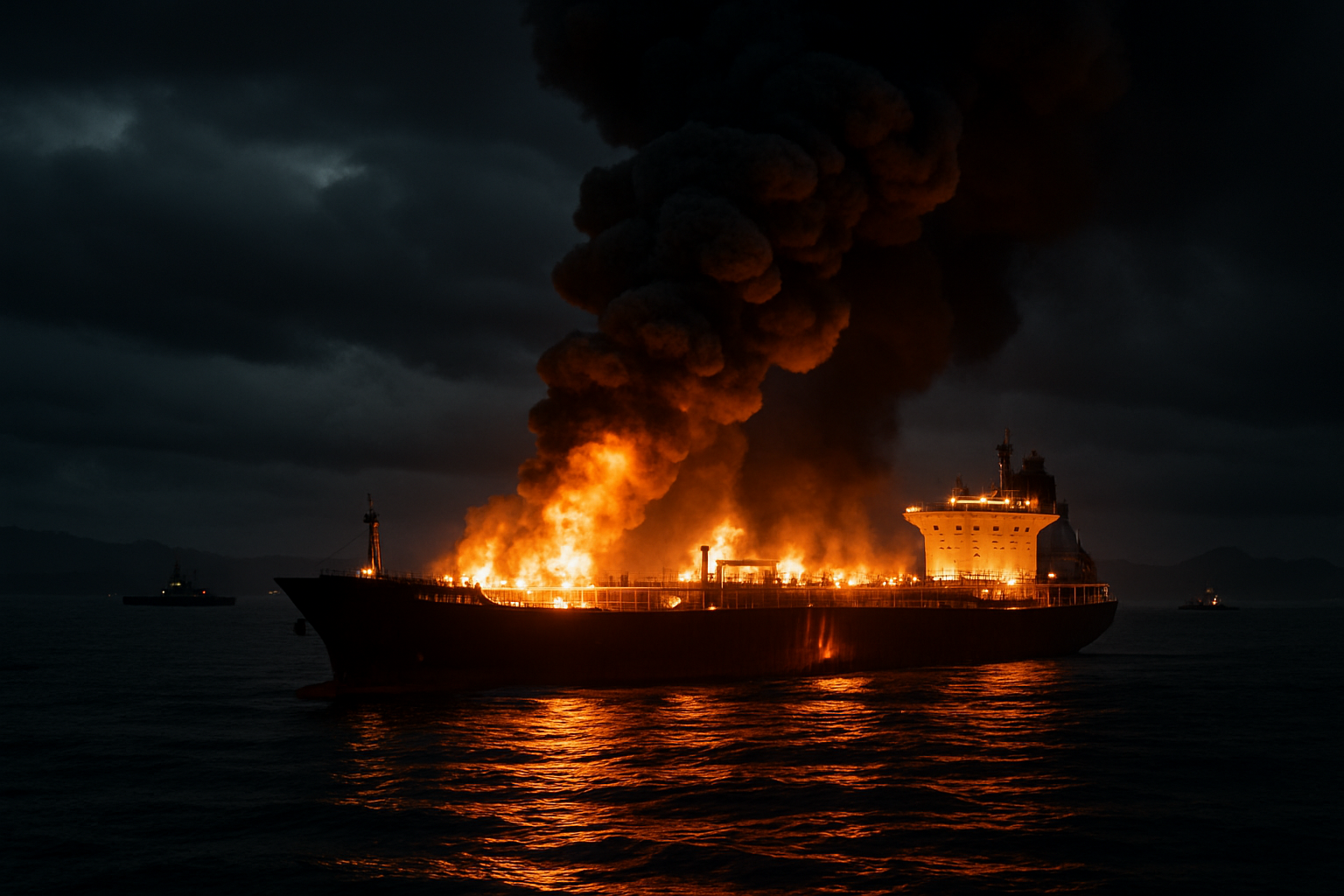
On March 12, 2026, Iranian forces targeted the oil tankers Safesea Vishnu and Zefyros in Iraqi waters near Basra, using explosive-laden boats in what appears to be a carefully coordinated operation. At least one crew member was confirmed killed in the attacks, with reports indicating over 20 Georgian nationals were aboard one of the targeted vessels.
The Islamic Revolutionary Guard Corps (IRGC) claimed responsibility for the strikes, stating that the vessels had "ignored repeated warnings from Iranian authorities" and failed to comply with maritime instructions.
"Iran has made clear over the past two days that its strategy now is to impose a prolonged economic shock on the world to force Donald Trump to back off."
— Senior Defense Analyst
Iraq's General Company for Ports confirmed that both tankers were ablaze, with images showing massive orange fireballs lighting up the night sky near the port of Basra. The attacks prompted Iraq to immediately halt all oil terminal operations as a precautionary measure.
Strait of Hormuz Effectively Closed
The Iranian Revolutionary Guard declared the Strait of Hormuz "unsafe for shipping," effectively closing the critical waterway that handles 40% of global seaborne oil transit. Intelligence reports indicate Iran has deployed naval mines using small vessels, with estimates suggesting between 2,000-6,000 mines from Iran's strategic stockpile.
In response, the United States destroyed 28 Iranian mine-laying ships, escalating tensions in the region. The mining operation represents a significant escalation in Iran's strategy to leverage energy infrastructure as a weapon of economic warfare.
Global Economic Impact
The attacks have triggered massive disruptions across global markets:
- Oil prices reached a peak of $119.50 for Brent crude and $108.15 for WTI, representing the largest single-day jump on record
- Natural gas prices surged 24% in Europe and 78% in the United States
- Over 18,000 flights were cancelled worldwide—the most extensive aviation disruption since COVID-19
- Major shipping companies Maersk and MSC suspended all Persian Gulf operations
- Qatar halted LNG production at key facilities, threatening 20% of global LNG exports
The financial markets responded with panic selling, with Pakistan's KSE-100 index suffering its largest single-day decline in history, falling 8.97%. South Korea's KOSPI dropped 12%, triggering circuit breakers, while the Korean won fell to a 17-year low.
International Response and Strategic Reserves
The International Energy Agency announced the largest emergency oil reserve release in its 50-year history, coordinating the deployment of 400 million barrels from 32 member countries. Japan confirmed it would release 80 million barrels starting March 16—the first such deployment since the 2011 Fukushima crisis.
Several governments implemented emergency measures:
- Pakistan instituted wartime austerity measures with four-day government work weeks
- Bangladesh began fuel rationing for 170 million people
- Bosnia-Herzegovina reported only two days of gas reserves remaining
- France dispatched 500 inspectors to prevent fuel station price manipulation
Regional Coalition Under Pressure
The Iranian attacks have severely strained the unprecedented coalition of Saudi Arabia, UAE, Qatar, and Egypt that had been supporting diplomatic efforts to resolve the nuclear crisis. Iranian strikes targeted coalition member territories directly:
- UAE: One civilian killed in Abu Dhabi, Dubai International Airport shut down
- Kuwait: 32 people injured in airport drone strikes
- Qatar: Eight injured while intercepting 65 missiles and 12 drones using Patriot systems
"We condemn these attacks on sisterly Arab countries and warn against comprehensive chaos across the region."
— Egyptian President Abdel Fattah el-Sisi
Context of Escalating Conflict
The current energy crisis stems from the collapse of U.S.-Iran nuclear negotiations despite achieving what diplomats called "broad agreement on guiding principles"—the most significant progress since the 2018 JCPOA breakdown. The talks failed over fundamental scope disagreements, with Iran excluding ballistic missiles and regional proxies as "red lines" while the U.S. demanded comprehensive agreements covering missiles, armed groups, and human rights.
This diplomatic breakdown led to "Operation Epic Fury," the largest U.S.-Israeli coordinated military operation since 2003, which resulted in the death of Iranian Supreme Leader Ali Khamenei on March 1, 2026. Iran's retaliation, dubbed "Operation True Promise 4," has systematically targeted energy infrastructure across the region under the doctrine that "no red lines remain."
Nuclear Governance Crisis
The energy crisis is unfolding against the backdrop of a broader nuclear governance breakdown. The New START treaty between the U.S. and Russia expired in February 2026—the first time in over 50 years without U.S.-Russia nuclear constraints. Iran continues uranium enrichment at 60% purity, approaching weapons-grade levels, with over 400 kilograms of material sufficient for multiple nuclear weapons.
Long-term Implications
Energy analysts warn that the current crisis exposes fundamental vulnerabilities in global energy architecture. The 21-mile-wide Strait of Hormuz represents a single-point-of-failure for modern logistics, with no realistic alternatives for the massive volume of oil and gas that transits the waterway daily.
The crisis has accelerated discussions about energy security architecture transformation, but experts note that supply diversification and renewable energy transitions require years or decades to implement meaningfully.
"This represents the most severe energy security crisis in decades, exposing single-chokepoint vulnerabilities that have been building for years."
— Samuel Ciszuk, Energy Security Analyst
International Evacuations
The escalating conflict has prompted the largest international evacuation effort since the Arab Spring in 2011. Australia has 115,000 nationals trapped in the region, while Germany is coordinating the evacuation of 30,000 tourists. The European Union activated its ESTIA evacuation plan for Cyprus for the first time after Iranian drone strikes on RAF Akrotiri—marking the first attack on European territory since World War II.
Looking Ahead
As the crisis enters its second week, the timeline for recovery remains uncertain and dependent on military operations and diplomatic normalization rather than predictable factors like weather disruptions. Aviation industries cannot schedule flights through closed airspace, and energy markets remain volatile with critical transit routes blocked.
UN Secretary-General António Guterres described the current situation as "the greatest test of multilateral cooperation in crisis management in the modern era," emphasizing that the decisions made in the coming days will reverberate through international relations for decades to come.
The Iranian attacks on oil infrastructure represent more than just an energy crisis—they mark a potential watershed moment in 21st-century international relations, testing the resilience of global energy systems and the effectiveness of diplomatic versus military solutions in resolving territorial and nuclear disputes.