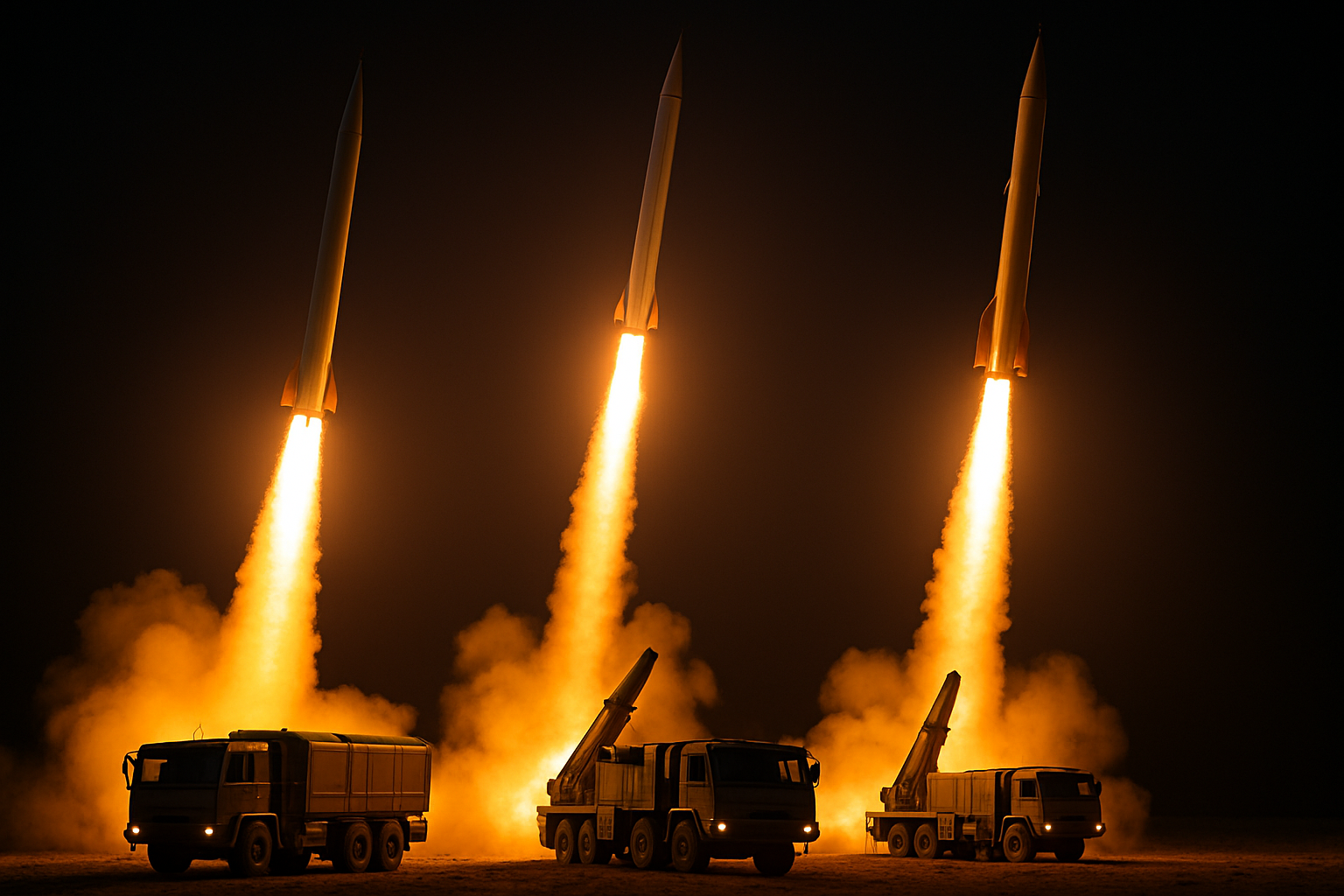
Iran launched a devastating wave of ballistic missile strikes targeting Israel and Gulf states on Tuesday, marking the most dangerous escalation in the ongoing Middle East crisis that has now claimed over 1,300 lives and triggered the worst global energy crisis in decades.
The Iranian Revolutionary Guard Corps (IRGC) conducted coordinated attacks as part of "Operation True Promise 4," with ballistic missiles striking civilian areas across Israel while simultaneously targeting critical infrastructure in Kuwait, Bahrain, and other Gulf nations. The attacks represent Iran's continued implementation of its "no red lines remain" policy following the death of Supreme Leader Ali Khamenei in U.S.-Israeli strikes on March 1.
Civilian Casualties Mount Across Multiple Nations
The latest wave of Iranian strikes has resulted in confirmed casualties across the region. In Israel, a woman identified as Nuriel Dubin, 27, a youth counselor who was about to be married, was killed in a Hezbollah rocket attack on northern Israel, while two others were injured. Iranian missiles also struck the city of Safed in northern Israel, causing additional casualties.
Palestinian territories were not spared, with six people injured when Iranian rockets and missile fragments fell in the Negev region and the city of Safed in occupied northern Palestine. Reports indicate that the projectiles were part of Iran's broader regional targeting campaign.
In the Gulf states, the humanitarian toll continues to rise. Kuwait's air defense systems are actively intercepting missile and drone attacks, with the General Staff of the Army confirming ongoing defensive operations. The attacks have resulted in multiple injuries among foreign nationals working in the region, highlighting the international scope of the crisis.
Strategic Infrastructure Under Attack
Iran's targeting has focused on critical infrastructure and military installations across the Gulf region. Cyprus has emerged as a key flashpoint, with intelligence sources reporting that an Iranian missile intercepted over northern Lebanon may have been aimed at British military bases in Cyprus. The missile disintegrated mid-air, scattering debris across towns north of Beirut and causing minor injuries.
The expansion of Iranian targeting to potentially include European territories represents a dangerous new phase in the conflict. RAF Akrotiri in Cyprus, a British sovereign base area, has been identified as a potential target, marking what could be the first direct threat to European territory since World War II.
Meanwhile, reports from Italy indicate that Iranian forces may have attempted to target U.S.-Israeli assets near Iran's Bushehr nuclear facility, though initial assessments suggest no technical damage or casualties occurred.
Global Aviation and Energy Crisis Deepens
The ongoing conflict has created unprecedented disruptions to global transportation and energy markets. Over 18,000 flights have been cancelled worldwide - the most extensive aviation crisis since COVID-19 - as eight Middle Eastern countries maintain simultaneous airspace closures including Iran, Iraq, Israel, UAE, Qatar, Syria, Kuwait, and Bahrain.
Dubai International Airport, the world's busiest with 86 million passengers annually, remains shut down due to missile damage sustained in earlier Iranian attacks. Major carriers including Emirates, Air France-KLM, and Wizz Air have suspended operations indefinitely, affecting hundreds of thousands of passengers globally and severing critical Asia-Europe flight corridors.
Energy markets have reached crisis levels, with oil prices surging past $110 per barrel as Iran continues to mine the Strait of Hormuz, effectively closing the waterway that handles 40% of global oil transit. Natural gas prices have exploded by 24% in Europe and 78% in the United States, with Qatar halting LNG production at facilities that supply approximately 20% of global exports.
Diplomatic Efforts Collapse Amid Military Escalation
The current crisis stems from the complete breakdown of nuclear negotiations between the United States and Iran, despite achieving what officials described as "broad agreement on guiding principles" - the most significant diplomatic progress since the 2018 collapse of the Joint Comprehensive Plan of Action (JCPOA).
The fundamental disagreement centered on Iran's exclusion of ballistic missiles and regional proxy forces as "red lines" that could not be discussed, while the United States demanded comprehensive agreements addressing missiles, armed groups, and human rights issues. This structural deadlock proved insurmountable despite months of intensive diplomacy mediated by Switzerland and Oman.
President Trump has demanded Iran's "unconditional surrender" and claimed the right to personally choose Iran's next Supreme Leader, rejecting the appointment of Mojtaba Khamenei, the late leader's son, as his successor. This represents the most direct assertion of American control over Iranian affairs since the 1979 revolution and effectively eliminates any remaining diplomatic solutions.
Regional Coalition Under Severe Strain
The unprecedented coalition of Saudi Arabia, UAE, Qatar, and Egypt that had backed diplomatic processes is now severely strained as Iranian retaliation directly targets member territories. Egyptian President Abdel Fattah al-Sisi condemned attacks on "sisterly Arab countries" and warned of "comprehensive chaos" spreading across the region.
Kuwait has expressed condolences to the UAE following the death of a military contractor during a routine mission in Bahrain that was targeted in Iranian attacks. This diplomatic solidarity comes as Gulf nations face the difficult choice between maintaining their alliance with the United States and avoiding further Iranian retaliation.
The breakdown of this regional consensus represents a significant blow to Middle Eastern stability, as the coalition had provided crucial diplomatic cover for peaceful resolution efforts over recent months.
Historical Context and Global Implications
The current crisis represents the most dangerous international situation since the end of the Cold War, occurring at a time when nuclear governance mechanisms are already under severe strain. The New START treaty between the United States and Russia expired on February 5, marking the first time in over 50 years that the two nations lack nuclear arms constraints.
Iran continues enriching uranium at 60% purity with over 400 kilograms of weapons-grade material - sufficient for multiple nuclear weapons if weaponized. UN Secretary-General António Guterres has warned that nuclear risks are at their "highest in decades," making the failure of diplomatic engagement particularly concerning for global non-proliferation efforts.
The rapid transition from diplomatic breakthrough to military confrontation demonstrates what experts describe as the fragility of crisis management in the multipolar era. The outcome will establish precedents for international approaches to nuclear crisis resolution, territorial sovereignty enforcement, and diplomatic credibility that will influence global governance for decades.
International Response and Future Implications
The international community faces its greatest test of multilateral cooperation in the modern era, as UN Secretary-General Guterres has characterized the situation. Emergency sessions of the UN Security Council have been called, though meaningful intervention remains limited by great power divisions and the rapid pace of military escalation.
The crisis has exposed fundamental vulnerabilities in global supply chains and energy architecture, with the 21-mile-wide Strait of Hormuz representing a critical single point of failure for modern logistics. The strategic petroleum reserves release of 400 million barrels from 32 countries - the largest in the International Energy Agency's 50-year history - provides only temporary relief from structural disruptions.
As the conflict enters what appears to be a prolonged phase, the stakes extend far beyond the immediate participants. Regional war prevention, global energy security, nuclear governance credibility, and international law enforcement mechanisms are all being tested simultaneously, with implications that will reshape international relations for decades to come.
The coming days will prove decisive in determining whether this crisis can be contained as a regional confrontation or will escalate into a broader Middle Eastern war with worldwide implications for conflict resolution approaches in the 21st century.