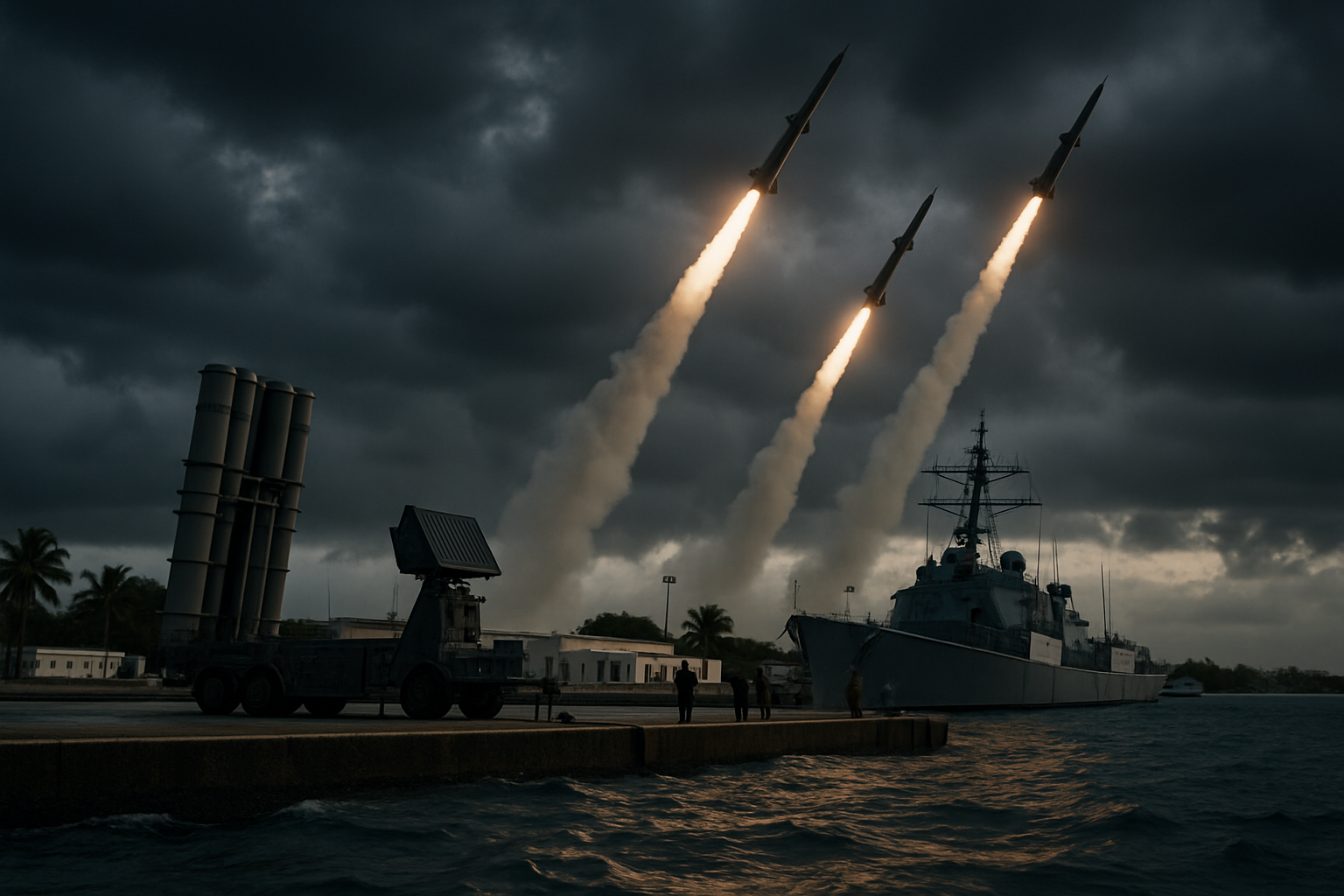
Iran launched two ballistic missiles toward the US-UK military base at Diego Garcia in the Indian Ocean on Saturday, marking a dramatic escalation in the ongoing Middle East crisis as President Trump simultaneously signaled he is considering "winding down" military operations against Iran.
The missile strikes, reported by Iran's semi-official Mehr news agency, represent the furthest projection of Iranian military power in the current conflict, extending the theater of operations thousands of miles beyond the traditional Middle East battleground. According to multiple sources, including The Wall Street Journal, the missiles did not hit their target at the strategically vital Diego Garcia facility.
The attacks occurred as President Trump issued conflicting signals about the future of US military engagement in the region. In a Friday post on his Truth Social platform, Trump declared that America was "getting very close to meeting our objectives as we consider winding down our great Military efforts in the Middle East with respect to the Terrorist Regime of Iran."
Strategic Implications of Diego Garcia Strike
The targeting of Diego Garcia represents a significant escalation in Iran's "Operation True Promise 4" retaliation campaign, which the Islamic Revolutionary Guard Corps (IRGC) launched following the US-Israeli "Operation Epic Fury" that resulted in the death of Supreme Leader Ali Khamenei and other senior Iranian officials.
Mehr news agency described the missile strike as a "significant step" demonstrating that Iran's missile range "exceeded what its adversaries had previously believed." The facility at Diego Garcia serves as a crucial logistics hub for US operations across the Indian Ocean and has been a key staging area for Middle Eastern operations.
According to Iranian sources, one missile failed during flight while a US warship reportedly fired an SM-3 interceptor against the second projectile, though it remains unclear whether the interceptor was successful in neutralizing the threat.
Trump's Strategic Messaging Amid Military Pressure
Even as Iranian missiles flew toward US installations, President Trump appeared to be laying groundwork for a potential de-escalation. His Truth Social statement emphasized that "the Hormuz Strait will have to be guarded and policed, as necessary, by other Nations who use it -- The United States does not!"
This messaging represents a notable shift from earlier statements where Trump warned of "bad things" happening if Iran did not reach a nuclear agreement, and follows his previous description of Iranian government overthrow as "the best thing that could happen."
White House Press Secretary Karoline Livitt confirmed that Washington projects any potential military operation against Iran could last between four to six weeks, suggesting detailed contingency planning remains active despite Trump's de-escalation rhetoric.
Contradictory Signals on Military Engagement
The President's public stance has created confusion among allies and adversaries alike. While declaring intentions to wind down operations, reports indicate the US is simultaneously deploying thousands more Marines to the Middle East region, reinforcing the massive dual-carrier presence already established with the USS Gerald R. Ford and USS Abraham Lincoln.
"We are getting very close to meeting our objectives as we consider winding down our great Military efforts in the Middle East."
— Donald Trump, President of the United States
Regional Response and International Implications
The Iranian missile strikes have reverberated across the region, with multiple Arab nations experiencing direct attacks as part of the IRGC's broader retaliation campaign. According to Norwegian sources, Saudi Arabia successfully intercepted 22 drones targeting eastern regions of the kingdom, while other Gulf states have reported various forms of Iranian harassment.
Egypt's President Abdel Fattah el-Sisi condemned Iranian attacks on what he termed "sisterly Arab countries," warning that such actions risk pushing the region into "comprehensive chaos." The unprecedented Arab coalition that had supported diplomatic engagement with Iran now faces severe strain as member territories come under direct attack.
Meanwhile, international diplomatic efforts continue with reports that Iran and Japan are engaged in discussions that could allow Japanese vessels to transit the Strait of Hormuz, indicating Tehran's selective approach to targeting different nations based on their level of support for US operations.
Nuclear Diplomacy Breakdown Context
The current military escalation follows the complete collapse of nuclear negotiations that had achieved what Iranian Foreign Minister Abbas Araghchi called "broad agreement on guiding principles" – the most significant diplomatic progress since the 2018 JCPOA breakdown.
Despite this framework breakthrough in Geneva talks mediated by Switzerland and Oman, fundamental disagreements over scope proved insurmountable. Iran maintained that ballistic missiles and regional proxy relationships were "red lines" excluded from nuclear-only discussions, while US Secretary of State Marco Rubio insisted on comprehensive agreements addressing missiles, armed groups, and human rights.
Former IAEA inspector Dr. Yusri Abu Shadi has confirmed that Iran possesses over 400 kilograms of uranium enriched to 60% purity, making nuclear weapons capability "easily achievable" if Tehran chose to weaponize its stockpile.
Energy Security and Global Impact
The crisis has created unprecedented disruptions to global energy markets and transportation networks. Over 18,000 flights have been cancelled worldwide as eight Middle Eastern countries simultaneously closed their airspace – the most extensive aviation disruption since COVID-19.
Dubai International Airport, the world's busiest by international passengers, remains completely shut down due to missile damage, while major carriers including Emirates, Air France-KLM, and Wizz Air have suspended operations affecting hundreds of thousands of passengers globally.
Oil prices have surged past $110 per barrel as Iran has effectively closed the Strait of Hormuz to commercial shipping, affecting 40% of global oil transit. Natural gas prices have increased 24% in Europe and 78% in the United States, demonstrating the conflict's far-reaching economic impact.
Congressional and International Oversight
The escalating crisis has prompted intense congressional scrutiny, with bipartisan lawmakers demanding comprehensive briefings on long-term strategy, cost projections, and potential ground troop deployments. Senator Richard Blumenthal expressed being "more concerned than ever" about the possibility of "boots on the ground," while the conflict's unpopularity has reached what experts describe as "almost unprecedented" levels.
Financial markets have emerged as what some analysts term the "ultimate constraint" on further escalation, with major indices showing significant volatility. Pakistan's KSE-100 index experienced its largest single-day decline in history, dropping 8.97%.
The United Nations Security Council has convened multiple emergency sessions, with Secretary-General António Guterres warning of a "serious threat to international peace and security" and cautioning about a potential "chain of events no one can control."
Historical Context and Future Implications
The current crisis occurs against the backdrop of a broader nuclear governance breakdown, with the New START treaty having expired on February 5 – marking the first time in over 50 years without US-Russia nuclear constraints. Combined with China's nuclear expansion, UN officials warn that nuclear risks are at their "highest in decades."
The rapid transition from diplomatic framework to military escalation demonstrates what experts describe as the fragility of modern crisis management mechanisms in the multipolar era. The collapse of the most promising US-Iran diplomatic opening in years raises fundamental questions about the viability of diplomatic solutions to contemporary nuclear crises.
With Iran's new Supreme Leader succession crisis ongoing following Ali Khamenei's death, CIA assessments suggest a Revolutionary Guards member is likely to assume power, indicating a potential shift toward more hardline military influence in Iranian governance.
Humanitarian Concerns
The human cost of the escalating conflict continues to mount across the region. International evacuations are underway on a scale not seen since the Arab Spring, with Australia reporting 115,000 nationals trapped in the region and Germany struggling to extract 30,000 stranded tourists.
Tragic incidents, including the bombing of an elementary school in Minab, Iran, which killed between 53-85 students and staff, have drawn international condemnation and calls for Geneva Conventions investigations into potential war crimes.
As the crisis enters what many observers consider its most dangerous phase, the coming days will be crucial in determining whether President Trump's signals about "winding down" operations represent genuine policy shifts or strategic messaging aimed at managing domestic and international pressure while military operations continue.
The stakes could not be higher: regional war prevention, global energy security, nuclear governance credibility, and the future of international law enforcement all hang in the balance as the world watches this unprecedented crisis unfold across multiple theaters from the Persian Gulf to the Indian Ocean.