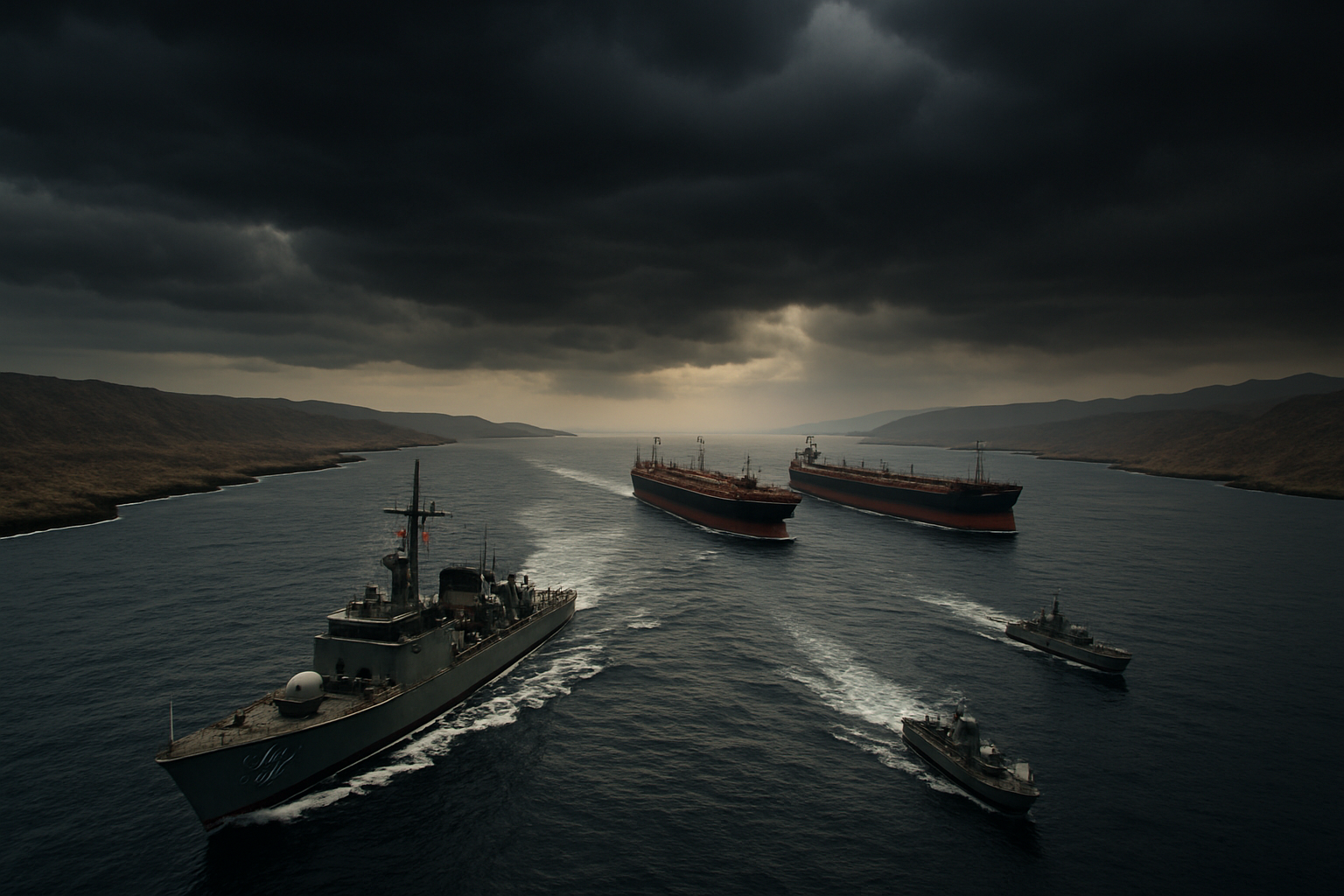
Iran announced Saturday it has reimposed "strict management and control" over the Strait of Hormuz just hours after reopening the critical waterway, citing the United States' continued naval blockade of Iranian ports as justification for the dramatic reversal.
The Islamic Revolutionary Guard Corps (IRGC) declared through state media that the strategic 21-mile waterway has "returned to its previous state" under Iranian military supervision, effectively reversing Friday's announcement that had allowed commercial shipping to resume during the Israel-Lebanon ceasefire.
"Iran has, in good faith as agreed in negotiations, allowed a limited number of oil tankers and commercial ships to pass through the Strait of Hormuz," the IRGC statement read. "Unfortunately, the Americans continue their blockade. Control of the Strait of Hormuz has therefore been resumed."
Friday's Brief Opening Quickly Reversed
The announcement comes just 24 hours after Iranian Foreign Minister Abbas Araghchi had declared the strait "completely open" for all commercial vessels during the 10-day Israel-Lebanon ceasefire. Oil prices, which had crashed over 10% on Friday's reopening news from peaks of $119.50 per barrel, immediately began surging again as markets processed the renewed restrictions.
According to multiple shipping industry sources, approximately six vessels had successfully transited the waterway during Friday's brief reopening window, including several Indian-flagged cargo ships and a Curaçao-flagged tanker, before Iran reimposed the restrictions Saturday morning.
Mohammad Bagher Ghalibaf, Speaker of Iran's Parliament, had warned early Saturday that the strait would not remain open if the US maintained its naval blockade of Iranian ports. "Maritime traffic will be regulated under Iran's authority," Ghalibaf stated, "and transit through the strait will take place only along designated routes and with Tehran's approval."
Trump's Dual-Track Approach Under Fire
The reversal represents a direct challenge to President Donald Trump's dual-track strategy of welcoming Iran's reopening while maintaining the US naval blockade. Trump had claimed credit for Friday's announcement, posting on Truth Social: "IRAN HAS JUST ANNOUNCED THAT THE STRAIT OF IRAN IS FULLY OPEN AND READY FOR FULL PASSAGE. THANK YOU!"
However, the president simultaneously emphasized that the US naval blockade of Iranian ports would continue "in full force" until a comprehensive agreement addressing Iran's nuclear program and regional activities is reached. This conditional approach appears to have backfired, prompting Iran's quick reversal.
"The blockade will remain until we have a deal that addresses not just the strait, but the nuclear program and Iran's destabilizing activities across the region."
— President Donald Trump, Friday statement
Speaking aboard Air Force One Saturday, Trump warned that the ceasefire with Iran may not be extended beyond its Wednesday expiration unless significant progress is made. "Maybe I won't extend it, but the blockade is going to remain," Trump told reporters, setting up a potential collision course for the coming week.
Global Energy Markets in Turmoil
The Strait of Hormuz handles approximately 40% of global seaborne oil transit, making it one of the world's most critical energy chokepoints. Iran's renewed closure threatens to reignite the severe energy crisis that peaked in March 2026, when oil prices surged to historic levels and the International Energy Agency was forced to release 400 million barrels from strategic reserves - the largest such release in the agency's 50-year history.
Major shipping companies including Maersk and MSC, which had been preparing to resume operations in the Persian Gulf, have now put their plans on hold pending further developments. Over 150 oil and LNG tankers worth billions in cargo remain stranded in the region, with ship owners reluctant to risk vessels in increasingly unpredictable waters.
The renewed uncertainty is particularly damaging given that global markets had just begun to stabilize following Friday's brief reopening. Airlines had started planning route resumptions through Middle Eastern airspace, and several countries including Bangladesh and Pakistan were reconsidering emergency fuel rationing measures implemented during the peak of the crisis.
International Response Divided
European leaders, who had welcomed Friday's reopening as a step toward regional stability, expressed concern over the rapid deterioration. French President Emmanuel Macron and British Prime Minister Keir Starmer, who had hosted a 49-country virtual conference Friday discussing multinational naval force deployment, are reportedly planning emergency consultations.
EU foreign policy chief Kaja Kallas emphasized that international law requires free transit through waterways, warning against the weaponization of shipping routes as setting a "dangerous precedent" for global commerce. Meanwhile, Nordic countries that had welcomed Iran's announcement are now reviewing contingency plans for renewed energy disruptions.
Australia indicated it would consider contributing military assets to an international mission to keep shipping free through the strait, though Prime Minister Anthony Albanese stopped short of committing vessels. Japan pledged "all possible measures" for Hormuz safety but has not specified what form such support might take.
Nuclear Negotiations at Impasse
The strait closure reversal underscores the broader challenges facing US-Iran nuclear negotiations, which collapsed in dramatic fashion just days ago after Pakistan's intensive mediation efforts. Despite achieving what was described as "broad agreement on guiding principles" - the most significant progress since the 2018 JCPOA breakdown - fundamental disagreements remain unresolved.
Iran continues to maintain uranium enrichment at 60% purity levels with over 400 kilograms of weapons-grade material, refusing to abandon what it calls its "inalienable right" to nuclear technology. The US insists on comprehensive agreements that would include Iran's ballistic missile program and support for regional proxy groups, which Tehran has declared "red lines" excluded from nuclear discussions.
The nuclear impasse is complicated by the February 2026 expiration of the New START treaty between the US and Russia, creating the first 50-year gap without major power nuclear constraints. UN Secretary-General António Guterres has warned that nuclear risks are at their "highest in decades," calling the current crisis the "greatest test of multilateral cooperation in the modern era."
Regional Coalition Under Strain
Iran's renewed closure particularly tests the unity of the unprecedented Saudi-UAE-Qatar-Egypt coalition that has supported diplomatic solutions throughout the crisis. This regional consensus has been severely strained by Iran's "Operation True Promise 4" systematic targeting of coalition territories during previous escalations.
The coalition members have suffered casualties from Iranian retaliation: one civilian killed in Abu Dhabi, 32 injured in Kuwait airport strikes, and eight wounded in Qatar despite successful Patriot missile intercepts. Egyptian President Abdel Fattah el-Sisi had warned of "comprehensive chaos" across "sisterly Arab countries" if the crisis continued to escalate.
The rapid reversal of Iran's opening decision may force these regional powers to choose more definitively between their historic security partnerships with the United States and the immediate economic necessities of keeping regional shipping lanes open.
Economic and Humanitarian Implications
The renewed strait closure threatens to reverse recent progress in addressing the humanitarian and economic impacts of the prolonged crisis. Bangladesh, which had implemented fuel rationing affecting 170 million people, was preparing to ease restrictions. Pakistan was considering ending its wartime austerity measures, including four-day government work weeks.
European consumers, who had seen energy costs begin to stabilize after months of elevated natural gas prices (up 24% in Europe, 78% in the US at crisis peaks), now face renewed uncertainty about winter heating costs. Swedish authorities had warned that electricity prices could increase by 10-20 öre per kilowatt-hour, with gasoline potentially rising by 1-2 kronor per liter.
The aviation industry, which had cancelled over 18,000 flights during the peak crisis period - the most severe disruption since COVID-19 - was beginning to plan recovery operations. Dubai International Airport, the world's busiest with 86 million annual passengers, had been preparing to fully reopen after missile damage forced its closure.
Template-Setting Moment for 21st Century
The rapid reversal of Iran's strait opening decision highlights the fragility of diplomatic progress in the current crisis, which experts describe as the most dangerous international confrontation since the end of the Cold War. The events of April 17-18, 2026, may serve as a template for how quickly geopolitical situations can change in an interconnected world where single chokepoints control critical global infrastructure.
The stakes extend far beyond the immediate energy and economic impacts. Success or failure in resolving the Strait of Hormuz crisis will likely influence international approaches to territorial sovereignty enforcement, energy security planning, and conflict resolution for decades to come.
As the Wednesday ceasefire deadline approaches, both sides appear to be calculating their next moves carefully. Iran has demonstrated its ability to rapidly open and close the world's most important energy chokepoint, while the United States has shown its determination to maintain pressure through naval blockade until broader agreements are reached.
Path Forward Uncertain
With the ceasefire set to expire Wednesday and both sides maintaining incompatible positions, the coming days will be critical for determining whether diplomatic innovation can bridge decades-old US-Iran disagreements or whether the world will return to the maximum crisis conditions that nearly triggered what Trump called civilizational consequences.
The international community, having witnessed the speed with which hope can turn to renewed crisis, is preparing for multiple scenarios. The template being established in the Persian Gulf may determine not just regional stability, but the broader question of whether diplomatic solutions can compete with military approaches in resolving 21st-century international disputes.