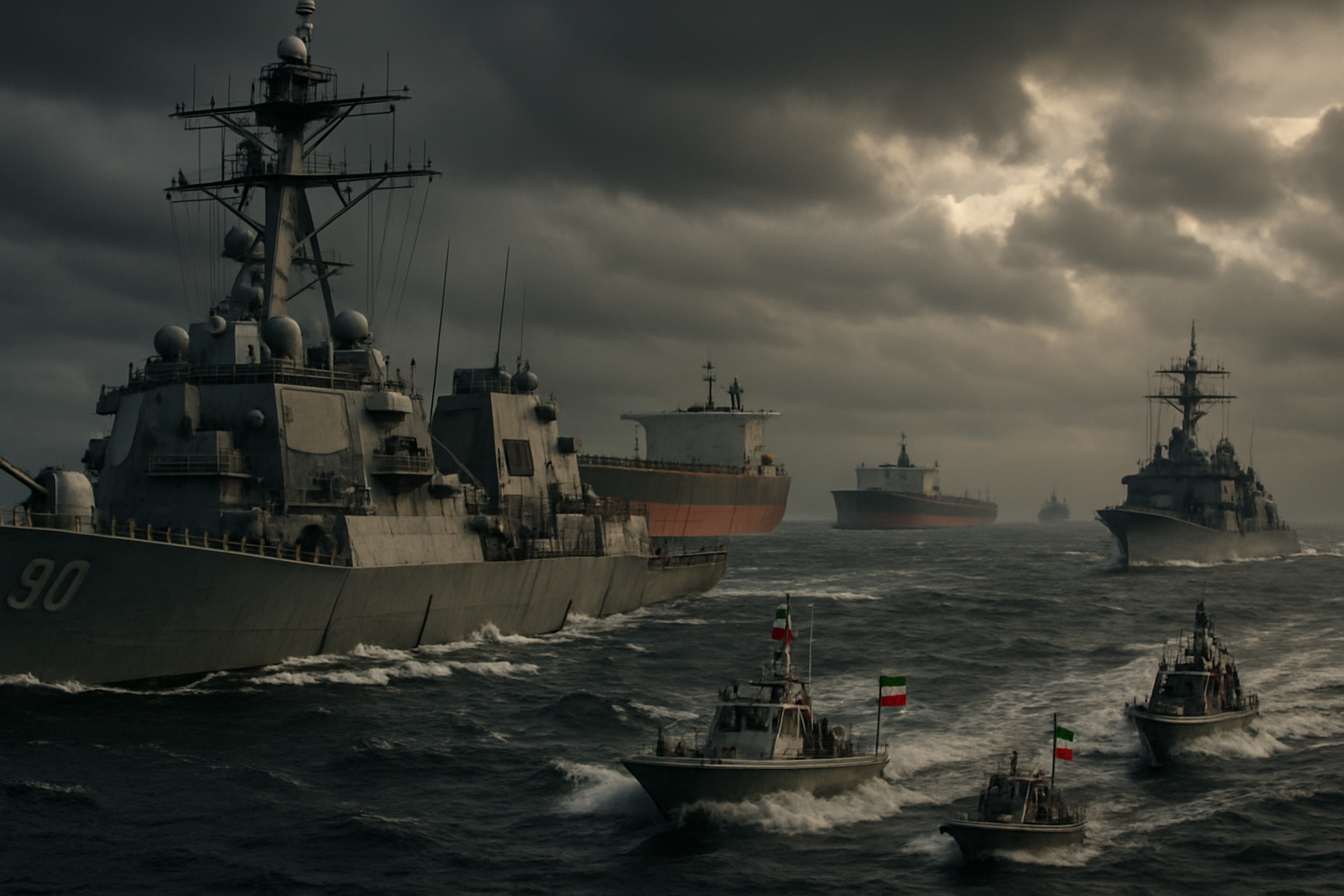
Iran's Revolutionary Guards announced Saturday they have re-imposed complete control over the Strait of Hormuz, declaring any ship approaching the strategic waterway will be "taken as target" in a dramatic escalation that threatens 40% of global oil transit and has prompted a stern warning from President Donald Trump against Iranian "blackmail."
The announcement marks a reversal of Iran's brief reopening of the critical 21-mile maritime passage during a temporary Israel-Lebanon ceasefire, effectively returning to the blockade that has characterized the ongoing Middle East crisis since March 2026. The development has triggered immediate market volatility and renewed concerns about global energy security.
Revolutionary Guards Issue Direct Threat
Iran's Islamic Revolutionary Guard Corps (IRGC) issued its warning through multiple channels Saturday, with statements appearing in Danish, Norwegian, and Greek media outlets. The Danish publication Ekstrabladet quoted Revolutionary Guards as declaring that "every ship approaching the Strait of Hormuz will be considered as cooperating with the enemy" and targeted accordingly.
The threat represents a return to the hardline stance Iran maintained during the height of the crisis, when the country deployed between 2,000-6,000 naval mines in the waterway, effectively shutting down one of the world's most critical shipping routes.
"Iran has announced Saturday having re-imposed strict control of the Strait of Hormuz, reversing its decision to partially reopen this key passage for global hydrocarbon trade."
— Le Monde reporting
According to French media reports, Iran has accused the United States of maintaining a blockade of Iranian ports and engaging in "acts of piracy," with Deputy Foreign Minister Saeed Khatibzadeh denouncing what he called American attempts to "impose a siege" on the country.
Trump Responds with 'Blackmail' Warning
President Trump responded swiftly to Iran's move, warning against what he characterized as attempts at economic blackmail. Speaking from Mar-a-Lago, Trump indicated that the United States would not be intimidated by Iran's control of the strategic waterway.
The U.S. response comes as Trump had previously claimed credit when Iran briefly reopened the strait, posting on social media: "IRAN HAS JUST ANNOUNCED THAT THE STRAIT OF IRAN IS FULLY OPEN AND READY FOR FULL PASSAGE. THANK YOU!" However, the President had emphasized at the time that the U.S. naval blockade of Iranian ports would continue until a comprehensive deal was reached.
International Diplomatic Efforts Intensify
The closure has prompted renewed diplomatic activity, with French President Emmanuel Macron and UK Prime Minister Keir Starmer issuing a joint statement "affirming the international community's determination to ensure the free movement of vessels" through the strait.
European leaders have called for unrestricted access through the waterway, with the European Union emphasizing that international law requires free transit and warning against the weaponization of shipping routes as setting a "dangerous precedent."
Global Economic Impact
The strait's closure immediately sent shockwaves through global markets, with oil prices jumping as traders priced in the renewed supply disruption. The Strait of Hormuz handles approximately 40% of the world's seaborne oil shipments, making any disruption a critical threat to global energy security.
Major shipping companies Maersk and MSC had previously suspended operations in the Persian Gulf during the crisis, with over 150 tankers worth billions of dollars in cargo stranded in regional waters. Industry analysts warn that a prolonged closure could force the International Energy Agency to consider another major strategic reserve release, following the record 400 million barrel deployment earlier this year.
Regional Security Concerns
The renewed closure comes amid ongoing tensions between Iran and its Gulf Arab neighbors, who have been caught between maintaining relations with the United States and managing Iranian pressure. The crisis has previously seen casualties across the region, including in the UAE, Kuwait, and Qatar during Iranian retaliation operations.
Egypt's President Abdel Fattah el-Sisi had previously warned of "comprehensive chaos" spreading to "sisterly countries" if diplomatic solutions failed, highlighting the regional stakes involved in the maritime dispute.
Nuclear Diplomacy Context
The strait closure occurs against the backdrop of collapsed nuclear negotiations between the United States and Iran. Despite achieving what negotiators called "broad agreement on guiding principles" in Geneva talks, fundamental disagreements over Iran's uranium enrichment program and regional activities proved insurmountable.
Iran continues to maintain uranium enrichment at 60% purity levels, approaching weapons-grade capability, with international experts confirming the country possesses sufficient material for multiple nuclear weapons if weaponized. The nuclear crisis has been complicated by the February 2026 expiration of the New START treaty between the US and Russia, marking the first time in over 50 years without nuclear arms constraints between the superpowers.
Aviation and Supply Chain Disruption
The regional crisis has had far-reaching effects beyond energy markets. Dubai International Airport, one of the world's busiest with 86 million passengers annually, remains closed due to missile damage sustained during earlier phases of the conflict. Over 18,000 flights have been cancelled globally during the crisis, representing the most severe aviation disruption since the COVID-19 pandemic.
Supply chain experts warn that the Persian Gulf serves as a critical trade hub beyond energy, affecting consumer goods and industrial materials worldwide. The automotive, electronics, and textiles industries have experienced severe disruptions due to their dependence on Gulf logistics networks.
Historical Context and Precedent
The current crisis represents the most dangerous international confrontation since the end of the Cold War, according to UN Secretary-General António Guterres, who has described it as "the greatest test of multilateral cooperation and crisis management in the modern era."
Iran's control of the Strait of Hormuz recalls historical precedents from the 1980s "Tanker War" during the Iran-Iraq conflict, when Iran previously mined the waterway. However, the current crisis occurs in a more interconnected global economy where disruptions have immediate worldwide impact.
Looking Forward
As tensions remain high, diplomatic observers note that the cycle of escalation and temporary de-escalation that has characterized the crisis since March 2026 continues. The current closure follows the pattern established during previous phases, where brief diplomatic openings have been followed by renewed confrontations.
The stakes extend far beyond the immediate region, with the crisis serving as a template-setting moment for 21st-century international conflict resolution. Success in finding a diplomatic solution could provide a framework for future nuclear and territorial disputes, while failure may encourage military approaches over diplomatic engagement globally.
Energy markets, international law enforcement, and the post-World War II international order principles are all being tested simultaneously in what many observers consider the most consequential international crisis in decades, with implications that will extend well beyond the current events and shape global governance mechanisms for years to come.