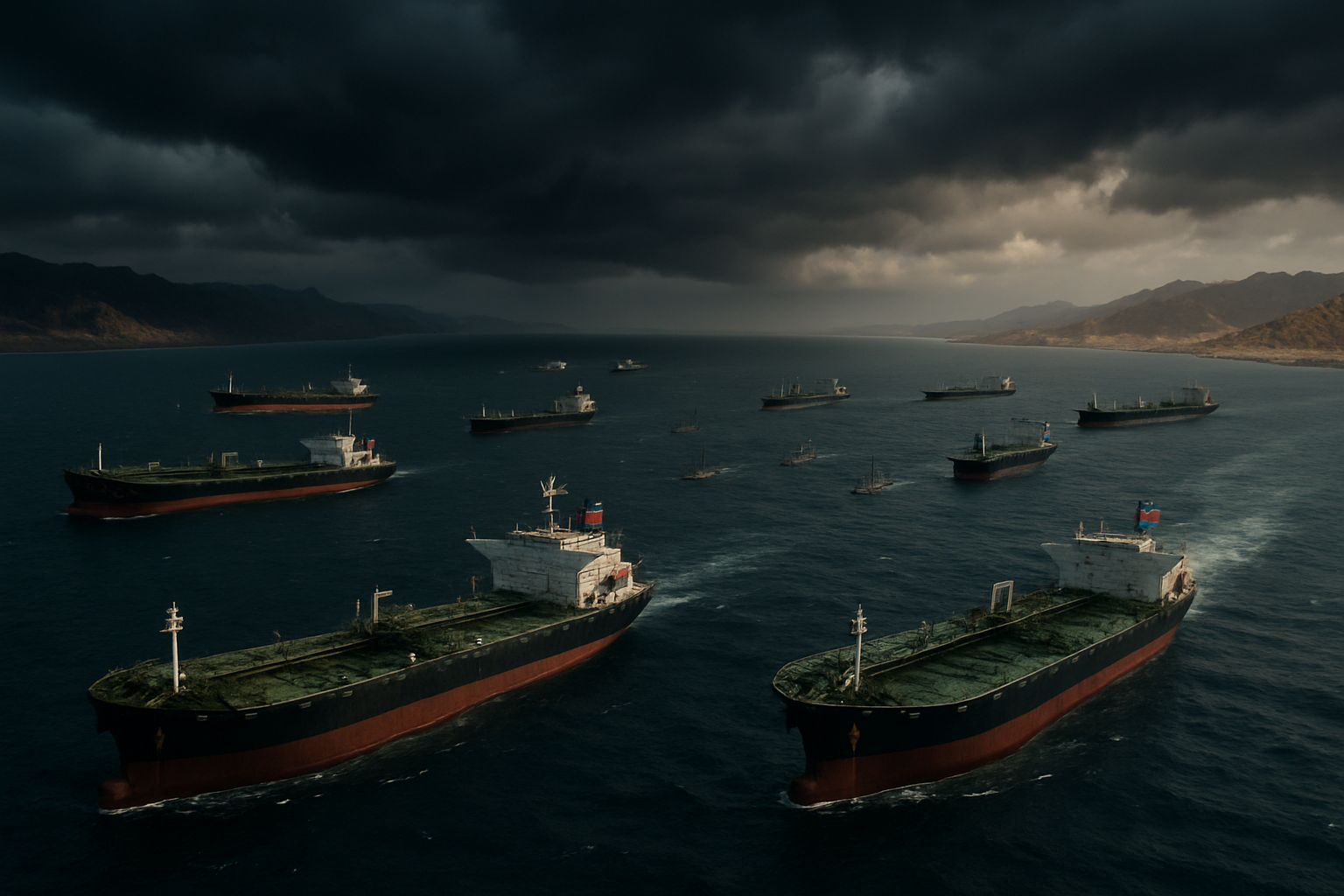
Iran has effectively closed the Strait of Hormuz, the world's most critical oil transit route, declaring the strategic waterway "unsafe" following the largest US-Israeli coordinated military operation since 2003, triggering an unprecedented global energy crisis that has left over 150 oil tankers stranded in Persian Gulf waters.
The closure of the 21-mile-wide chokepoint, through which 40% of the world's seaborne oil transits daily, has sent shockwaves through global markets as Brent crude oil prices surged 10% to $80 per barrel. Major shipping companies Maersk and MSC have suspended all operations in the Persian Gulf, leaving more than 150 tankers carrying crude oil and liquefied natural gas anchored in what industry analysts describe as "billions of dollars in stranded cargo."
Historic Military Operation Triggers Crisis
The maritime blockade follows "Operation Epic Fury," described by Pentagon officials as the largest coordinated US-Israeli military operation since the 2003 Iraq invasion. The unprecedented dual-carrier deployment of USS Gerald R. Ford and USS Abraham Lincoln—representing approximately one-third of the active U.S. Navy fleet—positioned 800 kilometers from Iran's coast provided the military backbone for strikes that have fundamentally altered Middle Eastern geopolitics.
Iranian Revolutionary Guard officials declared that "no red lines remain" following the operation, which confirmed the elimination of senior Iranian leadership including Defense Minister Nasirzadeh, IRGC Chief Pakpour, and over 40 officials. The Iranian Supreme Leader's compound was also targeted, with family casualties reported among the dead.
"The Strait of Hormuz is now considered unsafe for all international shipping. Iran will fire on any vessel attempting passage."
— Iranian State Media Report
Global Aviation Paralyzed
The crisis extends far beyond maritime shipping, with over 18,000 flights cancelled worldwide as Iran, Iraq, Israel, UAE, Qatar, Syria, Kuwait, and Bahrain simultaneously closed their airspace. Dubai International Airport, the world's busiest with over 86 million passengers annually, has been completely shut down after sustaining missile damage during Iranian retaliatory strikes.
Emirates, Etihad Airways, Air France-KLM, Wizz Air, and Bulgaria Air have suspended all Middle East operations, creating the most comprehensive aviation disruption since the COVID-19 pandemic. The closure has severed critical Europe-Asia hub connections, stranding hundreds of thousands of passengers globally and forcing airlines to implement complex and costly rerouting strategies.
Energy Markets in Turmoil
The energy implications of the Strait of Hormuz closure cannot be overstated. Natural gas prices have skyrocketed 24% in Europe and 78% in the United States, while analysts warn oil could reach $100-108 per barrel if the crisis continues. Sweden is already predicting electricity price increases of 10-20 öre and gasoline rises of 1-2 kronor per liter, while Mexico faces "gasolinazo" concerns and Australia has issued fuel price warnings.
OPEC+ held an emergency meeting and approved a 206,000 barrels per day production increase for April, but energy analysts confirm this is insufficient to offset the shipping disruption through the Persian Gulf. Alternative routes around the Arabian Peninsula add significant time and costs, while existing pipeline capacity cannot replace the enormous volume of seaborne crude that typically flows through Hormuz.
Qatar, the world's largest LNG producer, has also been forced to halt production at its Ras Laffan and Mesaid facilities following Iranian drone attacks on energy infrastructure, with the company expected to declare force majeure on LNG supplies to global markets.
Diplomatic Breakthrough Collapses
The crisis represents the complete breakdown of what had been the most promising US-Iran diplomatic engagement in years. Geneva talks mediated by Switzerland and Oman had achieved what Iranian Foreign Minister Abbas Araghchi described as "broad agreement on guiding principles"—the most significant progress since the JCPOA collapse in 2018.
However, fundamental scope disagreements proved insurmountable. Iran excluded ballistic missiles and regional proxy activities as "red lines," demanding nuclear-only talks, while US Secretary of State Marco Rubio insisted on comprehensive agreements addressing missiles, armed groups, and human rights. Iran's uranium enrichment at 60% purity—approaching the 90% weapons-grade threshold—with sufficient material for multiple weapons if weaponized, added urgency to negotiations that ultimately failed.
Regional Coalition Under Strain
An unprecedented coalition of Saudi Arabia, UAE, Qatar, and Egypt had backed the diplomatic process—representing extraordinary Middle Eastern consensus for preventing military confrontation. However, this regional unity is now severely strained as Iranian retaliatory strikes have directly targeted member territories.
The UAE reported one civilian killed in Abu Dhabi from falling debris, Kuwait's airport was struck by Iranian drones causing injuries to 32 foreign nationals, and Qatar intercepted 65 missiles and 12 drones using Patriot systems, resulting in eight injuries from fragments. Bahrain's naval base, home to the U.S. Fifth Fleet, was also targeted.
Egyptian President Abdel Fattah al-Sisi condemned the attacks on "sisterly Arab countries," warning of "comprehensive chaos" if the situation continues to deteriorate. The strain on regional relationships represents a fundamental shift in Middle Eastern security architecture.
Global Economic Ripple Effects
Financial markets worldwide have responded with alarm. Pakistan's KSE-100 index crashed 8.97%, while Dow futures dropped 400-570 points and the S&P 500 futures declined more than 1%. The crisis demonstrates how regional conflicts can instantly become global economic disruptions in our interconnected world.
Supply chain disruptions extend well beyond energy, affecting consumer goods to industrial materials that depend on Persian Gulf shipping routes. The 150 stranded tankers represent not just crude oil and LNG, but also petrochemicals, refined products, and manufacturing feedstocks critical to global industry.
International Emergency Response
Multiple nations have activated emergency evacuation protocols for their citizens across 15+ Middle Eastern countries. Sweden and Serbia have ordered immediate evacuations from Iran citing "extremely uncertain" security conditions, while Estonia has advised 3,000 nationals to contact authorities. Kenya is coordinating the potential evacuation of over 66,000 nationals from Qatar and up to 40,000 from the UAE.
UN Secretary-General António Guterres has convened emergency Security Council sessions, warning of a "serious threat to international peace and security" and cautioning about "a chain of events that no one can control." Russia has condemned what it calls "reckless actions by Washington and West Jerusalem," while China has issued some of its strongest condemnations in years regarding "sovereignty violations."
Nuclear Governance Crisis Context
The crisis unfolds against the backdrop of a broader nuclear governance breakdown. The New START treaty expired on February 5, marking the first time in over 50 years without US-Russia nuclear constraints. Combined with China's nuclear expansion and what Guterres calls nuclear risks at their "highest in decades," the Iran situation represents a template-setting moment for 21st-century crisis management.
Historical Significance and Long-term Implications
March 2026 marks what many analysts consider the most dangerous moment since the end of the Cold War. The rapid transition from diplomatic breakthrough to military escalation demonstrates the fragility of modern crisis management mechanisms in a multipolar era.
The Strait of Hormuz crisis exposes the vulnerability of over-dependence on strategic chokepoints for global energy security. The 21-mile-wide strait is geographically irreplaceable for regional oil exports, highlighting the urgent need for supply chain diversification—a process that would require years or decades to implement effectively.
For the aviation industry, the simultaneous closure of multiple airspaces represents the most comprehensive regional disruption in modern history, forcing fundamental reconsideration of route planning, risk assessment, and international cooperation frameworks.
Looking Ahead: Critical Decisions
The coming days will be decisive in determining whether this remains a contained regional confrontation or expands into a broader Middle Eastern war with global implications. Success in containing the escalation could provide a framework for future nuclear crisis resolution, while failure may accelerate military solutions that reshape geopolitics for decades, encourage nuclear proliferation elsewhere, and undermine diplomatic credibility worldwide.
The international community faces urgent decisions about immediate supply needs versus long-term energy security architecture. Strategic petroleum reserves provide only temporary buffers, while the critical need for innovative diplomatic solutions to bridge longstanding disagreements has never been more apparent.
As over 150 ships remain anchored in the Persian Gulf and global supply chains strain under the pressure, the world watches to see whether diplomatic channels can be reopened before this crisis transforms from a regional conflict into a global catastrophe that reshapes international relations for generations to come.