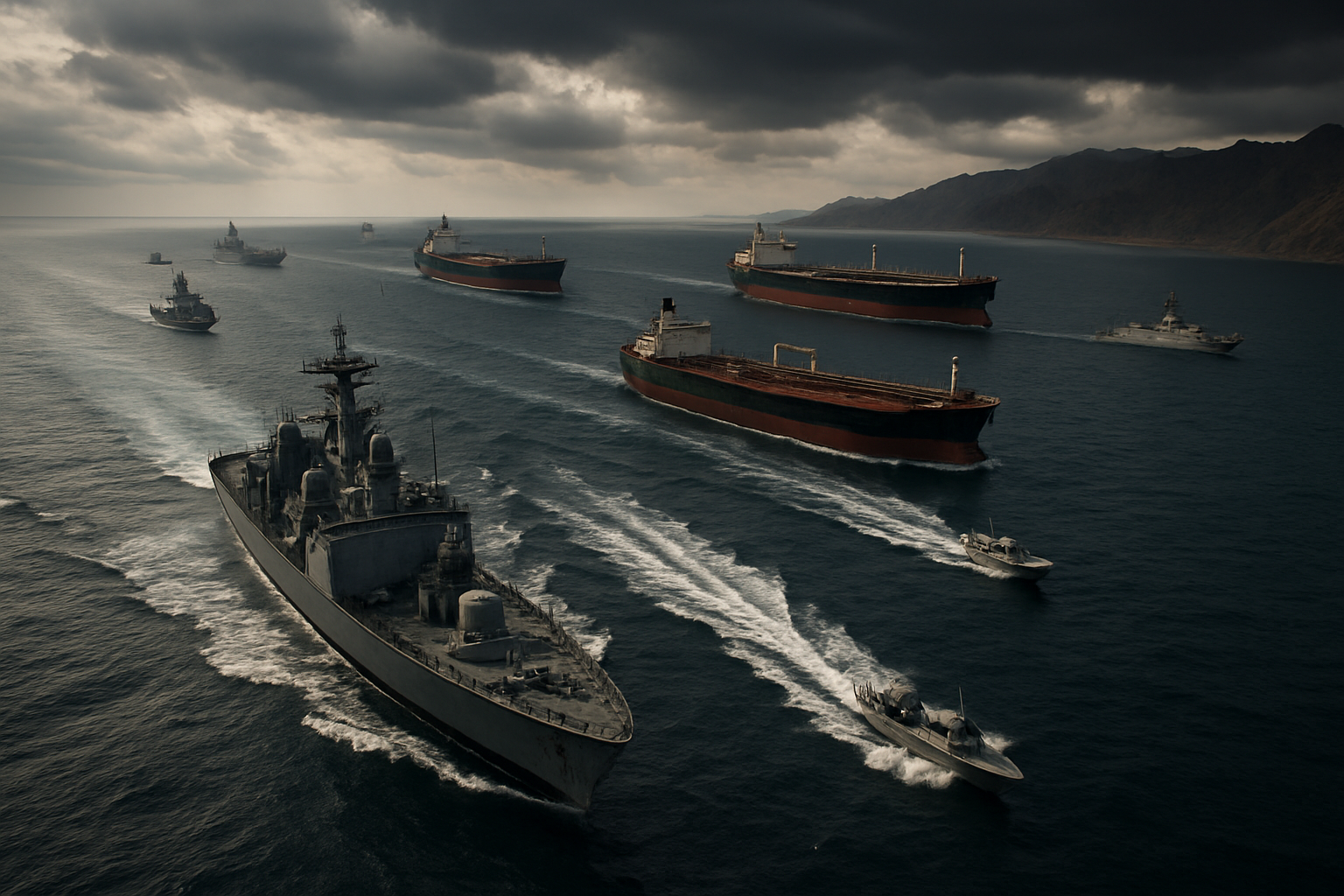
Iran's Revolutionary Guard has declared the Strait of Hormuz "unsafe for shipping" for the second time, blocking the strategic waterway that handles 40% of global seaborne oil transit as tensions escalate following Israeli airstrikes against Hezbollah positions in Lebanon.
The announcement on Wednesday represents a dramatic escalation that threatens to collapse the fragile ceasefire agreement reached between the United States and Iran just days earlier. The closure of the 21-mile waterway immediately sent shockwaves through global energy markets and raised fears of a return to the devastating crisis that gripped the world in March 2026.
Ceasefire Under Severe Strain
The Revolutionary Guard's maritime alert, transmitted through shipping brokerage SSY, warned that any vessel attempting passage without permission from Iranian forces "will be targeted and destroyed." The move came in direct response to Israeli air strikes on Hezbollah positions in Lebanon, which Tehran considers a violation of the recently negotiated ceasefire terms.
Iranian media cited unnamed sources saying Tehran "will punish" Israel for violating the agreement, while the Tasnim news agency reported that Iran could withdraw from the accord if attacks on Lebanon continue. The Iranian government has informed mediators it will not attend Friday's scheduled talks in Pakistan unless a comprehensive ceasefire is enforced across all regional fronts.
"Iran has warned it will withdraw from a ceasefire reached with the United States if Israeli strikes on Lebanon continue."
— Ukrainian News Source
US Vice President JD Vance acknowledged the precarious nature of the agreement, describing it as a "fragile deal" that the fresh violence threatens to scuttle. Israeli Prime Minister Benjamin Netanyahu's declaration that his finger is "on the trigger" and ready to return to striking Iran at any moment has further heightened tensions.
Global Energy Markets in Turmoil
The Strait of Hormuz closure immediately triggered alarm in global energy markets, reviving memories of the historic crisis that unfolded in March 2026 when oil prices surged past $119.50 per barrel for Brent crude. The waterway's strategic importance cannot be overstated – it serves as the world's most critical energy chokepoint with no viable alternatives for transporting Middle Eastern oil.
According to Russian media reports, Iran has informed negotiation mediators that it will limit vessel passage through the strait to just ten ships per day, creating a severe bottleneck for global trade. More than 400 oil tankers are reportedly waiting for passage, representing billions of dollars in stranded cargo.
The Iranian Navy has issued stark warnings to vessels anchored in the area, declaring that ships can only cross the strait after receiving explicit permission from Tehran. "If any vessel attempts to pass without permission, [it] will be destroyed," Iranian naval forces announced via maritime radio channels.
Historical Context and Previous Crisis
This latest closure represents the second time Iran has weaponized control of the Strait of Hormuz in recent months. The previous blockade in March 2026 triggered what experts described as the most severe global energy crisis since the 1970s oil shocks, forcing the International Energy Agency to authorize its largest-ever strategic petroleum reserve release of 400 million barrels from 32 countries.
That earlier crisis saw:
- Oil prices breach $100 per barrel for the first time since 2022
- Over 18,000 flight cancellations worldwide
- Major shipping companies suspending operations in the Persian Gulf
- Emergency fuel rationing in multiple countries
- The deployment of naval forces from multiple nations to protect shipping
The March crisis emerged from the complete collapse of US-Iran nuclear negotiations despite achieving what was described as "broad agreement on guiding principles" – the most diplomatic progress since the JCPOA framework fell apart in 2018.
Regional Coalition Under Pressure
The renewed Strait of Hormuz closure places severe strain on the regional coalition of Arab states that had supported diplomatic efforts to resolve the crisis. During the previous confrontation, Iran's "Operation True Promise 4" systematically targeted coalition member territories, including:
- UAE: 1 civilian killed in Abu Dhabi from debris
- Kuwait: 32 people injured in airport drone strikes
- Qatar: 8 injured despite Patriot missile systems intercepting 65 missiles and 12 drones
- Cyprus: First European territory attacked since WWII when Iranian drones struck RAF Akrotiri
Egyptian President Abdel Fattah el-Sisi had condemned attacks on "sisterly Arab countries," warning of "comprehensive chaos spreading across the region." The renewed closure threatens to fracture the unprecedented consensus that had emerged among Saudi Arabia, UAE, Qatar, and Egypt in supporting diplomatic solutions.
Nuclear Diplomacy Implications
The latest escalation occurs against the backdrop of a broader nuclear governance crisis. The New START Treaty between the United States and Russia expired in February 2026, marking the first time in over 50 years without nuclear constraints between the superpowers. Meanwhile, Iran continues uranium enrichment at 60% purity with over 400kg of weapons-grade material – sufficient for multiple nuclear weapons.
The collapse of the ceasefire could derail any remaining diplomatic channels for addressing Iran's nuclear program, potentially accelerating military solutions that experts warn could reshape Middle Eastern geopolitics for decades and encourage nuclear proliferation globally.
Economic and Humanitarian Consequences
The immediate economic impact of the renewed closure is already being felt globally. During the March crisis, countries from Bangladesh to Bosnia-Herzegovina implemented emergency fuel rationing, while government emergency responses included price controls and strategic reserve deployments across Europe, Asia, and North America.
The aviation industry faces particular vulnerability, having just recovered from the previous crisis that saw the closure of eight Middle Eastern countries' airspace simultaneously, severing critical Europe-Asia flight corridors and forcing the shutdown of Dubai International Airport.
International Response and Mediation Efforts
Pakistan, which successfully mediated the original ceasefire agreement, has confirmed that diplomatic efforts are at a "complete deadlock" with Qatar refusing to take over negotiation responsibilities. The failure of mediation efforts underscores the fragility of diplomatic solutions when fundamental regional security concerns remain unaddressed.
UN Secretary-General António Guterres previously described the March crisis as "the greatest test of multilateral cooperation in the modern era," warning that nuclear risks have reached their "highest levels in decades."
Looking Ahead
The renewed closure of the Strait of Hormuz represents a critical juncture for international crisis management in the 21st century. The incident demonstrates how quickly diplomatic breakthroughs can unravel when underlying regional conflicts remain unresolved, particularly when multiple proxy relationships and alliance commitments intersect.
Energy security analysts warn that the global economy remains dangerously vulnerable to single-point failures in strategic chokepoints, requiring fundamental transformation in energy architecture and supply chain diversification – processes that require years or decades to implement but have taken on new urgency given the recurring nature of these crises.
"This is a historic moment for the entire cryptocurrency market."
— Analysis from energy security experts during the March crisis
The success or failure of containing this latest escalation will likely set precedents for diplomatic versus military solutions to nuclear and territorial disputes globally, affecting not only Middle Eastern geopolitics but international approaches to crisis management for decades to come.
As the situation develops, the international community faces the same critical choice that emerged during the March crisis: whether multilateral cooperation can effectively manage interconnected security, energy, and nuclear challenges, or whether the resort to military solutions will reshape the post-Cold War international order in ways that extend far beyond the current conflict.