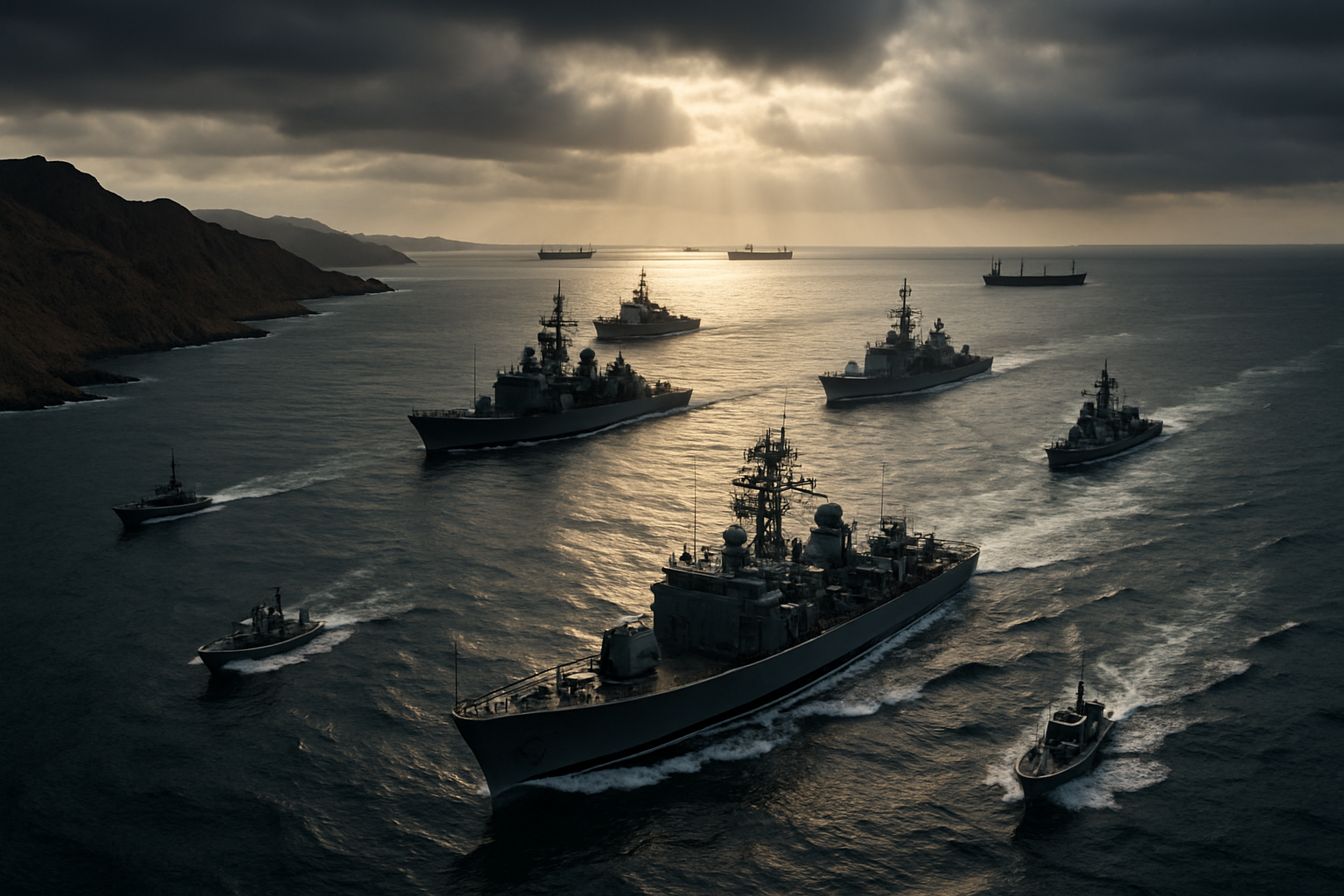
Iran has reimposed strict military control over the Strait of Hormuz, blocking maritime traffic and opening fire on merchant ships in the strategic waterway that handles 40% of global oil transit, escalating dangerous tensions with the United States just hours after briefly reopening the vital shipping corridor.
The Islamic Revolutionary Guard Corps (IRGC) announced Saturday that the 21-mile chokepoint had returned to its "previous status" under complete Iranian military supervision, citing what Tehran described as continued US violations of agreements and acts of "piracy" through an ongoing naval blockade of Iranian ports.
At least two merchant vessels reported being struck by gunfire as they attempted to cross the strait on Saturday, according to three maritime security and shipping sources. The UK Maritime Trade Operations (UKMTO) confirmed that a tanker's master reported being approached by two IRGC gunboats without radio challenge before shots were fired approximately 20 nautical miles northeast of Oman.
Brief Reopening Quickly Reversed
Earlier Saturday, maritime trackers had recorded a convoy of eight oil tankers transiting the strait — the first significant movement of commercial vessels since the US-Israeli war on Iran began seven weeks ago. The movement followed Friday's announcement by Iranian Foreign Minister Abbas Araghchi that the waterway was "completely open" for commercial traffic during a ceasefire in Lebanon.
However, within hours of the announcement, Iran's armed forces command reversed course. IRGC joint command stated in a statement carried by Tasnim news agency that the strait would remain under "strict management and control" until the United States restores "full freedom of movement" for vessels traveling to and from Iranian ports.
"The situation in the Strait of Hormuz will remain tightly controlled until the United States restores full freedom of movement for vessels traveling to and from Iran."
— IRGC Joint Command Statement
US-Iran Diplomatic Tensions Escalate
The renewed closure comes as diplomatic efforts between Washington and Tehran remain deadlocked over Iran's nuclear program and regional conflicts. Recent Pakistan-mediated peace talks in Islamabad collapsed after 21 hours of marathon negotiations led by US Vice President JD Vance, with the primary sticking point being Iran's uranium enrichment program.
Iran currently maintains uranium enrichment at 60% purity, significantly above the 3.67% limit set by the 2015 Joint Comprehensive Plan of Action (JCPOA), and possesses over 400 kilograms of weapons-grade material. US demands for Iran to suspend enrichment and abandon its weapons-grade stockpile were rejected by Iranian negotiators, with Foreign Minister Araghchi stating Iran would "never abandon enrichment even if war is imposed."
President Donald Trump responded to the latest developments by warning that Iran "can't blackmail us" with control of the strait. The US maintains a naval blockade of Iranian ports, which Trump has declared will remain "in full force" until a comprehensive agreement is reached that includes Iran's nuclear program, ballistic missile capabilities, and support for regional armed groups.
Global Economic Impact
The Strait of Hormuz is one of the world's most critical energy chokepoints, with approximately one-fifth of global petroleum liquids and natural gas transit passing through the narrow waterway. The repeated closures have sent shockwaves through international energy markets, with oil prices surging above $100 per barrel during previous phases of the crisis.
Major shipping companies including Maersk and MSC had previously suspended operations in the Persian Gulf, leaving over 150 tankers stranded with billions of dollars worth of cargo. The International Energy Agency has maintained the largest strategic petroleum reserve release in its 50-year history, coordinating the release of 400 million barrels from 32 countries to stabilize global markets.
The aviation industry has also been severely impacted, with over 18,000 flights cancelled during previous escalations, creating COVID-scale disruption to international air travel. Dubai International Airport, a major global hub, has faced repeated closures due to missile and drone attacks.
Regional Coalition Under Strain
An unprecedented coalition of Middle Eastern powers — including Saudi Arabia, the UAE, Qatar, and Egypt — has been backing diplomatic efforts to resolve the crisis. However, the latest escalation threatens to strain this remarkable consensus as Iran's Operation True Promise 4 retaliation campaign has resulted in casualties across the region.
The UAE reported one death in Abu Dhabi, Kuwait saw 32 people injured in airport strikes, and Qatar suffered 8 casualties despite intercepting 65 missiles and 12 drones using Patriot defense systems. Egyptian President Abdel Fattah el-Sisi has warned of "comprehensive chaos affecting sisterly countries" if diplomatic solutions fail.
European Security Implications
The conflict has expanded beyond the Middle East, with Iranian drones striking RAF Akrotiri in Cyprus — marking the first attack on European territory since World War II. The European Union has activated its ESTIA crisis mechanism for the first time in the bloc's history, while a multinational naval coalition including British, Spanish, Italian, French, Dutch, and Greek vessels has been deployed.
British Prime Minister Keir Starmer announced plans for a UK-France-led multinational mission to protect maritime navigation, describing it as "strictly peaceful and defensive" to reassure commercial shipping and support mine clearance efforts once conditions allow.
Nuclear Governance Crisis Context
The current crisis unfolds against the backdrop of a broader nuclear governance breakdown. The New START treaty between the US and Russia expired in February 2026, marking the first time in over 50 years without nuclear arms control constraints between the superpowers. China is simultaneously expanding its nuclear arsenal from 350 to over 500 warheads.
UN Secretary-General António Guterres has warned that nuclear risks are at their "highest in decades," calling the current situation the "greatest test of multilateral cooperation in the modern era." Intelligence assessments confirm that Iran possesses sufficient enriched uranium to manufacture multiple nuclear weapons if it chooses to weaponize its program.
Congressional and International Opposition
President Trump faces unprecedented domestic opposition to military operations, with only 25% of Americans supporting the current approach according to recent polls. Senator Richard Blumenthal expressed being "more concerned than ever" about potential ground troop deployments, while Operation Epic Fury has already cost $11.3 billion in its first week.
International allies have largely refused to support broader US military action. UK Prime Minister Starmer declared Britain would "not be dragged into an Iran war," while France, Germany, and other European allies have called for diplomatic approaches and distanced themselves from military solutions.
Humanitarian Crisis Mounting
The conflict has created a significant humanitarian crisis, with the Iranian Red Crescent reporting over 787 civilian casualties. The Pentagon has acknowledged responsibility for an elementary school strike that killed between 165-185 students due to what officials described as "outdated targeting data," prompting war crimes investigations.
International evacuations are occurring on a scale reminiscent of the Arab Spring, with Australia reporting 115,000 nationals trapped in the region and Germany evacuating 30,000 citizens. The humanitarian toll continues to mount as diplomatic solutions remain elusive.
Looking Ahead
The repeated opening and closing of the Strait of Hormuz represents what analysts describe as Iranian leverage tactics ahead of potential renewed negotiations. Chinese foreign policy experts suggest Tehran is using control of the waterway to strengthen its position before possible talks, though the likelihood of imposing tolls on shipping remains low.
With negotiations scheduled to continue in Islamabad under Pakistani mediation, both sides face mounting pressure to find innovative diplomatic solutions to bridge decade-old disagreements over nuclear issues, regional conflicts, and sanctions relief. The stakes remain enormous — affecting global energy security, nuclear proliferation prevention, and the credibility of diplomatic solutions in resolving 21st-century international crises.
As Supreme Leader Mojtaba Khamenei warned that Iran's navy is ready to inflict "new bitter defeats" on its enemies, the world watches to see whether diplomatic innovation can ultimately triumph or whether military confrontation will reshape international relations for decades to come.