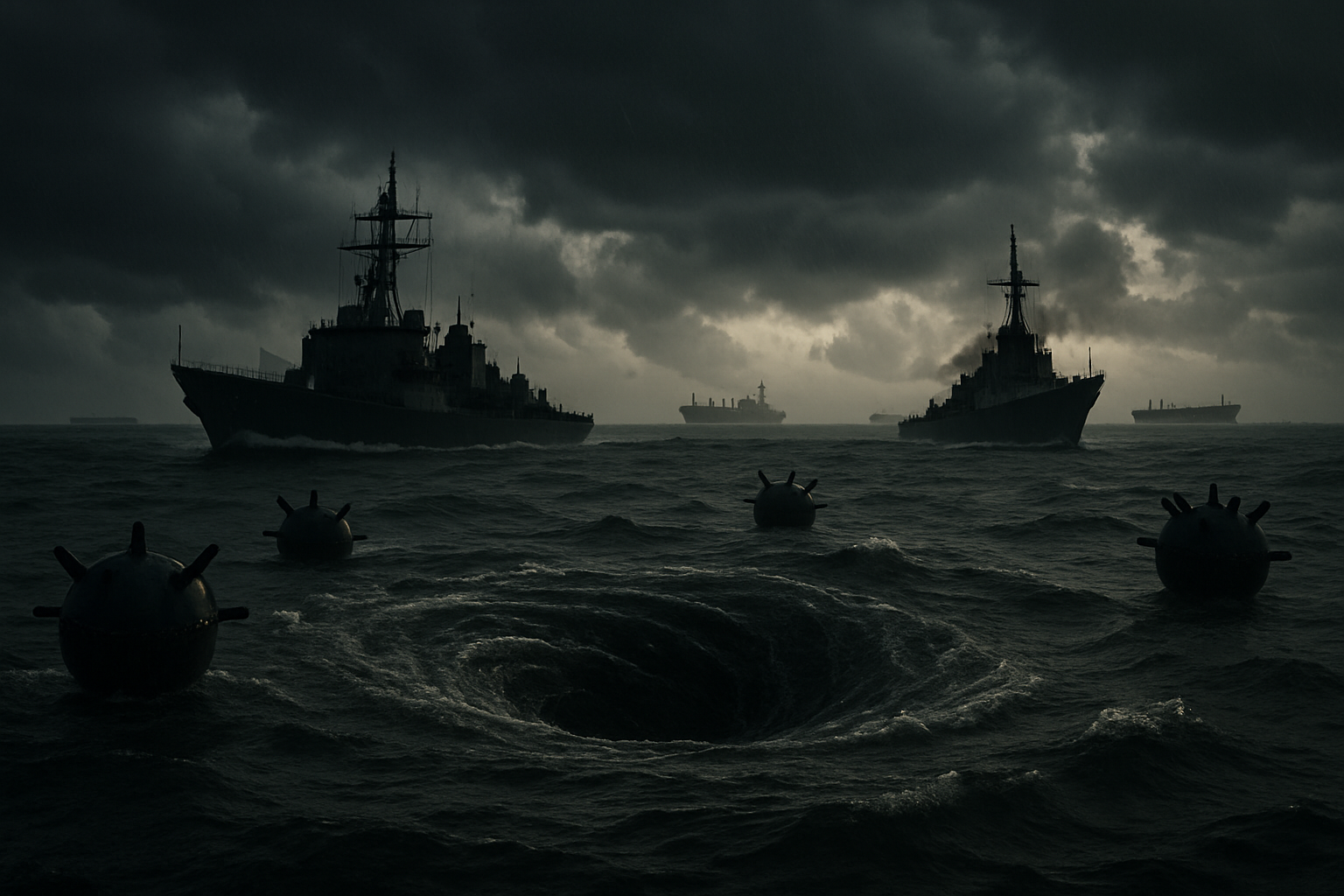
Iran's Revolutionary Guards have issued their most ominous maritime threat yet, warning they will trap enemy vessels in a "deadly whirlpool" if military ships approach the strategic Strait of Hormuz, as President Trump orders an immediate US Navy blockade following the collapse of Pakistan-mediated peace talks.
The dramatic escalation comes just hours after Trump announced that "any Iranian who fires at us, or at peaceful vessels, will be BLOWN TO HELL!" while declaring an immediate naval blockade of the Strait of Hormuz - a move generally considered an act of war under international law.
Revolutionary Guards Issue Maritime Death Threat
Speaking through official channels, Iran's Islamic Revolutionary Guard Corps (IRGC) declared they maintain "complete control" over all traffic through the critical 21-mile waterway that handles 40% of global oil transit. The Guards warned that any enemy vessels making "wrong moves" would find themselves trapped in what they described as a "deadly whirlpool."
Multiple international sources confirm the Revolutionary Guards have deployed between 2,000-6,000 naval mines throughout the strait since March, effectively turning the strategic chokepoint into a maritime death trap. The IRGC maintains their forces have the capability to create swirling water patterns using specialized naval tactics that could disable or destroy approaching enemy vessels.
"The enemy will find themselves trapped in a deadly whirlpool if they dare approach our territorial waters. We have complete control over every movement in these waters."
— IRGC Naval Command, Fars News Agency
Trump Orders Naval Blockade After Diplomatic Collapse
The Iranian threats follow Trump's announcement of an immediate US Navy blockade after 21 hours of marathon negotiations in Islamabad ended in failure. The talks, mediated by Pakistani Prime Minister Shehbaz Sharif and Field Marshal Asim Munir, had achieved a temporary ceasefire just 88 minutes before Trump's previous "whole civilization will die tonight" deadline on April 8.
Vice President JD Vance, who led the US delegation, declared the failure to reach a lasting agreement after what sources describe as the most direct US-Iran diplomatic engagement since the 1979 Revolution. The primary sticking point remained Iran's nuclear program, with the US demanding commitment against nuclear weapons development while Iran maintained its right to 60% uranium enrichment with over 400kg of weapons-grade material.
A critical factor in the talks' collapse was what Vance acknowledged as a "legitimate misunderstanding" regarding Lebanon. Netanyahu's explicit exclusion of Lebanon from the ceasefire framework created fundamental disagreement, with Israeli strikes killing 254+ people in a single day during negotiations while 1.2 million Lebanese remained displaced.
Global Energy Crisis Resurges
The renewed confrontation has immediately reignited the global energy crisis that had briefly subsided during the ceasefire. Oil futures are climbing back toward the $119+ per barrel levels seen during the peak of the conflict, when Brent crude reached historic highs and the International Energy Agency deployed its largest-ever strategic reserve release of 400 million barrels from 32 countries.
Iran's cryptocurrency payment system, charging vessels $1 per barrel to transit the strait under their "coordination," continues to operate despite international sanctions. This system affects the 21-mile chokepoint that handles not just oil but also liquefied natural gas exports, manufacturing supply chains, and shipping routes connecting Asia-Europe trade.
Major shipping companies Maersk and MSC, which had begun preparing to resume operations in the Persian Gulf, are now reassessing their positions as over 150 tankers carrying billions in cargo remain stranded in the region.
Military Confrontation Escalates
The failed diplomatic breakthrough represents a devastating setback after what UN Secretary-General António Guterres called "the greatest test of multilateral cooperation in the modern era." The conflict, which began in February with Operation Epic Fury - the largest US military operation since 2003 - has already cost over $11.3 billion in its first week alone.
During the previous phase of fighting, Iran deployed what military analysts describe as the most sophisticated maritime mining operation in decades. US forces destroyed 16 Iranian mine-laying vessels while the USS Charlotte submarine achieved the first enemy vessel kill by a US submarine since World War II, sinking the Iranian frigate IRIS Dena off Sri Lanka.
The Iranian threats of a "deadly whirlpool" appear to reference both their extensive mining capabilities and potential tactical use of naval vessels to create dangerous water conditions for approaching ships. Intelligence sources suggest Iran has developed specialized techniques for manipulating water flow patterns in the narrow strait.
Regional Coalition Under Pressure
The collapse of negotiations has severely strained the unprecedented regional coalition of Saudi Arabia, UAE, Qatar, and Egypt that had supported diplomatic efforts. During the previous conflict phase, Iranian retaliation directly targeted coalition member territories - killing one civilian in Abu Dhabi, injuring 32 at Kuwait's airport, and wounding 8 in Qatar despite Patriot missile systems intercepting 65 Iranian missiles and 12 drones.
Egyptian President Abdel Fattah el-Sisi's warning of "comprehensive chaos" spreading to "sisterly Arab countries" now appears prophetic as the coalition faces the choice between continued support for US military action or accommodation with Iranian regional influence.
Nuclear Implications Loom Large
The diplomatic failure occurs against the backdrop of Iran's continued nuclear advancement, with the country maintaining uranium enrichment at 60% purity - approaching the 90% weapons-grade threshold. Former IAEA inspector Dr. Yusri Abu Shadi confirms Iran possesses over 400kg of enriched uranium, making nuclear weapons capability "easily achievable."
The crisis unfolds as the New START treaty between the US and Russia expired in February 2026, creating the first 50+ year period without nuclear constraints between the superpowers. This broader nuclear governance crisis adds urgency to preventing Iran's potential weaponization of its nuclear program.
Congressional Opposition Mounts
The resumption of military confrontation faces unprecedented domestic opposition, with only 25% of Americans supporting continued military operations - described by analysts as "almost unprecedented" unpopularity for early-stage military operations. Senator Richard Blumenthal has expressed being "more concerned than ever" about potential ground troop deployment, while Pentagon operations are planned through September, far beyond the initial 4-6 week timeline.
The financial cost has become what analysts call the "ultimate constraint" on escalation, with Operation Epic Fury running at approximately $1 billion daily. Stock markets from Pakistan to South Korea have experienced historic crashes, while the global supply chain disruption has affected industries from automotive to electronics worldwide.
Aviation Crisis Returns
The renewed crisis threatens to restart the aviation nightmare that saw over 18,000 flights cancelled during the peak conflict - the most severe disruption since COVID-19. Dubai International Airport, the world's busiest with 86 million passengers annually, had just begun recovery efforts after being shut down by missile damage.
Eight Middle Eastern countries had maintained simultaneous airspace closures during the conflict, creating what aviation experts termed an "aviation black hole" that severed Europe-Asia flight corridors and affected hundreds of thousands of passengers globally.
European Security Implications
The crisis carries particular significance for European security after Iranian drones struck RAF Akrotiri in Cyprus - the first attack on European territory since World War II. This unprecedented escalation prompted a multinational naval coalition including HMS Dragon and vessels from Spain, Italy, France, Netherlands, and Greece.
The European Union's activation of the ESTIA crisis mechanism for Cyprus evacuation marked the first time in the bloc's history that such measures were necessary, demonstrating how the Middle Eastern conflict directly impacts European security architecture.
Template-Setting Crisis for 21st Century
Military and diplomatic analysts view the current standoff as a template-setting moment for 21st-century international crisis management. The rapid transition from diplomatic breakthrough to military confrontation demonstrates what experts call "multipolar era fragility" in crisis resolution mechanisms.
Pakistan's mediation effort, while ultimately unsuccessful, provided a framework for how middle powers can bridge major adversary divides when traditional diplomatic mechanisms fail. The "message relay system" developed by Islamabad represents an innovation in diplomatic engagement that may influence future crisis management approaches.
The stakes extend far beyond the immediate regional confrontation, affecting global energy security, nuclear governance credibility, international law enforcement, and post-World War II order principles. Success in containing the crisis could provide a diplomatic template for future nuclear disputes, while failure may accelerate military solutions and undermine diplomatic credibility worldwide.
Uncertain Path Forward
As Iranian forces prepare their "deadly whirlpool" tactics and US naval vessels move into position for the blockade, the world faces the resumption of the most dangerous international crisis since the Cold War's end. The narrow two-week window that provided hope for innovative diplomatic solutions has closed, leaving military confrontation as the primary mechanism for resolving fundamental disagreements that have persisted for decades.
The international community watches anxiously as two powers with massive military capabilities and irreconcilable positions edge toward a confrontation that could reshape global energy markets, nuclear governance frameworks, and the fundamental principles of international relations for decades to come.
With Iran's Revolutionary Guards promising that enemy vessels will be "trapped in a deadly whirlpool" and Trump declaring that Iranian forces will be "blown to hell," the stage is set for a maritime confrontation that could determine whether diplomatic innovation or military force becomes the preferred template for resolving 21st-century international crises.