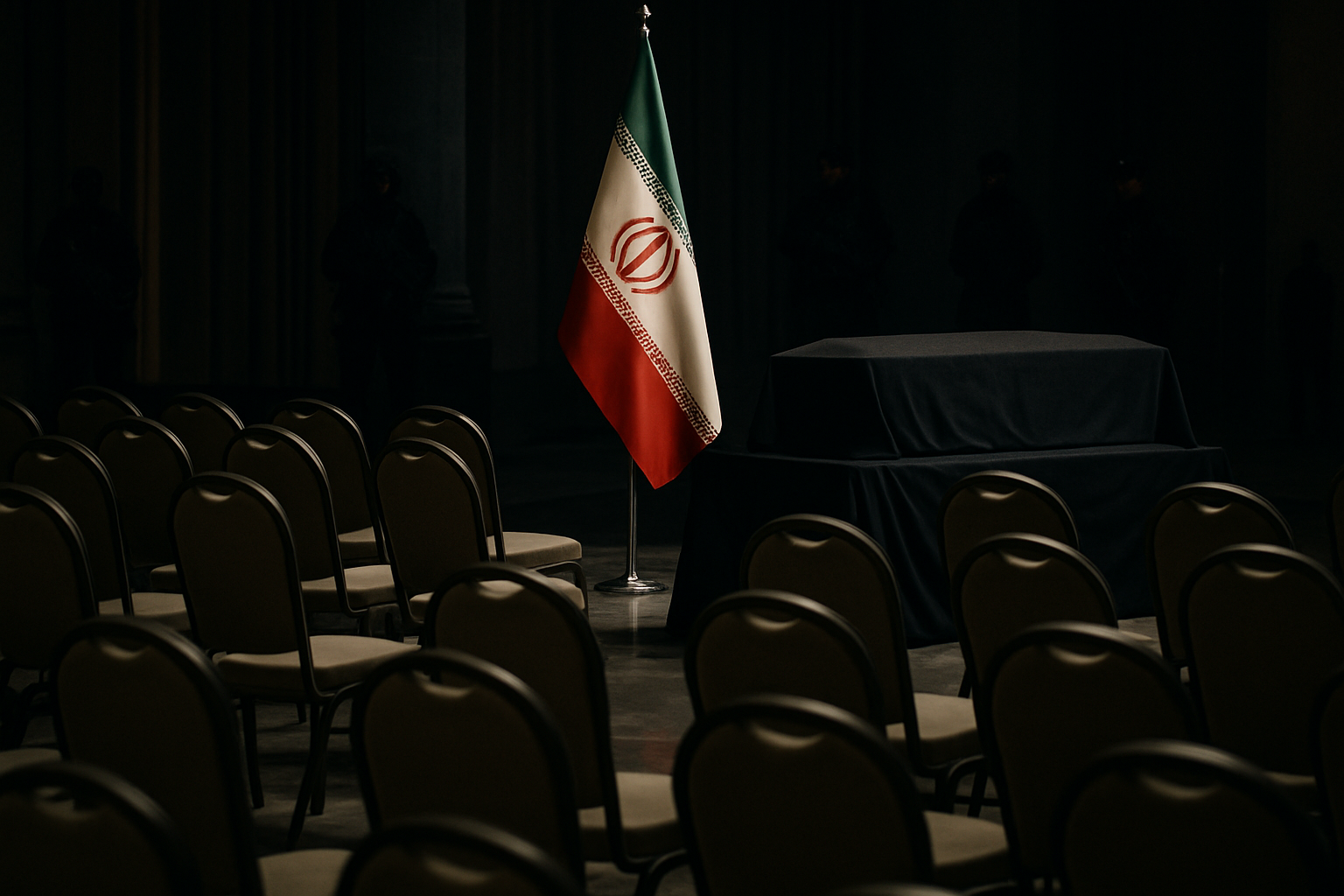
Iran has indefinitely postponed the planned state funeral ceremony for Supreme Leader Ayatollah Ali Khamenei, citing overwhelming security concerns and unprecedented attendance expectations amid the most dangerous Middle Eastern crisis since the Cold War.
The postponement announcement came through state-affiliated Tasnim news agency, marking an extraordinary development as Iran grapples with the aftermath of Operation Epic Fury - the largest coordinated US-Israeli military operation since 2003 - which killed the 86-year-old leader along with his daughter, son-in-law, and granddaughter on March 1, 2026.
Security Concerns Drive Delay Decision
Originally scheduled to begin at 10pm local time at Tehran's Imam Khomeini Prayer Hall and continue for three days, the ceremony faced insurmountable logistical and security challenges. Hojjatoleslam Mahmoudi, head of Iran's Islamic Propagation Council, had urged citizens to attend in large numbers to pay their respects to the leader who ruled Iran for 37 years.
However, state television later announced the proceedings were being delayed "due to the expected unprecedented presence of mourners," with officials acknowledging that security risks were also a major consideration. With millions expected to attend - comparable to the estimated 10 million who mourned Ayatollah Ruhollah Khomeini's death in 1989 - authorities face the daunting prospect of protecting mourners amid escalating regional hostilities.
Unprecedented Regional Crisis Context
The funeral delay occurs against the backdrop of Operation True Promise 4, Iran's massive retaliatory campaign launched by the Revolutionary Guard following Khamenei's death. The IRGC has declared "no red lines remain," targeting US and Israeli assets across the Middle East and causing casualties in multiple Gulf states.
Regional casualties from Iranian retaliation include one civilian killed in Abu Dhabi, 32 foreign nationals injured in Kuwait airport drone strikes, eight people wounded in Qatar despite successful Patriot missile interceptions, and devastating strikes that completely shut down Dubai International Airport - the world's busiest aviation hub.
Global Crisis Implications
The security concerns surrounding Khamenei's funeral reflect broader implications of the most serious international crisis since the Cold War ended. Over 18,000 flights have been cancelled worldwide as eight Middle Eastern countries simultaneously closed their airspace, creating the most extensive aviation disruption since COVID-19.
"This represents the most dangerous moment since the Cold War end, testing regional war prevention, global energy security, and nuclear governance credibility all simultaneously."
— International Relations Analyst
Oil prices have surged 10% to over $80 per barrel as Iran declared the Strait of Hormuz - through which 40% of global seaborne oil transits - "unsafe" for shipping. Major carriers including Maersk and MSC have suspended operations, leaving over 150 tankers anchored in the Persian Gulf with billions of dollars in stranded cargo.
Constitutional Succession Crisis
Iran has activated its constitutional succession protocols, establishing a three-member transitional council comprising President Masoud Pezeshkian, judiciary head Gholamhossein Mohseni Ejei, and Guardian Council jurist Ayatollah Alireza Arafi. The Assembly of Experts - 88 senior clerics - must now select a permanent successor during active military operations.
Intelligence assessments suggest a Revolutionary Guards member is likely to be chosen as the next Supreme Leader, indicating a potential shift toward hardline military influence in Iranian governance. Early reports suggest Mojtaba Khamenei, the deceased leader's son, has emerged as a favored candidate, which would represent the first hereditary succession in the Islamic Republic's 47-year history.
International Response and Diplomacy Collapse
The funeral postponement comes amid complete nuclear diplomacy collapse, despite recent breakthrough progress in Geneva talks that achieved "broad agreement on guiding principles" - the most significant progress since the 2018 JCPOA collapse. However, fundamental disagreements proved insurmountable, with Iran excluding ballistic missiles and proxy relationships as "red lines" while the US demanded comprehensive agreements including missiles, armed groups, and human rights.
UN Security Council emergency sessions have been convened, with Secretary-General António Guterres warning of "serious threats to international peace and security." Russia has condemned what it calls "reckless actions by Washington and West Jerusalem," while China issued its strongest condemnation in years, calling the strikes a "serious violation of Iran's sovereignty."
Energy Security and Global Economic Impact
The crisis has exposed critical vulnerabilities in global energy architecture, with Iran's control over the Strait of Hormuz representing a single chokepoint affecting worldwide oil supplies. Natural gas prices have surged 24% in Europe and 78% in the United States, while Qatar has halted LNG production following Iranian infrastructure strikes.
Stock markets have crashed globally, with Pakistan's KSE-100 recording its largest single-day decline in history at -8.97%. The interconnected nature of modern trade networks has meant that a regional crisis is now affecting supply chains, aviation networks, and energy markets worldwide.
Historical Significance and Future Implications
The postponement of Khamenei's funeral represents more than a logistical challenge - it symbolizes the broader transformation of Middle Eastern geopolitics and the end of an era that began with the 1979 Islamic Revolution. Khamenei's 37-year rule transformed Iran into a regional anti-US power with an extensive proxy network spanning from Lebanon to Yemen.
The crisis marks a template-setting moment for 21st-century international relations, demonstrating how rapidly diplomatic frameworks can collapse into military confrontation in the multipolar era. The success or failure of containing this escalation will influence international approaches to conflict resolution for decades to come.
Regional Coalition Under Strain
The unprecedented coalition of Saudi Arabia, UAE, Qatar, and Egypt that had supported diplomatic engagement with Iran now faces severe strain as Iranian retaliation targets member territories. Egyptian President Abdel Fattah al-Sisi condemned attacks on "sisterly Arab countries," warning of "comprehensive chaos" if the crisis continues to escalate.
Multiple nations have ordered immediate embassy evacuations, with Sweden and Serbia citing "extremely uncertain" security conditions in Iran. The US has authorized departure of non-essential personnel from 15 Middle Eastern countries, reflecting the breadth of the security crisis.
Nuclear Governance Crisis
The funeral delay occurs within a broader context of nuclear governance breakdown, coming after the New START treaty expired on February 5 - the first time in over 50 years that the United States and Russia have operated without nuclear arms constraints. Combined with China's nuclear expansion and Iran's continued uranium enrichment at 60% purity (approaching weapons-grade), UN officials warn that nuclear risks are at their "highest in decades."
Iran's nuclear program continues to advance with over 400 kilograms of enriched uranium - sufficient material for multiple weapons if further processed. The collapse of diplomatic engagement raises fundamental questions about the viability of negotiated solutions to modern nuclear crises.
As Iran struggles to balance mourning its longest-serving leader with managing an unprecedented regional crisis, the postponed funeral ceremony has become a symbol of how rapidly geopolitical events can disrupt even the most fundamental state functions. The coming days will prove decisive in determining whether this crisis can be contained or will escalate into the broader Middle Eastern war that many analysts now fear is becoming inevitable.