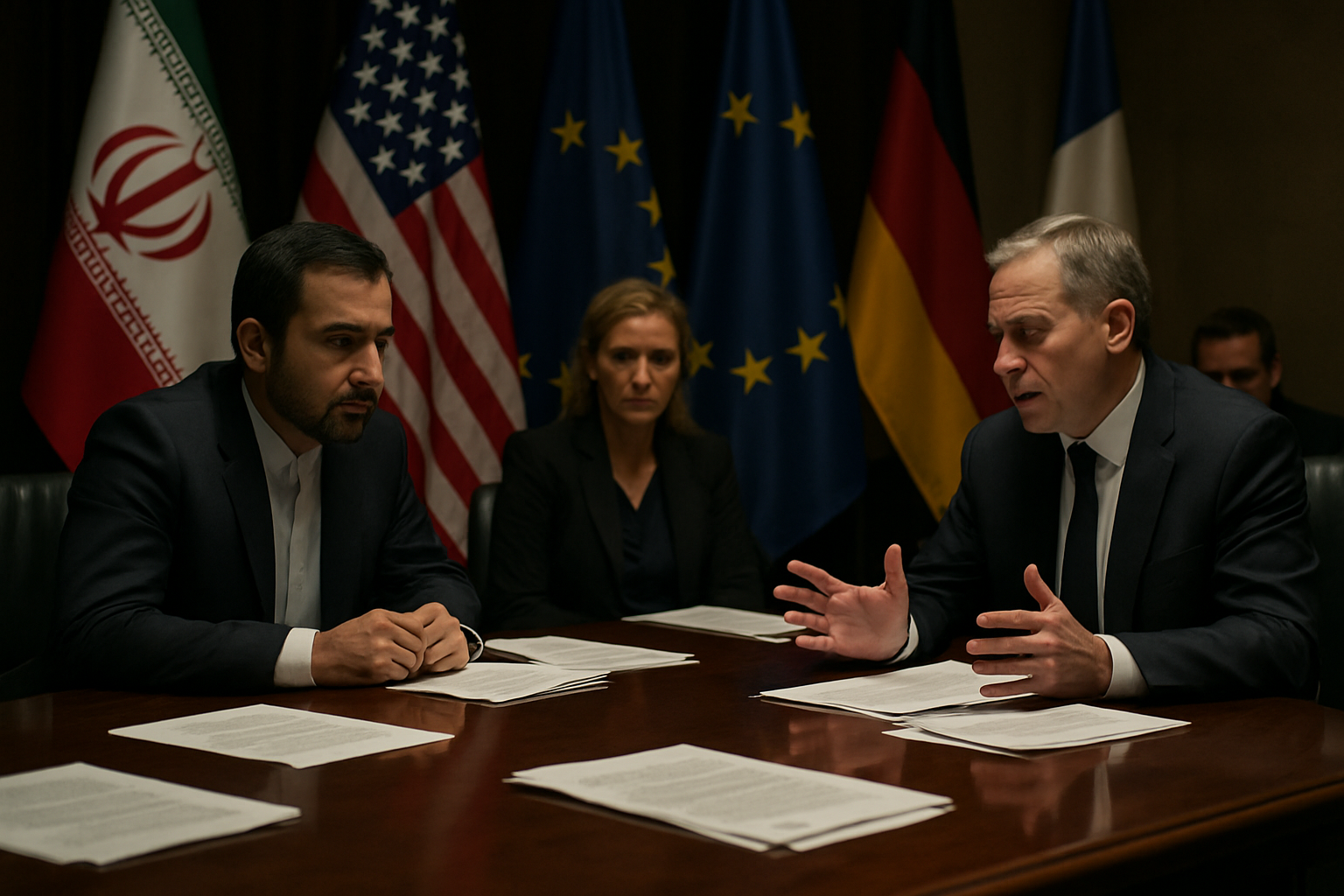
Iran's Foreign Ministry on Wednesday dismissed President Donald Trump's claims about the Islamic Republic's nuclear and missile programs as "big lies," delivering a sharp rebuke hours after the US leader's State of the Union address that vowed to prevent Iran from acquiring nuclear weapons.
Foreign Ministry spokesman Esmaeil Baqaei posted on X that "everything they claim about Iran's nuclear program, Iranian ballistic missiles, and the number of casualties during January disturbances is nothing but the repetition of big lies." The statement came in direct response to Trump's Tuesday night speech to Congress, where he declared the US would "never allow the world's number one sponsor of terrorism to have a nuclear weapon."
Trump's Escalating Rhetoric and Military Deployment
During his State of the Union address, Trump made some of his most explicit anti-Iran statements since returning to office, describing Iran as the "world's number one sponsor of terror" while vowing to prevent nuclear weapons acquisition. The president also claimed that Iran had "killed 32,000 protesters in recent unrest," a figure that Iran's Foreign Ministry strongly disputes.
Trump further alleged that Iran has "already developed missiles that can threaten Europe and our bases overseas, and they're working to build missiles that will soon reach the United States of America." These claims represent a significant escalation in rhetoric from previous diplomatic engagements.

Unprecedented Military Buildup in the Persian Gulf
The war of words comes against the backdrop of the largest US naval presence in the Middle East in years. The Pentagon has deployed dual aircraft carriers - the USS Gerald R. Ford and USS Abraham Lincoln - creating an unprecedented military buildup approximately 800 kilometers from Iran's coast. This represents roughly one-third of the US Navy's active fleet concentrated in the Arabian Sea.
Recent military incidents have heightened tensions further. An F-35C fighter jet from the USS Abraham Lincoln shot down an Iranian Shahed-139 drone after it approached the carrier group aggressively. Separately, Iran's Revolutionary Guard Corps (IRGC) vessels have harassed US-flagged tankers in the strategically vital Strait of Hormuz, through which 40% of global oil transit passes.
Oil prices rose over $1 per barrel following these incidents, demonstrating the global economic implications of the escalating tensions.
Nuclear Negotiations Continue Despite Tensions
Paradoxically, diplomatic efforts continue even as rhetoric and military posturing intensify. Recent nuclear negotiations in Geneva, mediated by Oman and supported by Switzerland, have achieved what Iranian Foreign Minister Abbas Araghchi called "broad agreement on guiding principles" - the most significant diplomatic progress since the Joint Comprehensive Plan of Action (JCPOA) collapsed in 2018.
However, fundamental disagreements persist over the scope of any potential agreement. Iran maintains that ballistic missiles and regional proxy activities are "red lines" that must be excluded from nuclear-only talks. The US, led by Secretary of State Marco Rubio, insists that any comprehensive agreement must address missiles, armed groups, and human rights issues.
"Iran maintains ballistic missiles and regional proxy activities are 'red lines' that must be excluded from nuclear-only talks."
— Iranian diplomatic position
Nuclear Program Status Remains Critical
Iran continues to enrich uranium at 60% purity, far exceeding the 3.67% limit established in the original JCPOA and approaching the 90% threshold required for weapons-grade material. Former IAEA inspector Dr. Yusri Abu Shadi confirms that Iran possesses over 400 kilograms of uranium enriched to 60%, making nuclear weapons capability "easily achievable" if Iran chooses to weaponize.
Intelligence assessments suggest Iran has sufficient enriched uranium for multiple weapons if it decides to proceed with weaponization, creating unprecedented urgency for diplomatic resolution. Despite ongoing negotiations, Iranian officials have maintained their position that uranium enrichment is an "inalienable right" that they will "never abandon even if war is imposed."
Verification Challenges
Any future agreement would face unprecedented verification challenges. Iran's nuclear infrastructure has significantly expanded since 2018, featuring advanced centrifuge technology and sophisticated facilities that would require monitoring mechanisms far exceeding the original JCPOA's complexity. The International Atomic Energy Agency (IAEA) suspended inspections in November 2025, further complicating oversight efforts.
Regional Coalition Seeks Diplomatic Solution
Despite the escalating tensions, an unprecedented regional coalition comprising Saudi Arabia, the UAE, Qatar, and Egypt continues to support diplomatic engagement. This extraordinary Middle Eastern consensus reflects shared concerns about preventing military confrontation that could destabilize the Persian Gulf and global energy markets.
Oman has played a crucial mediating role, leveraging its historical neutrality and experience from the 2015 JCPOA negotiations. The sultanate's continued facilitation has proven essential for maintaining structured dialogue despite deep mutual distrust and military tensions.
Domestic Pressures on Both Sides
Iran faces severe domestic challenges, with over 42,000 arrests since the 2022 uprising and continued civil society suppression. The regime appears to prioritize nuclear capabilities over economic relief, despite sanctions creating a survival crisis. Nobel Peace Prize laureate Narges Mohammadi received an additional 7.5-year prison sentence during the nuclear talks, demonstrating the government's priorities regarding domestic control.
On the American side, President Trump must balance Republican hawks who view diplomatic engagement as appeasement against the need for foreign policy achievements. Israeli Prime Minister Benjamin Netanyahu has coordinated closely with Trump, emphasizing that any agreement must include "limiting ballistic missiles and ending Iranian axis support" - requirements that go well beyond nuclear issues.
Global Nuclear Governance at Critical Juncture
The Iran nuclear crisis unfolds against a broader breakdown in global nuclear governance. The New START treaty between the US and Russia expired on February 5, 2026 - the first time in over 50 years without nuclear constraints between the superpowers. China's nuclear expansion and UN Secretary-General António Guterres' warning that nuclear risks are at their "highest in decades" underscore the stakes.
Success in resolving the Iran crisis could provide a template for 21st-century nuclear diplomacy. Failure might accelerate military solutions that could reshape Middle Eastern geopolitics for decades while encouraging nuclear proliferation elsewhere and undermining diplomatic credibility for international disputes.
Economic and Strategic Implications
The economic implications extend far beyond the Middle East. Natural gas prices have increased 24% in Europe and 78% in the US amid geopolitical pressures. Iran has positioned potential agreements as offering "trillion-dollar opportunities" in energy and mining sectors for US companies, framing commercial incentives alongside security arrangements.
The strategic stakes are maximum: regional war prevention, nuclear governance credibility, and the establishment of diplomatic precedents for international conflict resolution in the multipolar era. The outcome will influence global approaches to territorial and security disputes far beyond the current crisis.
Looking Ahead: A Decisive Moment
As diplomatic efforts continue through Geneva talks while military tensions escalate, the coming weeks represent a template-setting moment for diplomacy versus military confrontation. Framework progress has been achieved despite fundamental positions remaining unchanged from decade-old challenges.
The critical test is whether innovative compromise solutions can bridge longstanding disagreements about uranium enrichment, verification mechanisms, sanctions relief, and negotiation scope. The alternative - military confrontation acceleration - could affect regional stability, global nuclear governance, and international law enforcement mechanisms for generations.
With Iran dismissing Trump's claims as propaganda while maintaining its nuclear program, and the US deploying unprecedented military force while pursuing diplomatic engagement, the world watches to see whether 21st-century nuclear crises can be resolved through negotiation or whether military solutions will prevail in shaping the future of Middle Eastern geopolitics.