Iran's Revolutionary Guard claimed responsibility for shooting down two US military aircraft on Friday, marking the first confirmed American warplane losses in the escalating five-week Middle East conflict that has become the most dangerous international crisis since the Cold War.
The incidents involved an F-15E Strike Eagle fighter jet shot down over southwestern Iranian territory and an A-10 Warthog attack aircraft that crashed in Persian Gulf waters near the Strait of Hormuz. Iranian officials released debris photos and videos as evidence of the downings, representing a major symbolic and tactical victory against American air superiority in the region.
Critical Rescue Operations Underway
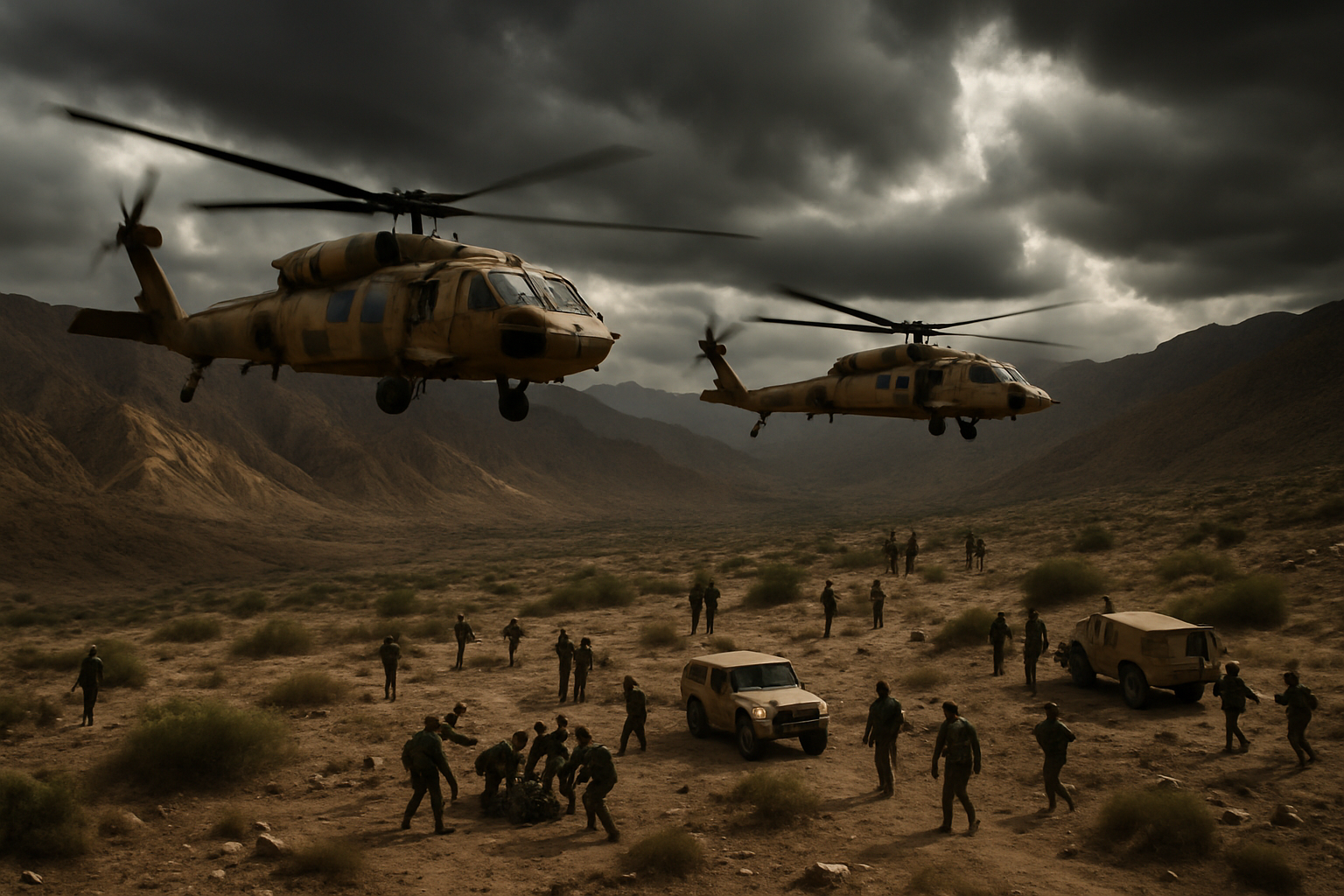
One crew member from the F-15E Strike Eagle has been successfully rescued by US Air Force Black Hawk helicopters, while a second pilot remains missing with intensive search-and-rescue operations ongoing. The missing aircrew member is reported to be a weapons systems officer, with Iranian forces conducting "comprehensive field operations" to locate the American pilot.
The situation has become increasingly perilous as Iranian forces have been firing at low-flying US helicopters conducting search operations, marking some of the most direct military engagement between US and Iranian forces in decades. Two additional Black Hawk helicopters involved in the rescue mission sustained damage from ground fire, with crew members wounded.
"The pilot of the A-10 aircraft was successfully located and evacuated safely with no serious injuries,"
— US Military Officials, speaking on condition of anonymity
Context of Escalating Conflict
The aircraft losses occur within the broader context of Operation Epic Fury, the largest coordinated US-Israeli military campaign since the 2003 Iraq invasion. The conflict began February 28, 2026, following the complete collapse of nuclear negotiations in Geneva, despite what diplomats described as "broad agreement on guiding principles" - the most progress since the 2018 JCPOA breakdown.
The war dramatically escalated on March 1 when Israeli and US forces killed Iran's Supreme Leader Ali Khamenei, ending his 37-year rule and triggering massive Iranian retaliation under "Operation True Promise 4," with Revolutionary Guards declaring "no red lines remain."
Iran's current Supreme Leader, Mojtaba Khamenei - the son of the deceased leader - represents the first hereditary succession in the Islamic Republic's 47-year history. This unprecedented transition has consolidated Revolutionary Guard control over Iranian governance, marking a shift from clerical to military leadership during active warfare.
Global Crisis Reaches Peak
The aircraft downings compound an already unprecedented global crisis that has affected international transportation, energy markets, and diplomatic relations worldwide:
- Over 18,000 flights have been cancelled globally - the most extensive disruption since COVID-19
- Eight Middle Eastern countries have simultaneously closed their airspace
- Dubai International Airport, the world's busiest, remains closed due to missile damage
- Oil prices have surged past $100 per barrel as Iran has effectively closed the Strait of Hormuz
- The International Energy Agency has released 400 million barrels from strategic reserves - the largest intervention in the agency's 50-year history
Diplomatic Breakdown and Military Costs
The current crisis emerged from the complete breakdown of nuclear diplomacy despite February's Geneva breakthrough. Iran maintained that ballistic missiles and regional proxies were "red lines" to be excluded from nuclear-only talks, while the US demanded comprehensive agreements covering missiles, armed groups, and human rights.
Operation Epic Fury has cost $11.3 billion in its first week alone, with Pentagon operations now planned through September - far beyond President Trump's initial 4-6 week timeline. This represents the first confirmed US casualties, with 3 service members killed and over 150 wounded, including 8 in critical condition.
Regional Coalition Under Severe Strain
The conflict has severely tested the unprecedented regional coalition of Saudi Arabia, UAE, Qatar, and Egypt that had been supporting diplomatic solutions. Iranian "Operation True Promise 4" retaliation has directly targeted these nations:
- UAE: 1 civilian killed in Abu Dhabi, Dubai International Airport shut down
- Kuwait: 32 injured in airport strikes
- Qatar: 8 wounded despite intercepting 65 missiles and 12 drones with Patriot systems
- Cyprus: RAF Akrotiri base struck - the first attack on European territory since World War II
"We cannot allow attacks on sisterly Arab countries to spread comprehensive chaos across the region,"
— Egyptian President Abdel Fattah el-Sisi
Congressional Pressure Intensifies
The aircraft losses have intensified already unprecedented Congressional scrutiny of the conflict. Senator Richard Blumenthal stated he is "more concerned than ever" about potential ground troop deployment, while the conflict maintains historically low public support at just 25 percent among Americans.
The financial markets have also shown signs of strain, with Pakistan's KSE-100 index experiencing its largest single-day decline in history at -8.97 percent, while South Korea's KOSPI fell 12 percent, triggering circuit breakers.
Trump Administration Response
President Trump has been briefed on the situation but has not provided immediate operational details for security reasons. His administration has demanded Iran's "unconditional surrender" and has claimed the right to personally choose Iran's next Supreme Leader - the most direct assertion of American control over Iranian affairs since 1979.
Defense Secretary Pete Hegseth has requested a historic $200 billion military appropriation from Congress to continue operations, stating "It takes money to kill bad guys." This would represent the largest military funding request in recent history.
Nuclear Governance Crisis
The crisis unfolds against the backdrop of broader nuclear governance breakdown. The New START treaty expired February 5, 2026 - the first time in over 50 years without US-Russia nuclear constraints. Iran continues uranium enrichment at 60 percent purity with over 400 kilograms of weapons-grade material, sufficient for multiple nuclear weapons.
UN Secretary-General António Guterres has called this "the greatest test of multilateral cooperation in crisis management in the modern era," warning that nuclear risks are at their "highest in decades."
Historical Significance and Global Implications
The shooting down of US aircraft over Iranian territory represents a watershed moment in 21st-century international relations. The crisis demonstrates the rapid transition from diplomatic breakthrough to military confrontation, highlighting what experts call "multipolar era crisis management fragility."
Success in containing this escalation could provide a framework for nuclear crisis resolution in the future, while failure might accelerate military solutions for decades, encouraging proliferation globally and undermining diplomatic credibility worldwide.
The stakes include regional war prevention, global energy security, nuclear governance credibility, and international law enforcement, with post-World War II order principles being tested simultaneously. The outcome will determine precedents for diplomatic versus military solutions in future territorial and nuclear disputes globally.
Humanitarian Impact
The conflict has created a massive humanitarian crisis, with Iran's Red Crescent reporting over 787 civilian casualties from US-Israeli strikes. International evacuations are occurring on a scale not seen since the Arab Spring of 2011, with Australia reporting 115,000 nationals trapped in the region and Germany evacuating 30,000 stranded tourists.
The European Union has activated its ESTIA crisis mechanism for Cyprus for the first time in the bloc's history, while multiple countries have ordered immediate evacuations of their citizens from Iran citing "extremely uncertain" security conditions.
As search and rescue operations continue for the missing American pilot, the international community faces what may be the most consequential crisis since the Cold War, with implications extending decades beyond current events and potentially reshaping the global order for the 21st century.