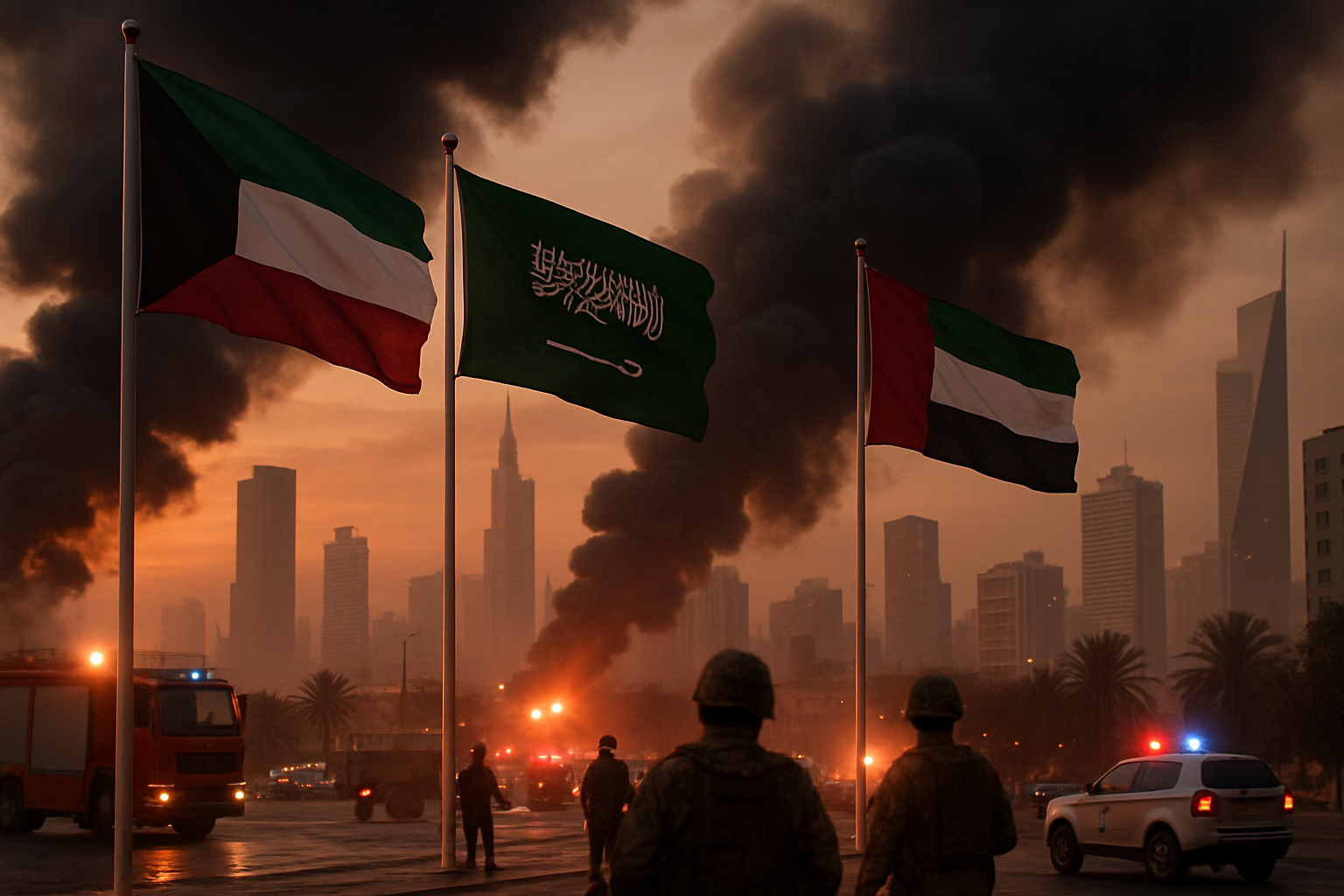
Iran has launched a devastating wave of drone and missile attacks against multiple Gulf Arab states including Kuwait, Saudi Arabia, and the United Arab Emirates, marking the most dangerous escalation in the ongoing Middle East crisis that has now entered its second week.
The Iranian Revolutionary Guard Corps (IRGC) declared that "no red lines remain" as coordinated strikes targeted critical infrastructure across the Gulf region on Sunday, March 8, 2026. The attacks represent a dramatic expansion of Iran's "Operation True Promise 4" retaliation campaign following the confirmed death of Supreme Leader Ali Khamenei in US-Israeli "Operation Epic Fury" strikes.
Multiple Casualties Across Gulf States
Kuwait bore the brunt of the latest attacks, with the country's Ministry of Interior confirming the deaths of two border security personnel during dawn operations. Kuwait International Airport's Terminal 1 was struck by Iranian drones, sparking fires at fuel tanks belonging to the Kuwait Aviation Fueling Company (KAFCO). While no casualties were reported at the airport, multiple employees sustained injuries in the coordinated strike.
Saudi Arabia's Ministry of Defense reported that air defense systems successfully intercepted multiple drone attacks targeting Riyadh, including attempts to strike the Diplomatic Quarter housing foreign embassies. Additional drones were destroyed while attempting to target the Shaybah oil field, marking the second attack on Saudi diplomatic facilities since the crisis began.
The United Arab Emirates confirmed that debris from aerial interceptions killed a Pakistani driver in Dubai's Al Barsha area late Saturday night, bringing the civilian death toll to at least two across the Gulf states. This marks the second Pakistani national killed in the UAE due to falling debris from defensive operations.
Regional War Enters Second Week
The attacks come as the broader Middle East conflict has created unprecedented global disruptions. Over 18,000 flights have been cancelled worldwide—the most extensive aviation crisis since COVID-19—as eight countries simultaneously closed their airspace. Dubai International Airport, the world's busiest with over 86 million passengers annually, remains completely shut down after sustaining missile damage.
"Gulf nations reported on Sunday missiles and drone attacks, while Iran vowed to press on with strikes against neighbouring countries as the regional war entered its second week."
— South China Morning Post Report
The crisis began with the collapse of nuclear negotiations despite achieving what Iranian Foreign Minister Abbas Araghchi called a "broad agreement on guiding principles"—the most significant diplomatic progress since the 2018 JCPOA breakdown. However, fundamental disagreements over Iran's ballistic missile program and regional proxy activities proved insurmountable.
Energy Markets in Turmoil
Iran's closure of the Strait of Hormuz, through which 40% of global seaborne oil transit passes, has sent oil prices surging past $80 per barrel—a 10% increase. Natural gas prices have exploded by 24% in Europe and 78% in the United States, while Qatar has halted LNG production affecting approximately 20% of global exports.
Major shipping companies Maersk and MSC have suspended operations, leaving over 150 oil and LNG tankers stranded in the Persian Gulf with cargo worth billions of dollars. Kuwait's national oil company announced precautionary production cuts in response to the security situation.
International Evacuations Accelerate
The escalating violence has triggered the largest coordinated international evacuation since the Arab Spring in 2011. Australia has 115,000 nationals trapped in the region, while Germany is extracting 30,000 tourists. Cyprus activated its ESTIA evacuation plan for the first time in history.
Multiple countries have issued urgent travel warnings and ordered embassy evacuations. Sweden and Serbia have demanded immediate citizen departures from Iran, citing "extremely uncertain" security conditions. The US Embassy in Kuwait closed indefinitely, with all consular appointments cancelled.
Nuclear Diplomacy Completely Collapses
The current military escalation follows the complete breakdown of intensive nuclear negotiations that had achieved the most progress since 2018. Iran maintained its uranium enrichment at 60% purity—approaching the 90% threshold needed for weapons-grade material—while excluding ballistic missiles and proxy support as "red lines" from nuclear-only talks.
The US demanded comprehensive agreements addressing Iran's missiles, armed groups, and human rights record, creating an unbridgeable scope disagreement that has persisted for over a decade. Iran continues to possess over 400 kilograms of enriched uranium, sufficient material for multiple nuclear weapons if weaponized.
Regional Coalition Under Unprecedented Strain
The attacks have severely strained an unprecedented regional coalition of Saudi Arabia, UAE, Qatar, and Egypt that had backed diplomatic solutions. Egyptian President Abdel Fattah al-Sisi condemned Iranian attacks on "sisterly Arab countries," warning of "comprehensive chaos" spreading across the region.
Qatar successfully intercepted 65 ballistic missiles and 12 drones using Patriot defense systems, though eight people were injured by falling debris. The scale of the attack—described as Iran's largest single-day missile barrage—demonstrates the systematic nature of the retaliation campaign.
Global Nuclear Governance Crisis
The current crisis unfolds against the backdrop of broader nuclear governance breakdown. The New START treaty between the US and Russia expired on February 5, marking the first time in over 50 years without bilateral nuclear constraints between the superpowers. UN Secretary-General António Guterres has warned that nuclear risks are at their "highest in decades."
The rapid transition from diplomatic breakthrough to military confrontation demonstrates what experts call the fragility of crisis management mechanisms in the multipolar era. Success in containing the escalation could provide a template for future nuclear crisis resolution, while failure may accelerate military solutions and encourage nuclear proliferation globally.
Humanitarian Impact Mounting
Beyond the immediate casualties, the conflict has created severe humanitarian consequences. The tragic attack on a girls' elementary school in Minab, Iran, which killed 53-85 students and staff, has become a symbol of the human cost of diplomatic failure. Images of children's backpacks scattered among the rubble have drawn international condemnation and calls for Geneva Conventions investigations.
Stock markets have crashed worldwide, with Pakistan's KSE-100 recording its largest single-day decline in history at -8.97%. The Persian Gulf's role as a critical trade hub for Asia-Europe routes has exposed global supply chain vulnerabilities affecting automotive, electronics, and textile manufacturing.
Coming Phase Critical
As the crisis enters its second week, analysts warn that the coming days will be decisive in determining whether this remains a contained regional confrontation or escalates into a broader Middle Eastern war with global implications. The stakes include regional war prevention, global energy security, nuclear governance credibility, and the enforcement of international law principles that have governed the post-World War II order.
Military experts describe the current moment as the most dangerous international crisis since the end of the Cold War, with multiple critical systems—energy markets, aviation networks, nuclear governance mechanisms—under simultaneous stress. The resolution of this crisis will likely set precedents for 21st-century conflict management and diplomatic approaches to territorial and nuclear disputes worldwide.
With Iran vowing to continue strikes and Gulf states mobilizing defensive capabilities, the international community faces its greatest test of multilateral cooperation and crisis management in the modern era. The decisions made in the coming days will reverberate through international relations for decades, affecting approaches to conflict resolution, energy security architecture, and the credibility of diplomatic solutions to complex geopolitical challenges.