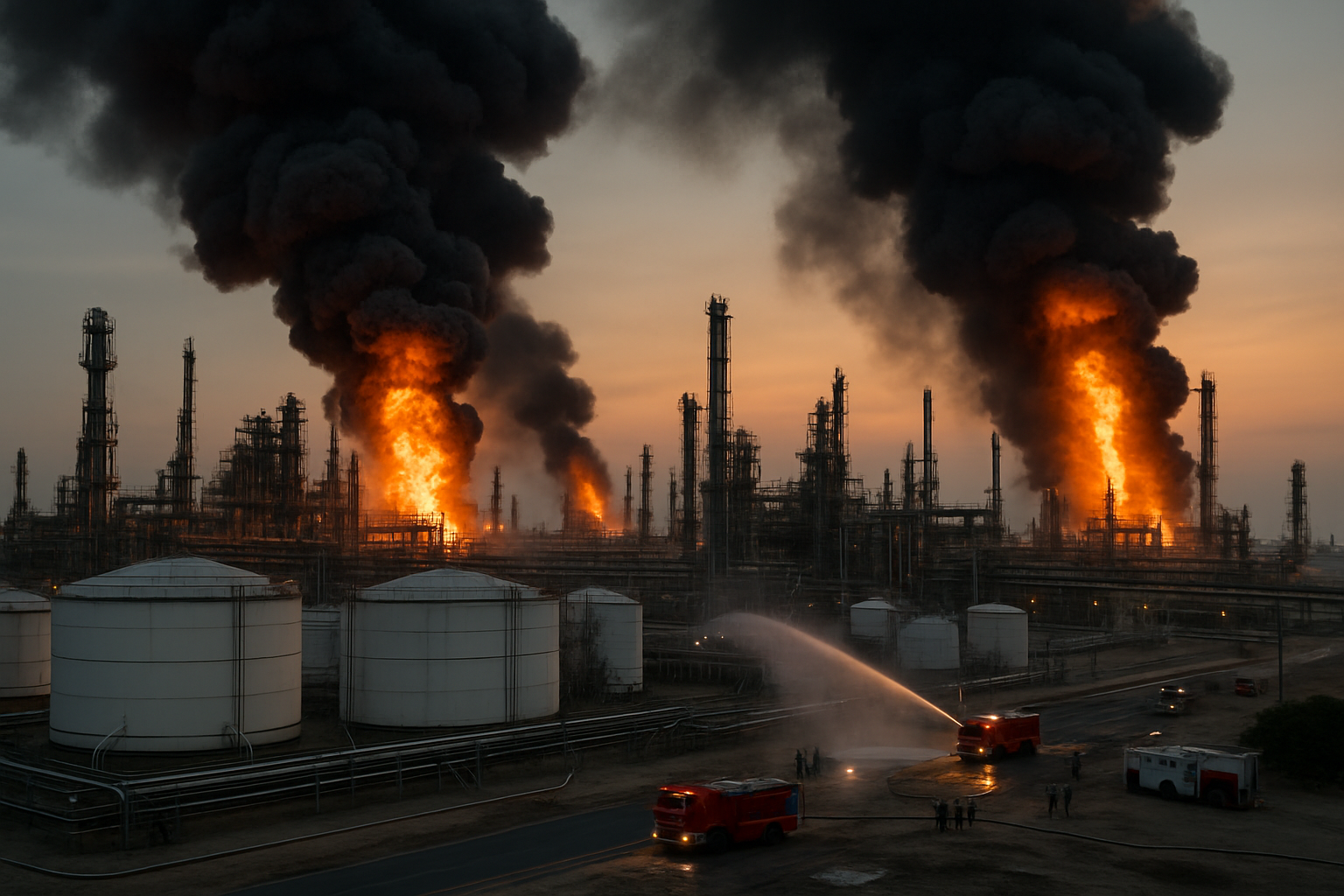
Iranian Revolutionary Guard forces have launched their most coordinated assault yet on Gulf energy infrastructure, with drone strikes targeting Kuwait Petroleum Corporation facilities in Shuwaikh and multiple power generation plants across the region on Sunday morning, marking a dangerous escalation in what has become the most severe energy crisis since the 1970s oil shocks.
Kuwait Petroleum Corporation confirmed "severe material damage" at multiple operating units following coordinated drone attacks that struck the Shuwaikh oil sector complex, home to both the oil ministry headquarters and KPC's main facilities. Emergency response teams worked throughout Sunday to contain fires at the Petrochemical Industries Company and National Petroleum Company subsidiaries, while two power generation units were taken offline after strikes on water desalination plants.
The attacks represent the latest escalation in Iran's "Operation True Promise 4" systematic targeting campaign, which has now struck energy facilities across Kuwait, UAE, Qatar, and Saudi Arabia over the past month. Kuwait's Armed Forces confirmed intercepting 9 ballistic missiles, 4 cruise missiles, and 31 drones during a 24-hour period ending Sunday evening, demonstrating the intensity of Iranian targeting.
Gulf States Under Systematic Attack
The Iranian Revolutionary Guard has declared "no red lines remain" in their targeting of regional infrastructure, expanding attacks beyond military installations to critical energy facilities that underpin the global economy. Kuwait has been repeatedly struck, with 32 foreign nationals injured in earlier airport attacks and airline operations forced to relocate to Saudi Arabia due to ongoing threats.
The United Arab Emirates has suffered one civilian death from missile debris in Abu Dhabi, while Qatar successfully intercepted 65 missiles and 12 drones using Patriot defense systems, though 8 civilians were injured by falling fragments. Cyprus experienced the first European territory attack since World War II when Iranian drones struck RAF Akrotiri, prompting an unprecedented naval coalition response from HMS Dragon and Mediterranean allies.
According to Israeli intelligence reports, Iranian forces have also targeted civilian areas across the Gulf, with systematic strikes on airports, government buildings, and energy infrastructure representing a calculated economic warfare strategy designed to pressure Gulf states to distance themselves from US operations.
Global Energy Crisis Reaches Critical Point
Iran's effective closure of the Strait of Hormuz through naval mining operations has blocked 40% of global seaborne oil transit, triggering the most severe energy crisis in decades. Oil prices have surged past $100 per barrel for the first time since 2022, with Brent crude reaching a peak of $119.50 and WTI hitting a record single-day jump to $108.15.
The International Energy Agency has deployed its largest strategic petroleum reserve release in 50 years, coordinating 400 million barrels from 32 countries - double the amount released during the 2022 Ukraine crisis. Japan is contributing 80 million barrels in its first emergency release since the 2011 Fukushima disaster, highlighting the crisis's global implications for energy-dependent nations.
Qatar's energy infrastructure has sustained "extensive damage" to the Ras Laffan Industrial City, which handles approximately 20% of global LNG exports. Energy Minister Saad Al Kaabi has warned that Gulf states may be forced to declare force majeure "within weeks" if the conflict continues, with oil potentially reaching $150-200 per barrel that could "bring down the economies of the world."
Aviation Industry in Crisis
The conflict has triggered the most extensive aviation disruption since COVID-19, with over 18,000 flights cancelled worldwide as eight Middle Eastern countries have simultaneously closed their airspace. Dubai International Airport, the world's busiest with 86 million annual passengers, remains shut down due to missile damage, while major carriers including Emirates, Air France-KLM, and Wizz Air have suspended operations indefinitely.
The simultaneous closure of airspace across Iran, Iraq, Israel, UAE, Qatar, Syria, Kuwait, and Bahrain has created an "aviation black hole" that has severed critical Asia-Europe flight corridors. Jet fuel costs have exploded from $85-90 per barrel to $150-200, forcing airlines to implement emergency surcharges that are being passed on to consumers globally.
Historical Context: Month-Long Escalation
The current crisis began with the collapse of nuclear diplomacy in late February 2026, despite achieving a "broad agreement on guiding principles" - the most significant progress since the 2018 JCPOA collapse. Iran excluded ballistic missiles and proxy support as "red lines" while the US demanded comprehensive agreements covering missiles, armed groups, and human rights.
The diplomatic breakdown led to "Operation Epic Fury," the largest US-Israeli coordinated military campaign since 2003, which resulted in the confirmed death of Supreme Leader Ali Khamenei on March 1. His son Mojtaba Khamenei has assumed power in the first hereditary succession in the Islamic Republic's 47-year history, with the Revolutionary Guards gaining unprecedented control over governance.
Iranian casualties from US-Israeli strikes have reached 787+ civilians according to the Iranian Red Crescent, including a devastating attack on an elementary school in Minab that killed 165-185 students. The Pentagon later confirmed responsibility for the school attack, citing "outdated targeting data."
Regional Coalition Under Severe Strain
The unprecedented coalition of Saudi Arabia, UAE, Qatar, and Egypt that had supported diplomatic solutions is now severely strained as Iranian retaliation has directly targeted their territories. Egyptian President Abdel Fattah el-Sisi condemned the attacks on "sisterly Arab countries," warning of "comprehensive chaos" spreading across the region.
The systematic Iranian targeting of Gulf infrastructure has forced these nations into defensive postures while maintaining delicate diplomatic balances. Kuwait has been particularly affected, with its strategic position as a US ally making it a primary target for Iranian forces seeking to demonstrate the costs of supporting American operations.
Nuclear Diplomacy Collapsed
The crisis occurs against a broader nuclear governance breakdown, with the New START treaty between the US and Russia having expired on February 5, 2026 - the first time in over 50 years without bilateral nuclear constraints between the superpowers. Iran continues uranium enrichment at 60% purity with over 400kg of weapons-grade material, sufficient for multiple nuclear weapons if weaponized.
UN Secretary-General António Guterres has described the current moment as "the greatest test of multilateral cooperation in crisis management in the modern era," with nuclear risks at their "highest in decades." The rapid transition from diplomatic breakthrough to military confrontation demonstrates the fragility of crisis management mechanisms in the multipolar era.
Economic Impact Spreads Globally
Financial markets have crashed worldwide, with Pakistan's KSE-100 index suffering its largest single-day decline in history at -8.97%, while South Korea's KOSPI fell 12%, triggering circuit breakers as the Korean won hit 17-year lows. The crisis has exposed dangerous over-dependence on strategic chokepoints, with the 21-mile Strait of Hormuz representing a single-point failure for modern global logistics.
Supply chains for automotive, electronics, and textiles industries have been severely disrupted due to dependence on Gulf logistics networks. Major shipping companies Maersk and MSC have suspended Persian Gulf operations, leaving over 150 tankers stranded with billions of dollars in cargo.
Consumer impacts are being felt globally, from Bangladesh implementing fuel rationing for 170 million people to Pakistan introducing wartime austerity measures including four-day government work weeks. European consumers face heating oil approaching €2 per liter, while Sweden has seen electricity costs increase 10-20 öre with gasoline rising 1-2 kronor.
International Response and Evacuations
The crisis has triggered the largest international evacuation since the Arab Spring in 2011, with Australia reporting 115,000 nationals requiring evacuation and Germany coordinating the departure of 30,000 stranded tourists. The European Union activated its ESTIA evacuation mechanism for the first time in the bloc's history following the Cyprus attacks.
Congressional opposition in the United States is mounting, with only 25% American public support for the military operations - described as "almost unprecedented" unpopularity for early-stage operations. Senator Richard Blumenthal has expressed being "more concerned than ever" about potential ground troop deployments, as Pentagon operations are planned through September, far beyond the initial 4-6 week timeline.
Looking Forward: Template-Setting Crisis
The events of April 2026 represent a watershed moment in international relations, determining whether diplomatic or military solutions will provide the precedent for 21st-century conflict resolution. The crisis affects regional war prevention, global energy security, nuclear governance credibility, and international law enforcement simultaneously.
Energy security experts warn that fundamental transformation of global energy architecture is needed to reduce dependence on volatile geopolitical chokepoints. The crisis has demonstrated that strategic petroleum reserves, while providing temporary buffers, are insufficient for sustained disruptions of this magnitude.
As Iran continues its systematic targeting of Gulf energy infrastructure, the international community faces critical decisions about containing escalation versus accepting a broader Middle Eastern war with worldwide implications. Success in containment could provide a framework for future nuclear crisis resolution, while failure may accelerate military solutions that could reshape geopolitics for decades, encouraging proliferation and undermining diplomatic credibility globally.
The stakes could not be higher: the sustainability of the post-World War II international order, the evolution of global energy systems, and the template for managing conflicts in an increasingly multipolar world all hang in the balance as this crisis unfolds.