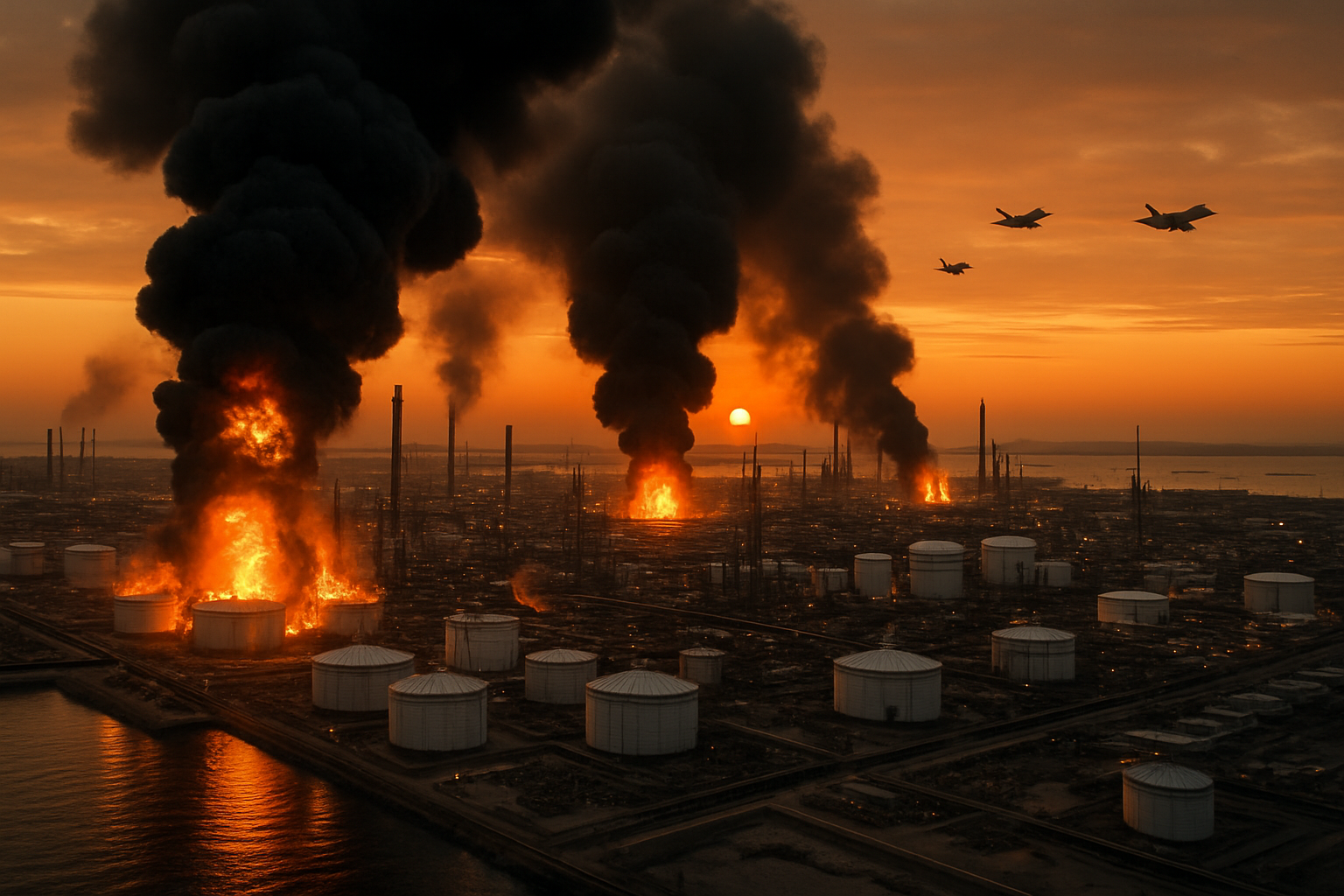
Iran has dramatically escalated its military campaign beyond Israel, launching devastating attacks on energy facilities across Qatar, UAE, and Saudi Arabia in the most dangerous expansion of the Middle East conflict since it began on March 1, 2026.
Iranian forces struck Qatar's critical Ras Laffan Industrial City on March 18, causing "extensive damage" to the energy hub that handles approximately 20% of global LNG exports, according to QatarEnergy. The attack prompted Qatar to immediately expel Iran's military and security attachés, marking a diplomatic rupture between the Gulf neighbors.
The escalation came in direct retaliation for Israel's coordinated strikes on Iran's South Pars gas field - the world's largest natural gas reservoir providing 70% of Iran's gas supply. Israeli forces reportedly "completely destroyed" military targets on the facility, representing the most significant strike on Iranian energy infrastructure in decades.
Revolutionary Guard Declares 'No Red Lines Remain'
Iran's Islamic Revolutionary Guard Corps announced that oil and gas facilities in Saudi Arabia, UAE, and Qatar are now "legitimate targets" under Operation True Promise 4, abandoning previous restraints on targeting civilian infrastructure.
Saudi Arabia intercepted and destroyed four ballistic missiles launched toward Riyadh on Wednesday, while also thwarting an attempted drone attack on an eastern gas facility. The kingdom's Foreign Minister Prince Faisal bin Farhan declared that trust in Iran has been "completely shattered," warning of severe consequences if attacks continue.
"Iran's actions demonstrate that it does not believe in genuine dialogue with neighboring countries, but instead relies on pressure and political and security coercion."
— Prince Faisal bin Farhan, Saudi Foreign Minister
Kuwait announced the arrest of 10 Hezbollah operatives allegedly planning attacks on "vital installations," while the UAE reported intercepting multiple missiles and drones targeting energy infrastructure in Dubai and Abu Dhabi.
Global Energy Markets in Crisis
The attacks have triggered the most severe energy crisis since the 1970s oil shocks. Oil prices surged past $110 per barrel - reaching Brent crude peaks of $119.50 and WTI record jumps to $108.15 - as Iran's Revolutionary Guard declared the Strait of Hormuz "unsafe for shipping."
The strategic waterway, through which 40% of global seaborne oil transits, has been effectively blockaded with Iran deploying between 2,000-6,000 naval mines. Over 150 oil and LNG tankers remain stranded in the Persian Gulf, representing billions in cargo value.
Qatar Energy Minister Saad Al Kaabi warned that Gulf states may be forced to declare force majeure "within weeks" if the conflict continues, with oil prices potentially reaching $150 per barrel - a level that could "bring down economies of the world."
Historic International Response
The International Energy Agency announced the largest strategic petroleum reserve release in its 50-year history - 400 million barrels from 32 member countries, more than double the 182.7 million barrels released during the 2022 Ukraine crisis.
Japan is releasing 80 million barrels starting March 16, marking the first deployment since the 2011 Fukushima disaster. With 95% of Japan's oil coming from the Middle East and 70% transiting through the now-blocked Strait of Hormuz, the island nation faces acute vulnerability.
Energy Secretary Christopher Wright confirmed the U.S. is considering lifting Russian oil sanctions to help stabilize global markets, noting "hundreds of millions of barrels of sanctioned oil" could potentially become available.
Aviation Crisis Compounds Global Disruption
The conflict has created an unprecedented aviation crisis, with over 18,000 flights cancelled worldwide - the most extensive disruption since COVID-19. Eight countries have simultaneously closed their airspace: Iran, Iraq, Israel, UAE, Qatar, Syria, Kuwait, and Bahrain.
Dubai International Airport, the world's busiest with 86 million passengers annually, remains completely shut down due to missile damage. Major carriers including Emirates, Air France-KLM, Wizz Air, and Bulgaria Air have suspended operations indefinitely, stranding hundreds of thousands of passengers globally.
Diplomatic Breakdown and Nuclear Concerns
The energy infrastructure attacks represent the complete collapse of diplomatic efforts that had shown promise in February. Despite achieving a "broad agreement on guiding principles" in Geneva talks - the most significant progress since the 2018 JCPOA collapse - fundamental disagreements over scope proved insurmountable.
Iran excluded ballistic missiles and regional proxies as "red lines" from nuclear-only discussions, while the U.S. demanded a comprehensive agreement addressing missiles, armed groups, and human rights. Iran continues enriching uranium to 60% purity, approaching the 90% weapons-grade threshold with over 400kg of enriched material - sufficient for multiple nuclear weapons.
The crisis unfolds against a broader nuclear governance breakdown, with the New START treaty having expired on February 5, marking the first time in over 50 years without U.S.-Russia nuclear constraints. UN Secretary-General António Guterres has described nuclear risks as at their "highest level in decades."
Regional Coalition Under Severe Strain
The unprecedented coalition of Saudi Arabia, UAE, Qatar, and Egypt that had backed diplomatic solutions now faces severe strain as Iranian attacks directly target member territories. Egyptian President Abdel Fattah el-Sisi condemned attacks on "sisterly Arab countries," warning of "comprehensive chaos spreading across the region."
The targeting of Gulf energy facilities marks a dangerous escalation that threatens to transform a bilateral Iran-Israel conflict into a broader regional war with global implications for energy security and economic stability.
Economic and Humanitarian Impact
Financial markets have crashed worldwide, with Pakistan's KSE-100 suffering its largest single-day decline in history at -8.97%. South Korea's KOSPI plunged 12% with circuit breakers triggered, while the Korean won hit a 17-year low.
Consumer impacts are being felt globally, from Sweden's electricity and gasoline price increases to fuel rationing affecting 170 million people in Bangladesh. Ireland has seen heating oil prices approach €2 per liter, while Pakistan implements wartime austerity measures with four-day government work weeks.
The humanitarian crisis continues to mount, with Iran's Red Crescent reporting over 787 civilian casualties from U.S.-Israeli strikes, while international evacuation efforts - the largest since the Arab Spring - have affected over 115,000 Australians and 30,000 Germans stranded in the region.
Template-Setting Crisis for 21st Century
March 18, 2026, represents what experts are calling the most dangerous international crisis since the Cold War's end, affecting regional war prevention, global energy security, nuclear governance credibility, and international law enforcement simultaneously.
The rapid transition from promising diplomatic frameworks to military escalation demonstrates the fragility of crisis management in the multipolar era. Success in containing the conflict could provide a nuclear crisis resolution template for the 21st century, while failure may accelerate military solutions, reshape Middle Eastern geopolitics for decades, and encourage nuclear proliferation globally.
"This is the most severe energy security crisis in decades, with single-chokepoint vulnerabilities completely exposed."
— Samuel Ciszuk, Energy Security Expert
As the conflict enters its third week, the stakes extend far beyond the Middle East. The outcome will determine whether diplomatic solutions can prevail over military confrontation in resolving 21st-century nuclear disputes, with implications for international stability mechanisms that will resonate for decades beyond current events.