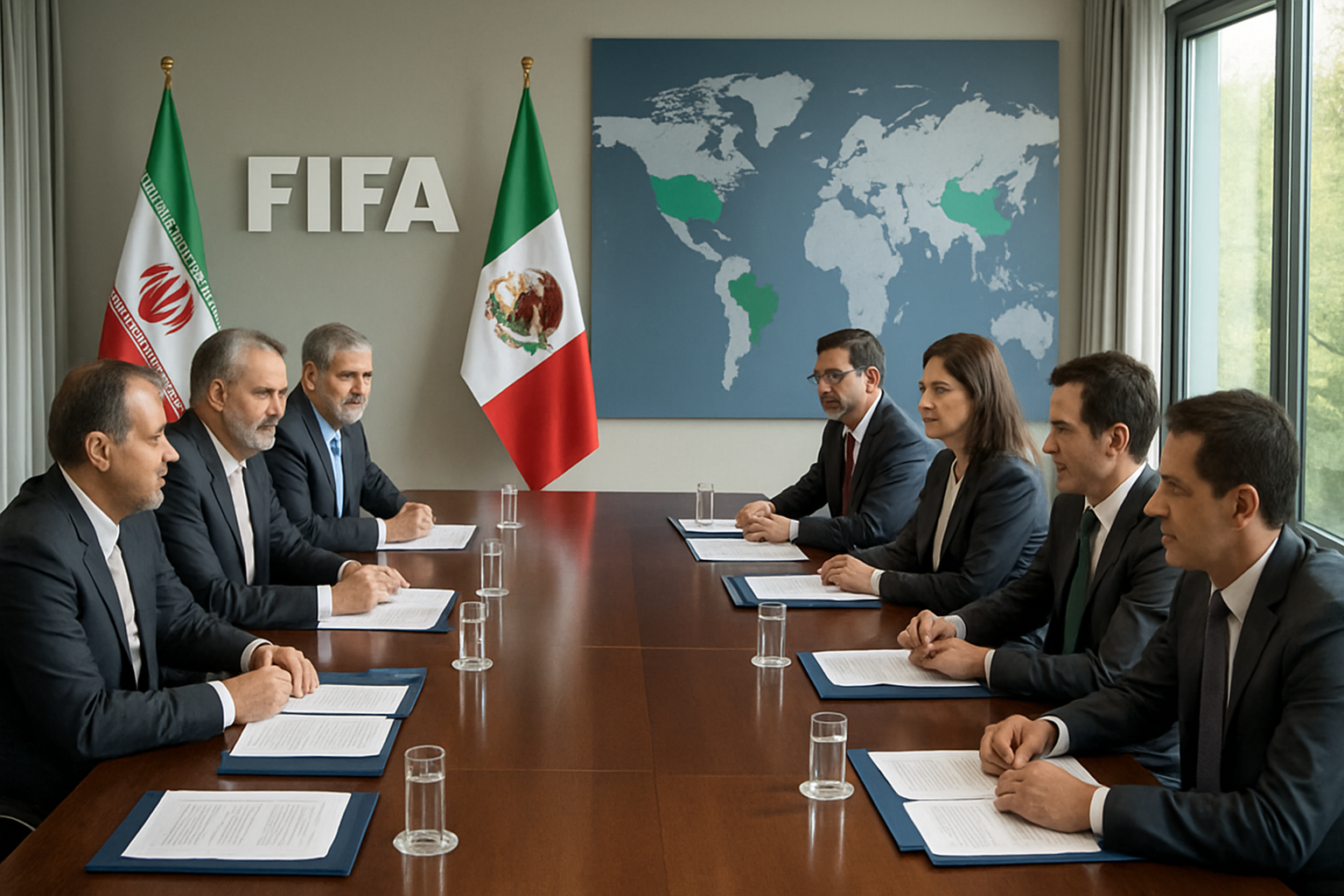
Iran's Football Federation has confirmed ongoing negotiations with FIFA to relocate their 2026 World Cup group stage matches from United States venues to Mexico, citing security concerns arising from the ongoing military conflict between Iran and the US-Israeli coalition.
Iranian Football Federation President Mehdi Tadj announced the unprecedented diplomatic initiative through a statement released by Iran's Embassy in Mexico, marking the first time in World Cup history that a qualified nation has sought to change venues due to geopolitical tensions. Iran is drawn in Group G alongside Belgium, New Zealand, and Egypt, with matches originally scheduled in Inglewood, California, and Seattle, Washington.
Unprecedented Diplomatic Challenge for FIFA
The venue change request represents an extraordinary challenge for FIFA, which has long maintained its position of political neutrality in international football. Iran's three group stage matches were scheduled for June 15 (vs New Zealand in Inglewood), June 21 (vs Belgium in Inglewood), and June 26 (vs Egypt in Seattle). All three venues are located in the United States, one of the three co-host nations alongside Canada and Mexico.
According to sources familiar with the negotiations, Iran has specifically requested that all their matches be moved to Mexican venues, leveraging Mexico's status as a co-host nation. Mexico operates three World Cup venues: Estadio Azteca in Mexico City, Estadio BBVA in Monterrey, and Estadio Akron in Guadalajara.
"We are currently negotiating with FIFA regarding the possibility of playing our World Cup matches in Mexican territory,"
— Mehdi Tadj, Iranian Football Federation President
Security Concerns Amid Regional Conflict
The venue change request comes amid the most dangerous international crisis since the Cold War. Operation Epic Fury, the US-Israeli military campaign against Iran, has fundamentally altered the security landscape for Iranian nationals traveling to the United States. The conflict, which began following the breakdown of nuclear negotiations in Geneva, has resulted in the death of Iranian Supreme Leader Ali Khamenei and widespread regional instability.
Iranian officials cite legitimate security concerns for their national team, coaching staff, and supporters planning to attend matches in the United States. The situation has been further complicated by Trump administration policies that have restricted visa processing for Iranian nationals and imposed additional travel limitations.
The timing is particularly sensitive given that the Los Angeles area, where two of Iran's three matches were scheduled, is home to over 200,000 Iranian-Americans in the community known as "Tehrangeles." This population had been anticipated to provide significant support for Iran's national team in what would have been historic matches on American soil.
FIFA's Unprecedented Situation
FIFA now faces a situation with no historical precedent. The organization's rules include provisions for venue changes due to force majeure events, but these have traditionally applied to natural disasters or infrastructure problems rather than geopolitical conflicts involving host nations.
The request puts FIFA in the difficult position of balancing its stated commitment to political neutrality with legitimate security concerns. Approving Iran's request could set a precedent for other nations to seek venue changes based on political considerations, while rejecting it could effectively force Iran to withdraw from the tournament entirely.
FIFA has requested detailed security reports from all three host nations – the United States, Canada, and Mexico – as part of its assessment of the situation. The organization maintains "complete confidence" in the security arrangements for the tournament but acknowledges the complexity of the current geopolitical situation.
Mexico's Position and Capacity
Mexico's potential role in accommodating Iran's request comes with its own complexities. The country has recently emerged from its own security crisis following the death of cartel leader "El Mencho" and subsequent violence that affected Guadalajara, one of the World Cup host cities. Despite this, FIFA President Gianni Infantino has maintained complete confidence in Mexico's hosting capabilities.
Mexican authorities have deployed over 100,000 security personnel for the World Cup – the largest security operation in the country's history. This massive deployment was designed to address cartel-related security concerns but could be adapted to provide additional security for Iranian team personnel and supporters.
The Mexican government has not yet issued an official response to Iran's request, though diplomatic sources suggest Mexico would be willing to accommodate the venue changes if FIFA approves the request. Mexico's position as a neutral party in the US-Iran conflict makes it a logical alternative venue from a diplomatic perspective.
Tournament Logistics and Implications
Moving Iran's matches to Mexico would require significant logistical adjustments to the tournament schedule. The 2026 World Cup is already the most complex in history, being the first to span three countries and featuring an expanded 48-team format with 104 matches over six weeks.
The venue changes would affect not only Iran's opponents – Belgium, New Zealand, and Egypt – but also broadcasters, ticketholders, and the overall tournament infrastructure. FIFA would need to work with Mexican venues to ensure adequate capacity and facilities for the relocated matches.
From a financial perspective, the venue changes could impact FIFA's revenue projections for the tournament. Matches in the Los Angeles and Seattle markets were expected to command premium ticket prices and attract significant commercial interest. Mexican venues, while enthusiastic football markets, may not generate equivalent revenue.
Broader World Cup Context
Iran's venue change request occurs against the backdrop of multiple challenges facing the 2026 World Cup. The tournament is already dealing with visa complications affecting fans from several countries, reduced travel bookings to the United States from European markets, and the unprecedented coordination challenges of tri-national hosting.
The situation highlights the intersection of sports and geopolitics in an increasingly polarized world. The World Cup, as the world's most-watched sporting event, has traditionally served as a unifying force that transcends political boundaries. Iran's request tests whether this ideal can be maintained in the current geopolitical climate.
Mexico's hospitality sector, already facing a projected 500,000 job deficit for the tournament, could benefit from accommodating additional matches and Iranian supporters. The country has been counting on the World Cup for post-pandemic economic recovery, making the additional matches potentially valuable from an economic perspective.
Historical Precedent and Future Implications
If approved, Iran's venue changes would mark the first time in World Cup history that matches have been relocated due to conflict involving a host nation. The decision would establish important precedents for how international sporting events navigate geopolitical tensions in the 21st century.
The resolution of Iran's request will be closely watched by other international sporting organizations facing similar challenges. The International Olympic Committee, UEFA, and other bodies regularly deal with the intersection of sports and politics, but rarely at the scale and visibility of a FIFA World Cup.
The situation also tests FIFA's often-stated principle that football should transcend political boundaries. The organization's handling of Iran's request will influence how future geopolitical conflicts are managed in international sports.
Regional Security Architecture
The Iran venue situation reflects broader changes in Middle Eastern geopolitics and their global implications. The breakdown of nuclear negotiations despite achieving a "broad agreement on guiding principles" in Geneva demonstrates the fragility of modern diplomatic mechanisms.
Regional coalitions that had supported diplomatic processes – including Saudi Arabia, UAE, Qatar, and Egypt – now face strain as Iranian retaliation has targeted their territories. This regional instability creates additional complications for FIFA's tournament planning beyond Iran's specific request.
The situation occurs amid unprecedented disruptions to global aviation, with over 18,000 flights cancelled worldwide and eight countries maintaining closed airspace. These broader disruptions add complexity to tournament logistics and international travel for the World Cup.
Looking Ahead
FIFA faces a critical decision in the coming weeks as the tournament approaches its 100-day countdown. The organization must balance legitimate security concerns, tournament integrity, commercial interests, and its commitment to political neutrality.
Iran's request represents more than a logistical challenge – it's a test of whether international sporting events can maintain their unifying role in an increasingly fragmented world. The resolution will influence not only the 2026 World Cup but the future of international sports in an era of renewed geopolitical competition.
As negotiations continue, the football world watches to see whether the beautiful game can truly transcend the political realities that increasingly shape our interconnected world. The outcome will establish precedents that extend far beyond the boundaries of any football pitch.
The decision timeline remains unclear, but FIFA is expected to resolve the matter well before the tournament's June 11 opening match at Estadio Azteca in Mexico City. Whatever the outcome, Iran's request has already highlighted the complex challenges facing international sports in the modern era.