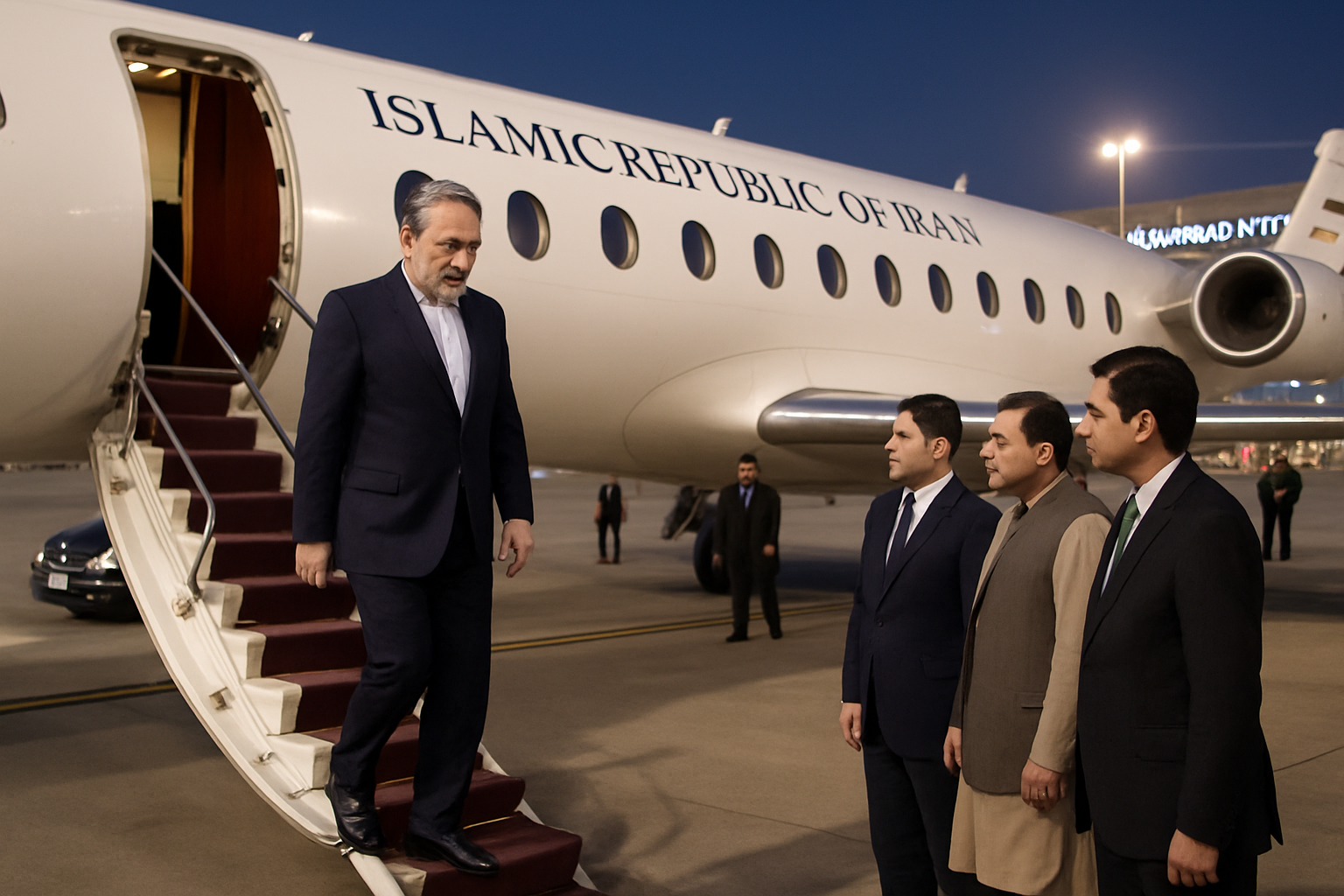
Iranian Foreign Minister Abbas Araghchi arrived in Islamabad Friday evening as part of a crucial regional diplomatic tour, while the Trump administration dispatched special envoys Steve Witkoff and Jared Kushner to Pakistan for potentially pivotal negotiations amid the ongoing nuclear crisis.
The arrival comes as conflicting signals emerge from Tehran regarding renewed engagement with Washington. While Iranian state media reported that Iran has "no plans for further negotiations with the US," citing excessive demands and the ongoing naval blockade, other Iranian sources suggest the final decision has not yet been made.
Pakistan's Historic Mediation Role Under Threat
Pakistan's unprecedented diplomatic achievement—the "Islamabad Accord" that prevented global catastrophe just 88 minutes before Trump's "whole civilization will die tonight" deadline on April 8—now faces its ultimate test. Prime Minister Shehbaz Sharif and Field Marshal Asim Munir's innovative "message relay system" had successfully bridged the communication gap between Washington and Tehran when direct diplomatic channels failed.
The framework crashed global oil prices by 20%, from $119.50 to $100 per barrel, and ended an aviation crisis that saw over 18,000 flights cancelled worldwide. More critically, it reopened the Strait of Hormuz—the world's most important energy chokepoint handling 40% of global oil transit.
"Pakistan has consistently demonstrated its commitment to regional peace and security through sustained diplomatic engagement with all stakeholders."
— Pakistani Foreign Ministry Statement
Revolutionary Guard Rejects Direct Talks
The Iranian Revolutionary Guard has taken an increasingly hardline stance, with sources confirming they "will not negotiate with the US directly" but rather through intermediary channels. Parliament Speaker Mohammad Bagher Ghalibaf warned Iran would not accept negotiations "under the shadow of threats," while threatening to demonstrate a "new balance of power on the battlefield" with prepared "new cards."
Foreign Ministry spokesman Esmaeil Baghaei categorically stated Iran has "no plans for further negotiations with the US," citing Washington's "excessive demands, unrealistic expectations, and the ongoing naval blockade of Iranian ports."
Nuclear Sticking Points Remain Unchanged
The fundamental disagreement that has prevented breakthrough since the JCPOA collapse in 2018 persists: the United States demands Iran suspend its 60% uranium enrichment program and abandon its stockpile of over 400 kilograms of weapons-grade material. Iran maintains this represents an "inalienable right" and Foreign Minister Araghchi has repeatedly stated Tehran will "never abandon enrichment even if war is imposed."
This crisis unfolds against the backdrop of the New START treaty's expiration in February 2026—the first time in over 50 years that the world lacks US-Russia nuclear constraints. Intelligence assessments confirm Iran possesses sufficient enriched uranium for multiple nuclear weapons if weaponized, making the stakes unprecedented.

The Lebanon Loophole Crisis
A critical complication has emerged regarding Lebanon's exclusion from the ceasefire framework. Israeli Prime Minister Netanyahu explicitly excluded Lebanon from the Pakistan-mediated accord, creating what Iranian officials describe as an "unbridgeable gap." Israeli strikes killed over 254 people in a single day during the previous talks, with 1.2 million Lebanese displaced—representing 25% of the country's population.
VP JD Vance acknowledged this represented a "legitimate misunderstanding" from Iran's perspective, but Washington never agreed to include Israeli-Hezbollah operations under the comprehensive ceasefire framework.
Energy Crisis Deepens
Oil markets have surged again, with Brent crude climbing above $106 per barrel and WTI reaching $104.29—the second time in 2026 prices have breached the $100 threshold. The Iranian Revolutionary Guard maintains "complete control" of the Strait of Hormuz, threatening a "deadly whirlpool" for any vessels challenging their sovereignty.
Major shipping companies Maersk and MSC have suspended operations, leaving over 150 tankers stranded with billions of dollars in cargo. The International Energy Agency maintains its record 400 million barrel strategic reserve release—the largest intervention in 50 years.
- Bangladesh has imposed fuel rationing affecting 170 million people
- Pakistan implemented wartime austerity measures including four-day work weeks
- European household heating costs have surged 24%
- Dubai International Airport remains closed due to missile damage
International Coalition Under Maximum Strain
The unprecedented regional coalition of Saudi Arabia, UAE, Qatar, and Egypt has maintained unity despite Iranian "Operation True Promise 4" attacks that resulted in casualties across member territories: one killed in Abu Dhabi, 32 injured in Kuwait airport strikes, and 8 wounded in Qatar despite Patriot missile intercepts.
Egyptian President Abdel Fattah el-Sisi's warnings about "comprehensive chaos in sisterly countries" have proved increasingly prophetic as diplomatic failures mount.
NATO allies have largely rejected US escalation demands, with UK Prime Minister Keir Starmer declaring Britain "won't be dragged into an Iran war," while France and Germany emphasize diplomatic approaches. Australia and Japan's refusal to provide naval vessels represents the most significant rejection of American military leadership since the 2003 Iraq War.
Congressional Opposition Reaches Historic Levels
Operation Epic Fury faces unprecedented domestic opposition, with only 25% American support—historic lows for early-stage military operations. The operation has cost $11.3 billion in its first week, with Pentagon timelines extending through September, far beyond initial 4-6 week projections.
Senator Richard Blumenthal expressed being "more concerned than ever" about potential ground troop deployment, while financial markets serve as what analysts call the "ultimate constraint" on prolonged military confrontation.
Humanitarian Crisis Mounting
The Iranian Red Crescent reports over 787 civilian casualties from US-Israeli strikes, including a Pentagon-acknowledged elementary school attack that killed 165-185 students due to "outdated targeting data." This has prompted war crimes investigations and massive international evacuations on an Arab Spring scale—Australia has 115,000 citizens trapped, while Germany has evacuated 30,000.
Template-Setting Diplomatic Innovation
UN Secretary-General Antonio Guterres has described this as the "greatest test of multilateral cooperation in the modern era." Pakistan's emergence as a crucial mediator demonstrates that middle powers can bridge major adversary divides when traditional great power mechanisms fail.
The innovative "message relay system" developed by Pakistani leadership shows that diplomatic solutions are possible even in the darkest hours of international crisis. China has provided "full support" for Pakistan's initiative, while Germany has noted "positive signs" for direct talks.
"This represents the most dangerous international crisis since the end of the Cold War, with implications extending decades beyond current events."
— International Crisis Analyst
Critical Juncture Ahead
The current diplomatic window represents perhaps the final opportunity to prevent a return to the most dangerous phase of this crisis. Stakes include regional war prevention, global energy security, nuclear governance credibility, and international law enforcement mechanisms with implications extending decades into the future.
Success would provide a template for 21st-century conflict resolution, demonstrating that diplomatic innovation can triumph over military confrontation. Failure could accelerate the use of military solutions in territorial and nuclear disputes worldwide, fundamentally reshaping the post-WWII international order.
As Iranian Foreign Minister Araghchi conducts his regional tour through Islamabad, Muscat, and Moscow, the world watches to see whether Pakistan's historic mediation framework can bridge decades-old US-Iran disagreements or whether the international community will face a return to the precipice of global catastrophe.
The coming days will determine whether April 2026 represents a watershed moment in international relations—where diplomatic innovation prevents the most dangerous crisis since the Cold War's end—or marks the beginning of a new era where military confrontation becomes the dominant paradigm for resolving international disputes.