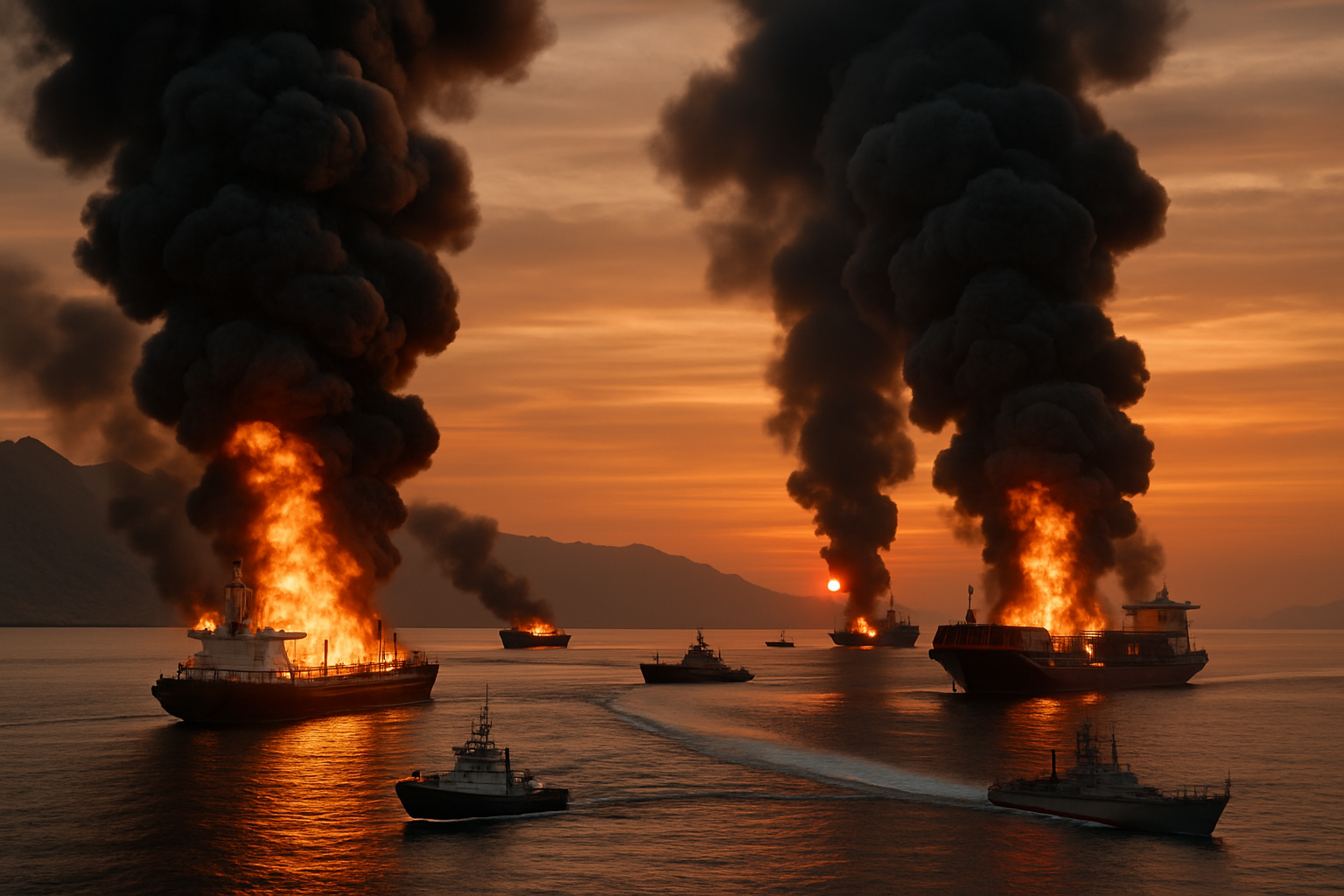
Iranian Revolutionary Guard forces launched the most severe escalation in maritime attacks since the Iran-US conflict began, with at least six commercial vessels struck by explosive-laden boats and projectiles across the Persian Gulf and Strait of Hormuz, leaving multiple ships ablaze and crews trapped.
The coordinated assault on Wednesday, March 12, 2026, targeted oil tankers in Iraqi waters and commercial vessels throughout the strategic waterway that carries 40% of the world's seaborne oil trade. According to maritime security firms and port authorities, explosive-laden Iranian boats attacked two fuel tankers in Iraqi territorial waters, setting them ablaze and killing at least one crew member.
The escalation comes as Iran's military announced a shift from its previous "proportional retaliation" policy to what it terms "continuous strikes" - launching consecutive attacks rather than measured responses. A spokesperson for Tehran's Khatam al-Anbiya military command headquarters warned that any ships or oil cargoes belonging to the United States, Israel, or their partners are now considered legitimate targets.
Six Vessels Under Attack in 24 Hours
Maritime authorities report that the Thai-flagged cargo ship Mayuree Naree was among the vessels struck, becoming engulfed in black smoke in the Strait of Hormuz with 23 crew members aboard. Iran's Revolutionary Guards claimed they targeted the vessel for ignoring "warnings" to vessels operating in what they now consider a combat zone.
Three crew members are believed trapped aboard the Thai vessel, according to the shipping company, while rescue operations continue under dangerous conditions. The attacks mark the highest number of commercial vessels struck in a single day since the conflict began, bringing the total number of ships attacked in the region to at least 16.
A container ship was also hit by an "unknown projectile" off the United Arab Emirates coast, causing a "small fire" but no reported casualties, according to maritime security sources. The systematic nature of the attacks suggests a coordinated Iranian campaign to disrupt shipping lanes vital to global energy supplies.
Iran Deploys Naval Mines
US intelligence reports confirm Iran has begun deploying naval mines throughout the Strait of Hormuz using small vessels carrying 2-3 mines each from an estimated stockpile of 2,000-6,000 total mines. President Donald Trump responded by threatening "consequences never seen before" if the mines are not immediately removed.
The US military has already destroyed 16 Iranian mine-laying vessels in response to what officials describe as an unprecedented threat to international maritime commerce. The 21-mile-wide strait represents a critical chokepoint for global energy security, with no realistic alternative routes for the massive volume of oil and natural gas exports from the Persian Gulf region.
The mining operation effectively blockades one of the world's most important trade routes, forcing major shipping companies including Maersk and MSC to suspend all operations in Persian Gulf waters. More than 150 oil and LNG tankers worth billions in cargo value remain stranded in the region.
Global Energy Crisis Deepens
Oil prices have surged past $100 per barrel for the first time since 2022, with Brent crude reaching $119.50 and West Texas Intermediate jumping 18.98% to $108.15 in the largest single-day increase on record. Natural gas prices have exploded 24% in Europe and 78% in the United States as the crisis threatens global energy security.
Qatar, which supplies approximately 20% of global LNG exports, has halted production at its Ras Laffan and Mesaid facilities following Iranian drone attacks on the infrastructure. Energy Minister Saad Al Kaabi warned that Gulf states may be forced to declare force majeure "within weeks" if the conflict continues, potentially driving oil prices to $150 per barrel.
The International Energy Agency announced its largest emergency oil reserve release in 50-year history - 400 million barrels from 32 member countries - in an attempt to stabilize markets. Japan is releasing 80 million barrels starting March 16, marking the first such deployment since the 2011 Fukushima disaster.
Aviation Industry Paralyzed
More than 18,000 flights have been cancelled worldwide in what aviation experts describe as the most extensive disruption since the COVID-19 pandemic. Eight Middle Eastern countries maintain simultaneous airspace closures: Iran, Iraq, Israel, UAE, Qatar, Syria, Kuwait, and Bahrain.
Dubai International Airport, the world's busiest with 86 million passengers annually, remains completely shut down due to missile damage sustained in previous Iranian attacks. Major carriers including Emirates, Air France-KLM, Wizz Air, and Bulgaria Air have suspended operations indefinitely, affecting hundreds of thousands of passengers globally.
The closure of Middle Eastern airspace has severed critical Europe-Asia flight corridors, forcing airlines to implement complex routing through longer, more expensive alternative paths while dealing with massive fuel cost increases.
Regional Coalition Under Strain
The unprecedented attacks have severely tested the diplomatic coalition of Saudi Arabia, UAE, Qatar, and Egypt that had been supporting diplomatic solutions to the crisis. Iranian strikes directly targeting member territories have killed civilians and damaged critical infrastructure.
The UAE reported one civilian killed in Abu Dhabi from aerial interception debris, while Kuwait confirmed 32 foreign nationals injured in airport drone strikes. Qatar intercepted 65 missiles and 12 drones using Patriot defense systems, with 8 people injured from fragments despite the successful interceptions.
Egyptian President Abdel Fattah el-Sisi condemned the attacks on "sisterly Arab countries," warning of "comprehensive chaos" if the escalation continues. The targeting of coalition member territories represents a significant expansion of Iran's military strategy beyond US and Israeli assets.
Humanitarian Crisis Mounts
The conflict has triggered the largest coordinated international evacuation since the Arab Spring of 2011, with Australia reporting 115,000 nationals trapped in the region and Germany confirming 30,000 stranded tourists. The European Union activated its ESTIA evacuation plan for Cyprus for the first time following Iranian drone attacks on RAF Akrotiri - the first attack on European territory since World War II.
Thailand has expressed grave concern over the worsening situation, particularly after the Thai-flagged vessel came under attack with 23 Thai crew members aboard. The Thai Ministry of Foreign Affairs called for immediate de-escalation and return to diplomatic dialogue, emphasizing the protection of civilian shipping and crew members.
Filipino sailors and crews from multiple nations remain trapped aboard vessels in the conflict zone, with their families expressing growing concern about their safety as rescue operations become increasingly dangerous.
Diplomatic Breakdown Context
The maritime escalation comes after the complete collapse of US-Iran nuclear negotiations despite achieving what negotiators called "broad agreement on guiding principles" - the most progress since the 2018 collapse of the Joint Comprehensive Plan of Action (JCPOA).
The fundamental disagreement centered on scope: Iran insisted on nuclear-only talks while excluding ballistic missiles and regional proxy forces as "red lines," while the US demanded comprehensive agreements including missiles, armed groups, and human rights issues. This same structural impasse has prevented diplomatic solutions for over a decade.
Iran continues enriching uranium to 60% purity with over 400 kilograms of material - sufficient for multiple nuclear weapons if weaponized - while the broader nuclear governance crisis deepens with the February expiration of the New START treaty between the US and Russia, marking the first time in over 50 years without nuclear constraints between the superpowers.
Financial Markets in Crisis
Global financial markets have crashed in response to the escalating conflict, with Pakistan's KSE-100 index recording its largest single-day decline in history at -8.97%. South Korea's KOSPI index plummeted 12% with circuit breakers activated, while the Korean won hit a 17-year low as investors fled risk assets.
US Dow futures fell 400-570 points, and major IPOs including PayPal's $1.1 billion offering have been postponed indefinitely due to market volatility. Central banks including the European Central Bank and Bank of Japan are coordinating emergency liquidity provision to prevent broader financial contagion.
Supply Chain Vulnerabilities Exposed
The crisis has exposed critical vulnerabilities in global supply chains that extend far beyond energy to consumer goods and industrial materials worldwide. The Persian Gulf serves as a critical trade hub, and the effective closure of the 21-mile Strait of Hormuz represents a single-point failure risk for modern logistics systems.
China has suspended refined fuel export contracts, canceling committed shipments, while Singapore retailers warn of 30% increases in logistics costs. Manufacturing sectors including automotive, electronics, and textiles that depend on Gulf shipping networks face severe disruptions.
Alternative routes through the Arabian Peninsula offer inadequate capacity with significant time and cost penalties, highlighting the dangerous over-dependence on strategic chokepoints that requires fundamental restructuring of global energy and trade architecture.
Historical Significance
March 12, 2026 represents what analysts describe as the most dangerous international crisis since the end of the Cold War, testing multiple critical systems simultaneously: regional war prevention, global energy security, nuclear governance credibility, and international law enforcement mechanisms.
The rapid transition from diplomatic breakthrough to military escalation demonstrates what experts call the fragility of crisis management in the multipolar era. The stakes extend far beyond the immediate conflict, potentially setting templates for 21st-century approaches to territorial disputes, nuclear proliferation, and energy security.
Recovery timelines remain uncertain and depend entirely on military operations resolution and diplomatic normalization rather than predictable factors like weather disruptions. Aviation industries cannot implement long-term scheduling with multiple airspaces closed, while energy markets remain volatile with critical transit routes blocked.
The conflict represents a watershed moment that will determine whether diplomatic solutions or military confrontation becomes the preferred approach for resolving international disputes in the coming decades, with implications extending far beyond the current crisis for global stability and international cooperation mechanisms.