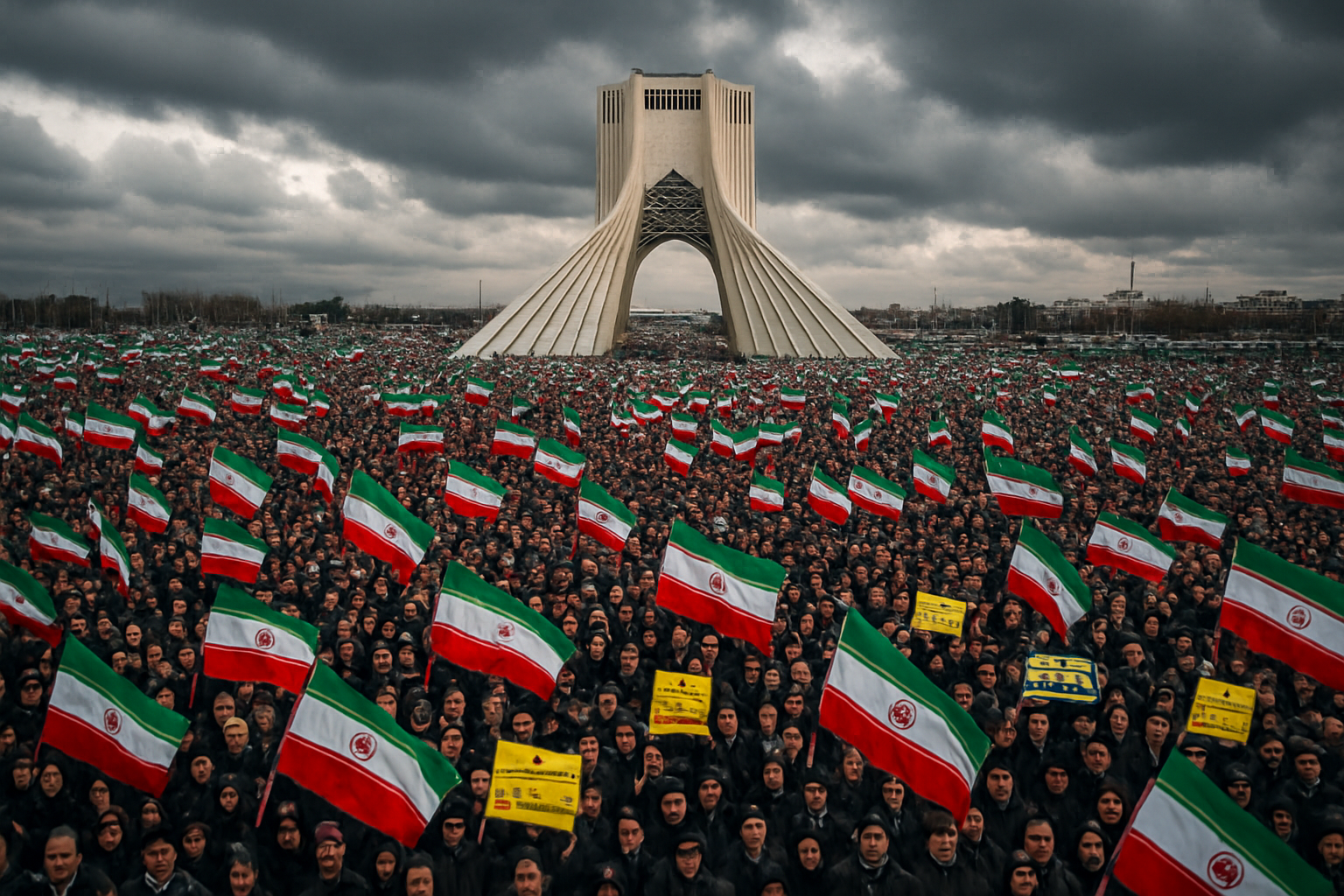
Iran commemorated the 47th anniversary of its 1979 Islamic Revolution on Wednesday with massive rallies across the country, as the nation finds itself caught between mounting domestic pressure from widespread protests and escalating international tensions over its nuclear program and ongoing diplomatic negotiations with the United States.
President Masoud Pezeshkian used the occasion to deliver a carefully calibrated message that acknowledged the government's failings while maintaining Iran's defiant stance on its nuclear rights. Speaking before hundreds of thousands of supporters in Tehran, Pezeshkian apologized for the government's shortcomings, particularly regarding the violent crackdown on nationwide protests that have resulted in over 42,000 arrests since 2022.
Presidential Apology and Nuclear Defiance
"We are ashamed before our people," Pezeshkian declared, in a rare admission of governmental failure. The president's apology represents a significant acknowledgment of public anger over the regime's harsh response to civil unrest, which has claimed thousands of lives according to human rights organizations.
However, Pezeshkian's conciliatory tone on domestic issues stood in sharp contrast to his uncompromising position on Iran's nuclear program. Despite ongoing negotiations with the United States, the president firmly stated that Iran "does not seek a nuclear weapon" while simultaneously declaring that the country "will not yield to excessive demands" regarding its uranium enrichment activities.
"Iran will not abandon its inalienable right to nuclear technology, even if war is imposed on us."
— Foreign Minister Abbas Araghchi, February 8, 2026
This defiant stance was further reinforced by Foreign Minister Abbas Araghchi, who just days after describing February 7 nuclear talks with the US as having a "positive atmosphere," declared that Iran would never abandon uranium enrichment regardless of international pressure.
Nuclear Negotiations at Critical Juncture
The anniversary celebrations occur against the backdrop of the most significant US-Iran diplomatic engagement since the collapse of the Joint Comprehensive Plan of Action (JCPOA) in 2018. Following talks in Muscat, Oman, mediated by Sultan Haitham bin Tariq, both sides agreed to continue negotiations, though fundamental disagreements persist.
Iran currently enriches uranium at 60% purity, significantly above the 3.67% limit established under the original JCPOA and approaching the 90% threshold required for weapons-grade material. Intelligence reports suggest Iran may be willing to consider a three-year enrichment halt and transfer existing stockpiles to Russia, though recent hardline statements cast doubt on such compromises.
The central obstacle remains scope disagreement: Iran insists on nuclear-only discussions, explicitly excluding ballistic missiles and regional proxy activities as "red lines." Meanwhile, US Secretary of State Marco Rubio demands a comprehensive agreement addressing missiles, armed groups, and human rights violations.
Military Tensions in the Persian Gulf
Military incidents have continued despite diplomatic engagement, underscoring the precarious nature of the current situation. A US F-35C fighter from the USS Abraham Lincoln shot down an Iranian Shahed-139 drone in the Arabian Sea after it aggressively approached the carrier. The same day, Islamic Revolutionary Guard Corps vessels harassed a US-flagged tanker in the Strait of Hormuz, through which 40% of global oil transits.
These incidents led to a $1+ per barrel increase in oil prices and highlight the dual-track approach both nations are pursuing—military deterrence alongside diplomatic engagement. The USS Abraham Lincoln carrier strike group remains deployed in the Arabian Sea, approximately 800 kilometers from Iran's coast, as a visible demonstration of US military readiness.

Revolutionary Guard Flexes Missile Capabilities
In a display of military strength timed with the anniversary, the Revolutionary Guard Corps unveiled its most sophisticated ballistic missile, the Khorramshahr-4, featuring a 1.5-ton warhead capacity—three times larger than previous Iranian missiles. The demonstration at an underground facility showcased Iran's subterranean military infrastructure and advanced guidance systems.
Ali Shamkhani, an adviser to Supreme Leader Ali Khamenei, emphasized during anniversary marches that "Iran's missile capabilities are non-negotiable" and constitute a "red line" that will not be subject to international negotiations. This position directly conflicts with US demands for a comprehensive agreement covering Iran's ballistic missile program.
Unprecedented Regional Coalition
Despite the tensions, an unprecedented coalition of Middle Eastern powers—including Saudi Arabia, the United Arab Emirates, Qatar, and Egypt—has emerged to support the diplomatic process. This remarkable consensus among traditionally opposing regional powers reflects shared concerns about preventing military confrontation that could destabilize global energy markets.
Oman's role as mediator has proven crucial, leveraging its historical neutrality and successful mediation of the original 2015 JCPOA negotiations. The sultanate's diplomatic infrastructure provides a neutral venue for continued dialogue despite fundamental position differences.
Domestic Pressure and International Context
The anniversary celebrations attempted to project unity and strength, but they occur amid severe domestic challenges. Iran faces its worst economic crisis in decades due to international sanctions, with inflation soaring and the national currency severely devalued. The government's violent suppression of protests has resulted in over 42,000 arrests and thousands of deaths, according to human rights organizations.
The timing of the nuclear negotiations coincides with broader global diplomatic initiatives, including Ukraine-Russia peace talks and the recent expiration of the New START treaty between the US and Russia—the first time in over 50 years without superpower nuclear constraints. This broader nuclear governance crisis adds urgency to resolving the Iranian nuclear question.
Israeli Coordination and Regional Security
Israeli Prime Minister Benjamin Netanyahu's February 11 meeting with President Trump specifically focused on Iran nuclear strategy coordination, emphasizing Israeli red lines requiring any agreement to include "limiting ballistic missiles and ending support for the Iranian axis." Israel views nuclear-only agreements as insufficient for addressing existential security threats posed by Iran's comprehensive regional strategy.
The coordination reflects broader concerns that incomplete agreements addressing only nuclear issues while leaving Iran's ballistic missile capabilities and proxy network intact would fail to address the full scope of regional security challenges.
Looking Forward: Critical Weeks Ahead
The coming weeks will prove decisive for determining whether innovative diplomatic solutions can bridge decade-old challenges or whether the current talks represent another false start in nuclear crisis resolution. Both sides have agreed to continue negotiations, but fundamental positions remain largely unchanged.
Success could prevent regional war and provide a diplomatic template for nuclear crisis resolution in an era of expanding global nuclear capabilities. Failure may accelerate military solutions that could reshape Middle Eastern geopolitics with global implications for energy security and nuclear governance.
The stakes extend far beyond bilateral US-Iran relations. With 40% of global oil transit dependent on Persian Gulf stability, the outcome of these negotiations will significantly impact international energy markets, regional security architecture, and the credibility of diplomatic solutions to nuclear proliferation challenges.
"We will not lower our guard but remain open to dialogue free of threats and unreasonable expectations."
— President Masoud Pezeshkian, February 11, 2026
As Iran marked another anniversary of its Islamic Revolution with characteristic defiance and calls for unity, the fundamental question remains whether the diplomatic window opened through Omani mediation can produce the innovative compromise solutions necessary to prevent a regional conflict that could have global repercussions. The answer will likely emerge in the critical negotiations planned for the coming weeks.