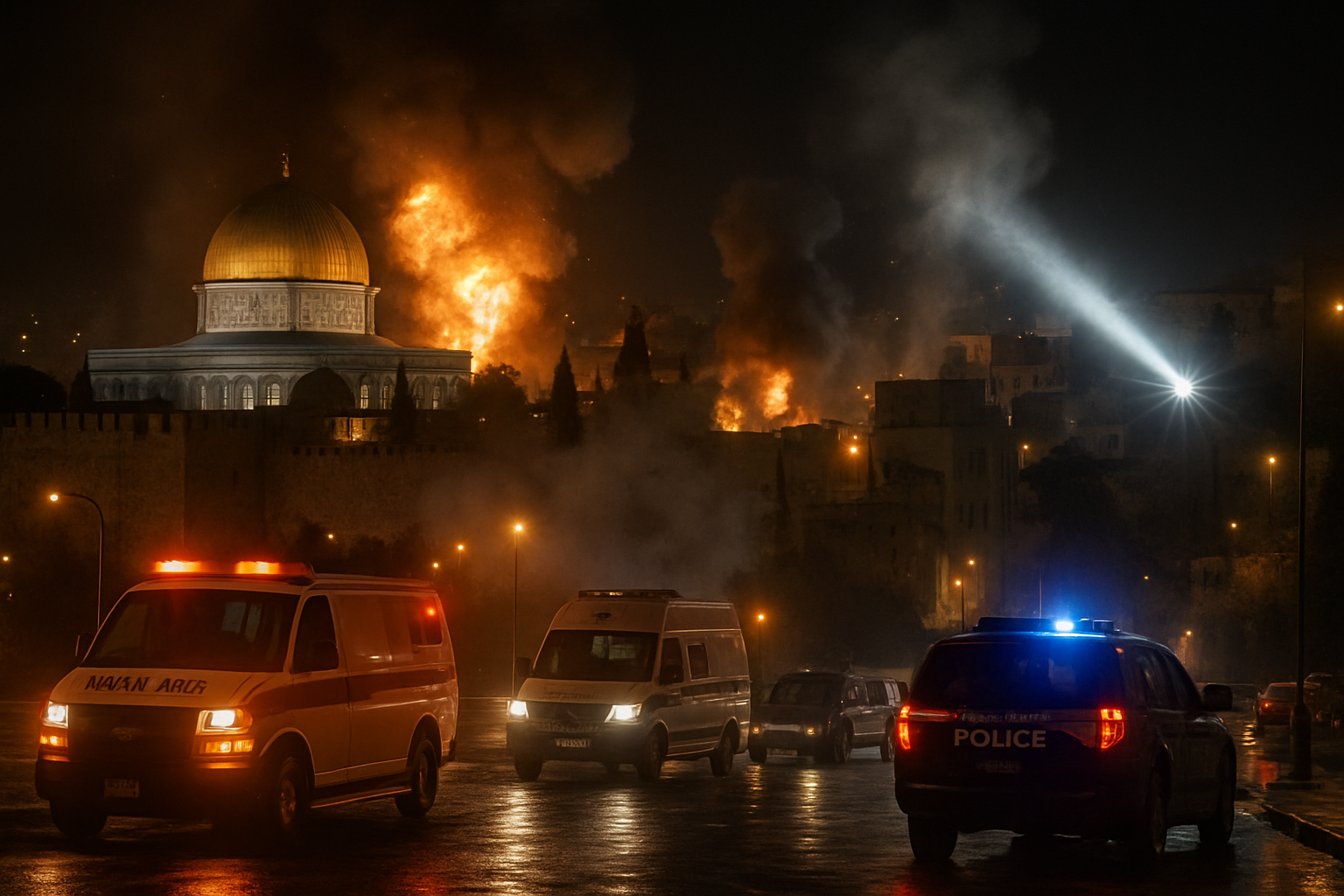
Despite recent ceasefire announcements, military strikes between Iran and Israel are continuing across multiple fronts, with new reports of explosions in Jerusalem and coordinated attacks on Gulf state infrastructure marking a dangerous escalation in the months-long regional conflict.
According to multiple sources, Iranian forces launched successive missile attacks targeting Israeli positions just hours after a temporary ceasefire was declared. Greek media reports confirm that Iranian Revolutionary Guard Corps (IRGC) forces conducted what they termed "three waves" of strikes against Jerusalem, with explosions reverberating across the historic city.
Expanding Regional Theater
The conflict has dramatically expanded beyond its original Iran-Israel bilateral scope, with Gulf states now finding themselves directly in the crosshairs. The United Arab Emirates, Kuwait, Qatar, and Saudi Arabia have all reported intercepting Iranian missiles and drones targeting critical infrastructure.
French sources confirm that Iran has claimed responsibility for strikes against a major petrochemical complex valued at $20 billion in Jubail, Saudi Arabia. The Islamic Revolutionary Guard Corps issued statements declaring that Gulf energy facilities are now considered "legitimate military targets" under their expanded operational doctrine.
"The regional coalition that once stood united in supporting diplomatic solutions is now severely strained as Iranian retaliation directly targets member territories."
— Regional Security Analyst
Egyptian President Abdel Fattah el-Sisi has condemned attacks on what he termed "sisterly Arab countries," warning of "comprehensive chaos" spreading across the Middle East. This marks a significant deterioration from the unprecedented Saudi-UAE-Qatar-Egypt consensus that had previously backed diplomatic engagement.
Nuclear Facilities in the Crosshairs
Perhaps most concerning are reports of strikes targeting nuclear infrastructure. Israeli forces have confirmed targeting Iran's uranium enrichment facilities, while Tehran has responded by launching hypersonic missiles toward the vicinity of Israel's Dimona nuclear research facility.
International atomic watchdogs have issued urgent warnings about the catastrophic potential of any direct hits on nuclear installations, emphasizing that such strikes could trigger radiological disasters with regional and global implications.
The current crisis emerged from the complete breakdown of nuclear negotiations that had achieved what many considered the most significant diplomatic progress since the 2018 collapse of the Joint Comprehensive Plan of Action (JCPOA). Despite achieving "broad agreement on guiding principles" during Geneva talks mediated by Switzerland and Oman, fundamental scope disagreements proved insurmountable.
Global Economic Disruption
The ongoing conflict has triggered unprecedented disruptions to global energy markets and supply chains. Oil prices have surged past $100 per barrel as Iran has effectively closed the Strait of Hormuz through naval mining operations, affecting approximately 40% of global oil transit.
The International Energy Agency has authorized the largest strategic petroleum reserve release in its 50-year history, releasing 400 million barrels in an attempt to stabilize markets. Natural gas prices have increased by 24% in Europe and 78% in the United States.

Aviation networks worldwide have been severely impacted, with over 18,000 flights cancelled - the most extensive disruption since the COVID-19 pandemic. Dubai International Airport, the world's busiest by passenger traffic, remains completely shut down due to missile damage.
Humanitarian Crisis Deepens
The humanitarian toll continues to mount as civilian casualties rise across multiple countries. The Iran Red Crescent reports over 787 civilian casualties from US-Israeli strikes, while Lebanese health authorities document hundreds killed as Hezbollah's involvement has completely collapsed the November 2024 ceasefire that had held for over a year.
International evacuations are now occurring on a scale not seen since the Arab Spring of 2011, with Australia reporting 115,000 nationals trapped in the region and Germany working to evacuate 30,000 stranded tourists and residents.
Congressional and International Pressure
In Washington, bipartisan congressional pressure is intensifying, with lawmakers demanding detailed explanations of strategy, costs, and the potential for ground troop deployment. Senator Richard Blumenthal has expressed being "more concerned than ever" about the possibility of boots on the ground.
The conflict's unpopularity among the American public is "almost unprecedented" for early-stage military operations, with only 25% support according to recent polling. Financial markets have emerged as what analysts call the "ultimate constraint" on further escalation.
Nuclear Governance Crisis
The crisis occurs against a backdrop of unprecedented nuclear governance challenges. The New START treaty between the United States and Russia expired on February 5, 2026, marking the first time in over 50 years without bilateral nuclear constraints between the world's two largest nuclear powers.
UN Secretary-General António Guterres has characterized the current period as having "the highest nuclear risks in decades," while describing the Middle East crisis as "the greatest test of multilateral cooperation in the modern era."
Template-Setting Implications
Beyond its immediate regional impact, this crisis is establishing precedents for how 21st-century conflicts involving nuclear powers might unfold. The rapid transition from diplomatic breakthrough to military confrontation demonstrates what experts term "multipolar era crisis management fragility."
The stakes extend far beyond the Middle East, encompassing global energy security, nuclear governance credibility, and international law enforcement mechanisms that have underpinned the post-World War II order.
"Success in containing this crisis could provide a framework for future nuclear crisis resolution, while failure may accelerate military solutions and reshape geopolitics for decades."
— UN Secretary-General António Guterres
Looking Ahead
As this crisis continues to unfold, the international community faces its most significant test of multilateral cooperation since the end of the Cold War. The decisions made in the coming days and weeks will likely reverberate through international relations for decades, affecting approaches to conflict resolution, energy architecture evolution, and the balance between diplomatic and military solutions to territorial and nuclear disputes worldwide.
The situation remains highly fluid, with multiple diplomatic channels reportedly working to prevent further escalation. However, the continuation of military strikes despite ceasefire announcements suggests that a negotiated resolution remains elusive, raising concerns about the potential for broader regional warfare with global implications.