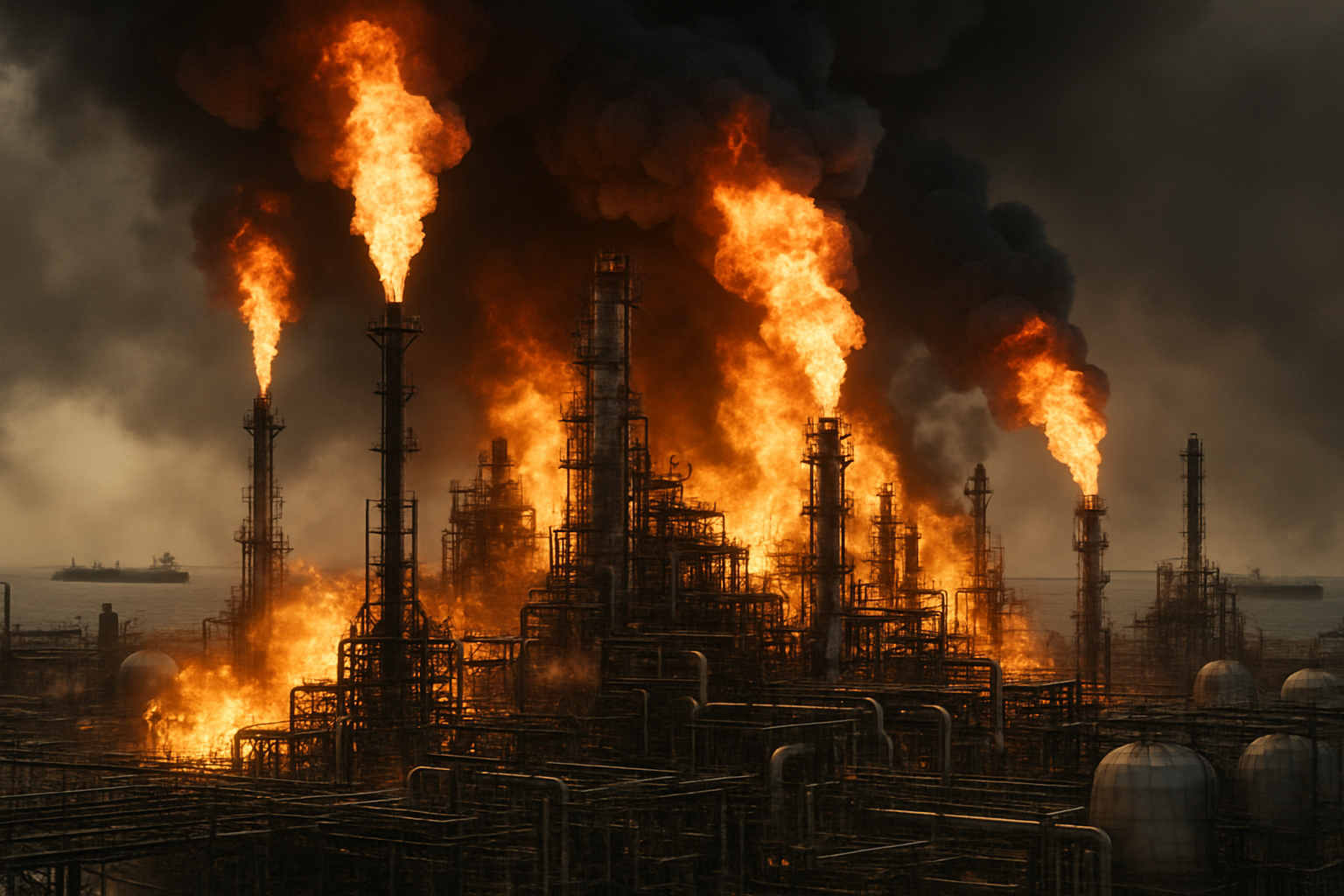
Israel launched its first major strikes against Iran's South Pars gas field - the world's largest natural gas reserve - while Iran retaliated with devastating attacks on Qatar's Ras Laffan energy complex, marking a catastrophic escalation that threatens global energy security and has sent oil prices soaring past $110 per barrel for the first time since March 2025.
The coordinated energy infrastructure attacks on March 18, 2026 represent the most dangerous development in the 18-day Iran-Israel war, with both sides targeting the critical energy assets that underpin the global economy. The strikes have prompted urgent international intervention as governments worldwide grapple with the implications of warfare directly targeting the world's energy lifelines.
Israel Strikes World's Largest Gas Field
Israeli forces conducted precision strikes against Iran's South Pars gas field complex, which contains an estimated 70% of Iran's natural gas reserves. The massive offshore field, shared with Qatar, represents one of the world's most significant energy assets, with daily production capacity exceeding 700 million cubic meters of natural gas.
"This will complicate the situation and could have uncontrollable consequences, the scope of which could engulf the entire world."
— Masoud Pezeshkian, Iranian President
According to multiple international sources, Israeli aircraft targeted petrochemical installations and processing facilities connected to the South Pars field. Iranian state media confirmed "significant damage" to infrastructure, though officials maintained that core production facilities remained operational.
The strikes represent Israel's first direct attack on Iran's energy infrastructure since the conflict began March 1, crossing a threshold that energy analysts have long warned could trigger catastrophic global economic consequences.
Iran Retaliates Against Qatar's Energy Hub
Within hours of the Israeli strikes, Iran launched ballistic missiles targeting Qatar's Ras Laffan Industrial City, home to the world's largest liquefied natural gas (LNG) export facility. QatarEnergy confirmed "extensive damage" to the complex, which handles approximately 20% of global LNG exports.
The Iranian attack sparked fires across the massive complex, with Qatar's Interior Ministry reporting that emergency teams were deployed to contain the blazes. No casualties were immediately reported, but the damage to critical infrastructure threatens global gas supplies, particularly to Europe and Asia.
Qatar's Foreign Ministry issued a strongly-worded condemnation, calling Iran's attack "a dangerous escalation that threatens regional security and stability." In an unprecedented diplomatic response, Qatar expelled two Iranian military attachés within 24 hours of the strike.
Global Energy Crisis Deepens
The energy infrastructure attacks have sent shockwaves through global markets, with Brent crude oil futures surging past $110 per barrel - the highest level since the early stages of the Iran war and representing a critical threshold that analysts warn could trigger worldwide economic disruption.
Natural gas prices have exploded, rising 24% in European markets and 78% in the United States as traders grapple with potential supply disruptions from both Iran and Qatar - two of the world's largest gas producers. The International Energy Agency (IEA) announced it is considering the largest strategic petroleum reserve release in its 50-year history to stabilize markets.
Airlines have begun implementing emergency fuel surcharges as jet fuel costs have jumped from $85-90 per barrel to $150-200 per barrel. Over 18,000 flights remain cancelled worldwide due to closed Middle Eastern airspace, creating the most severe aviation crisis since the COVID-19 pandemic.
Trump Warns Against Further Energy Attacks
President Donald Trump issued his strongest warning yet against attacks on energy infrastructure, stating that Iran has "received the message" following Israel's demonstration of capability against the South Pars field. According to Wall Street Journal reporting, Trump does not want further strikes on Iranian energy facilities, viewing the South Pars attack as sufficient messaging.
"Tehran has received the message. We don't want to see any more attacks on energy infrastructure that could destabilize global markets."
— Senior U.S. Official, speaking anonymously
The Trump administration has reportedly rejected British offers to join a naval coalition protecting shipping lanes, with the president stating America doesn't "need people to join wars we've already won." However, dozens of countries have condemned Iran's closure of the Strait of Hormuz at an emergency International Maritime Organisation meeting.
Regional Allies Under Pressure
The energy attacks have placed enormous strain on Gulf allies caught between their partnerships with the United States and Iranian threats against their own energy infrastructure. Saudi Arabia's air defenses intercepted multiple drones and ballistic missiles targeting oil facilities in the Eastern Province, while Kuwait has relocated some airline operations to Saudi Arabia due to repeated Iranian attacks.
The Gulf Cooperation Council issued an emergency statement condemning Iran's "blatant aggression against energy infrastructure," calling the attacks a violation of international law that threatens global economic stability.
Egypt's President Abdel Fattah el-Sisi warned of "comprehensive chaos" spreading across the region if energy infrastructure continues to be targeted, representing the concerns of Arab allies who have seen their own territories come under Iranian fire.
Economic Modeling Shows Devastating Scenarios
Australian Treasurer Jim Chalmers revealed that government economic modeling has examined "more drastic" fuel price scenarios, including projections where oil could reach $120 per barrel and take three years to return to pre-war levels. Such scenarios would trigger the most severe energy crisis since the 1970s oil shocks.
The attacks on critical energy infrastructure expose the fundamental vulnerability of the global economy to geopolitical shocks. The 21-mile-wide Strait of Hormuz, effectively closed by Iranian mining operations, normally handles 40% of the world's seaborne oil trade, making it perhaps the most critical chokepoint in global commerce.
Nuclear Diplomacy Remains Collapsed
The energy war escalation comes as nuclear diplomacy remains completely broken down. Despite achieving "broad agreement on guiding principles" in Geneva talks in February - the most progress since the 2018 JCPOA collapse - fundamental scope disagreements proved insurmountable.
Iran continues enriching uranium to 60% purity with over 400 kilograms of highly enriched material, approaching weapons-grade levels. With the New START treaty having expired February 5, 2026, the world faces its first period in over 50 years without US-Russia nuclear constraints, creating a broader nuclear governance crisis.
International Response Intensifies
The European Union has activated its ESTIA crisis response mechanism for the first time following Iranian drone attacks on British RAF Akrotiri base in Cyprus - marking the first attack on European territory since World War II. An unprecedented naval coalition including HMS Dragon, Spanish frigates, and vessels from Italy, France, Netherlands, and Greece is deploying to protect European territories.
UN Secretary-General António Guterres called the crisis "the greatest test of multilateral cooperation in the modern era," warning that the targeting of energy infrastructure could have "uncontrollable global consequences."
Humanitarian Concerns Mount
Beyond the economic implications, the conflict has created a mounting humanitarian crisis. Iran's Red Crescent reports over 787 civilian casualties from US-Israeli strikes, while international human rights organizations investigate potential Geneva Convention violations including attacks on medical facilities and schools.
The largest international evacuation since the Arab Spring is underway, with Australia reporting 115,000 nationals trapped in the region and Germany evacuating 30,000 tourists and citizens.
Historical Significance and Global Stakes
March 18, 2026 represents a watershed moment in international relations, demonstrating how rapidly diplomatic frameworks can collapse into military confrontation in the multipolar era. The crisis affects not just Middle Eastern stability but global energy architecture, nuclear governance, and the post-World War II international order.
The template-setting nature of this crisis will influence how future nuclear and territorial disputes are resolved - whether through diplomatic engagement or military escalation. The stakes extend far beyond the immediate participants, affecting energy markets, supply chains, aviation networks, and nuclear proliferation mechanisms worldwide.
As oil prices continue their relentless climb and energy infrastructure remains under attack, the world faces its most dangerous economic and security crisis since the Cold War, with implications that will extend decades beyond the current conflict.