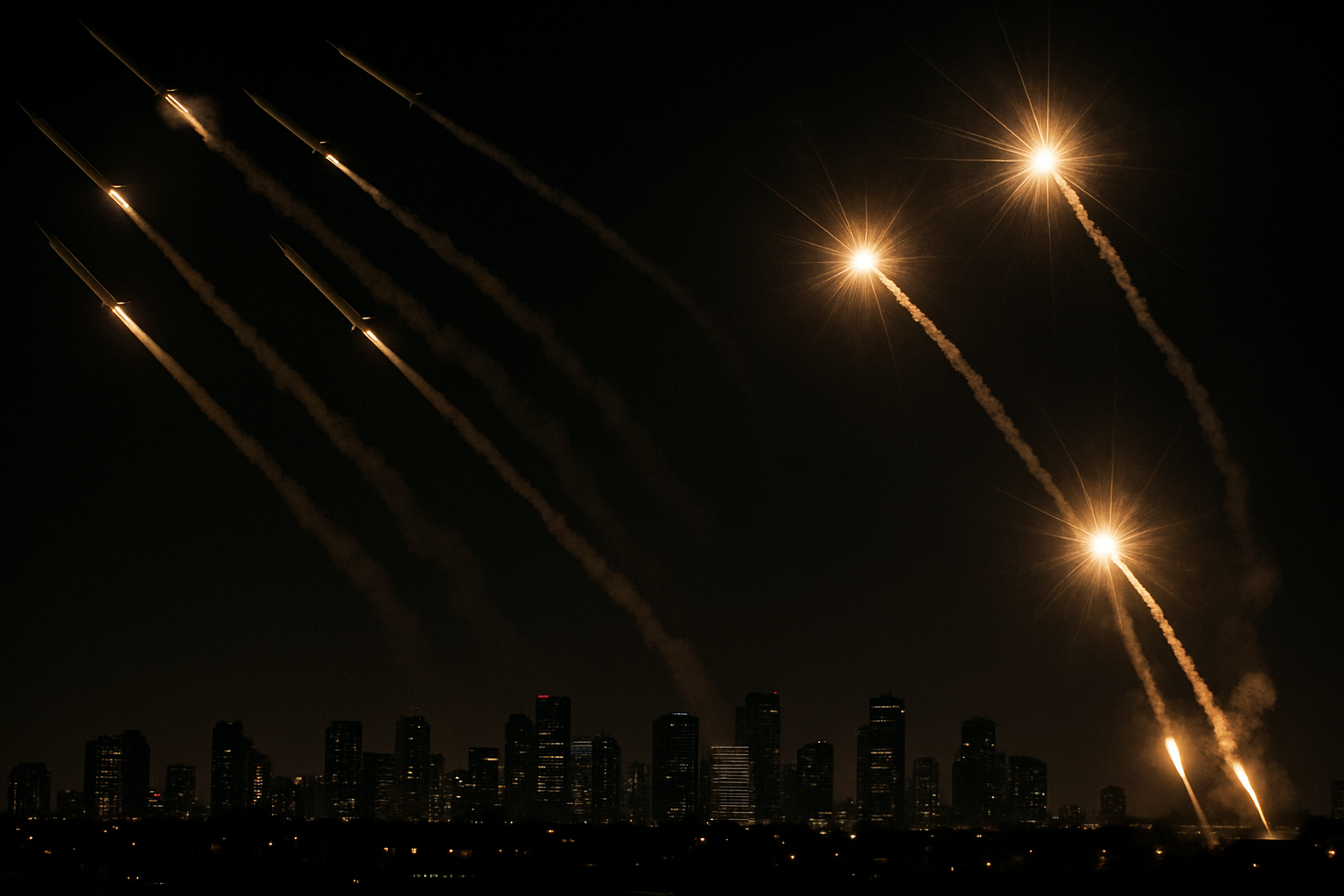
Iran launched multiple waves of missiles targeting Israeli cities including Tel Aviv and areas near the Dimona nuclear facility on Tuesday, even as President Donald Trump claimed the United States was holding "productive talks" with Tehran and announced a five-day delay in planned strikes on Iranian energy infrastructure.
The latest escalation comes as the brutal three-week war between Iran, Israel, and the United States enters its most dangerous phase yet, with global oil prices surging past $100 per barrel and over 18,000 flights cancelled worldwide in the most severe aviation crisis since COVID-19.
Trump's Diplomatic Gambit Amid Warfare
In a surprising development Tuesday morning, Trump announced via Truth Social that Washington and Tehran had held "very good and productive" conversations aimed at achieving a "complete and total resolution of hostilities." The President stated he was postponing planned strikes on Iran's energy infrastructure for five days to allow for continued dialogue.
"We have been having very good and productive conversations with representatives of Iran, aimed at a complete and total resolution of hostilities," Trump wrote, describing the talks as offering hope for ending the conflict that has devastated the Middle East since February 28.
However, Iran's parliament speaker Mohammad Bagher Qalibaf immediately dismissed Trump's claims as "fake news," calling them market manipulation tactics. Iranian officials categorically denied any direct negotiations with the United States, with multiple sources in Tehran describing Trump's statements as "psychological warfare."
Iran's Relentless Missile Campaign
Despite Trump's diplomatic overtures, Iran launched fresh waves of hypersonic missiles targeting Israeli cities throughout Tuesday. The attacks included sophisticated Khorramshahr-4 and Qadr missiles equipped with cluster warheads targeting areas near Israel's Dimona nuclear research facility—the first direct assault on Israeli nuclear infrastructure during the conflict.
Air raid sirens wailed across Tel Aviv as Iranian missiles triggered defensive responses from Israel's Iron Dome system. Explosions from interceptions lit up the night sky, with falling debris causing damage to homes in northern Israel. Israeli military sources reported intercepting most incoming projectiles, though several missile fragments struck populated areas.
The strikes represent Iran's ongoing "Operation True Promise 4" campaign, launched following the confirmed death of Supreme Leader Ali Khamenei on March 1 during the massive US-Israeli "Operation Epic Fury" assault—the largest coordinated Middle East military operation since the 2003 Iraq invasion.
Global Crisis Deepens
The war's economic impact has reached unprecedented levels, with Iran's closure of the Strait of Hormuz—through which 40% of global seaborne oil transits—using an estimated 2,000-6,000 naval mines to effectively blockade the critical waterway. Oil prices have surged to their highest levels since 2014, with analysts warning of potential $200-per-barrel costs if the conflict continues.
Aviation networks remain paralyzed, with Dubai International Airport—the world's busiest with 86 million passengers annually—remaining shuttered from missile damage. Eight Middle Eastern countries maintain simultaneous airspace closures, forcing complex rerouting of international flights and stranding hundreds of thousands of travelers globally.
The International Energy Agency has released a record 400 million barrels from strategic petroleum reserves—the largest intervention in the agency's 50-year history—in an attempt to stabilize global energy markets.
Regional Casualties Mount
Iranian retaliation has caused casualties across multiple Gulf nations, severely straining the unprecedented regional coalition that had supported diplomatic efforts. The United Arab Emirates reported one civilian killed in Abu Dhabi from missile debris, while Kuwait's international airport suffered drone strikes injuring 32 foreign nationals. Qatar intercepted 65 missiles and 12 drones using Patriot defense systems, with eight people injured by fragments.
Most dramatically, Iranian drones struck RAF Akrotiri in Cyprus—marking the first attack on European territory since World War II. The unprecedented strike has prompted a massive naval coalition response, with HMS Dragon and frigates from Spain, Italy, France, the Netherlands, and Greece deploying to protect European interests.
Trump's Controversial Energy Ultimatum
Even while claiming to pursue negotiations, Trump issued his most explicit energy infrastructure threat yet, demanding Iran "FULLY OPEN" the Strait of Hormuz within 48 hours or face US attacks that would "obliterate their POWER PLANTS, STARTING WITH BIGGEST FIRST."
The ultimatum represents an unprecedented civilian infrastructure targeting threat that has alarmed international observers. Energy warfare experts warn that strikes on power plants could affect Iran's 85 million civilians and potentially constitute violations of international humanitarian law.
Iran's Leadership Transition Under Fire
The conflict has coincided with Iran's most significant leadership transition since 1979. Following Ali Khamenei's confirmed death on March 1, his son Mojtaba Khamenei has emerged as the new Supreme Leader—marking the first hereditary succession in the Islamic Republic's 47-year history.
US Defense Secretary Pete Hegseth has claimed the new Iranian leader is "wounded and likely disfigured" from ongoing US-Israeli strikes, though these reports remain unverified. The Revolutionary Guards have assumed unprecedented control over Iranian governance, marking a historic shift from clerical to military leadership during active warfare.
Congressional Opposition Grows
Back in Washington, congressional scrutiny of the war has intensified dramatically. Senator Richard Blumenthal expressed being "more concerned than ever" about potential ground troop deployment, while Pentagon sources indicate operations could continue through September—far beyond the administration's initial 4-6 week timeline.
The conflict's unpopularity has reached "almost unprecedented" levels for early-stage military operations, with only 25% of Americans supporting the strikes according to recent polling. Financial markets have emerged as the "ultimate constraint" on further escalation, with Pakistan's stock exchange suffering its largest single-day decline in history.
Humanitarian Crisis Escalates
Iran's Red Crescent reports over 787 civilian casualties from US-Israeli strikes, while international evacuations have reached the largest scale since the Arab Spring in 2011. Australia has 115,000 nationals trapped in the region, while Germany reports 30,000 stranded tourists.
The most tragic symbol of the war's civilian cost remains the Minab elementary school attack, where 53-85 students and staff were killed during regular school hours. The Pentagon has confirmed US responsibility for the strike, attributing it to "outdated targeting data"—a revelation that has sparked Geneva Conventions investigations and widespread international condemnation.
Nuclear Diplomacy's Complete Collapse
The current military confrontation emerged from the complete breakdown of what had been the most promising nuclear negotiations in years. Geneva talks in February achieved "broad agreement on guiding principles"—the most significant progress since the 2018 JCPOA collapse.
However, fundamental disagreements proved insurmountable. Iran excluded ballistic missiles and regional proxy groups as "red lines" from nuclear-only discussions, while the United States demanded comprehensive agreements including missiles, armed groups, and human rights issues. Iran continues enriching uranium at 60% purity with over 400 kilograms of weapons-grade material—sufficient for multiple nuclear weapons if weaponized.
Global Template for 21st Century Crises
UN Secretary-General António Guterres has called the crisis the "greatest test of multilateral cooperation and crisis management in the modern era." The rapid transition from diplomatic breakthrough to military confrontation demonstrates the fragility of crisis management mechanisms in the multipolar era.
The conflict occurs amid a broader nuclear governance crisis, with the New START treaty having expired on February 5—the first time in over 50 years without US-Russia nuclear constraints. Combined with China's nuclear expansion, experts warn that nuclear risks have reached their "highest levels in decades."
Looking Ahead: Containment or Escalation
As the war enters its fourth week, the stakes could not be higher. Success in containing the conflict could provide a framework for future nuclear crisis resolution, while failure may accelerate military solutions for decades, encourage global proliferation, and fundamentally undermine diplomatic credibility worldwide.
Trump's claims of secret negotiations—vehemently denied by Iran—represent either a genuine diplomatic opening or a calculated pressure tactic. With oil prices soaring, global supply chains disrupted, and civilian casualties mounting, the coming days will determine whether this crisis can be resolved through dialogue or if the Middle East faces an even more dangerous escalation.
The world watches as the most consequential international crisis since the Cold War continues to unfold, with implications extending far beyond the Middle East to affect global energy security, nuclear governance, and the fundamental principles of post-World War II international order for decades to come.