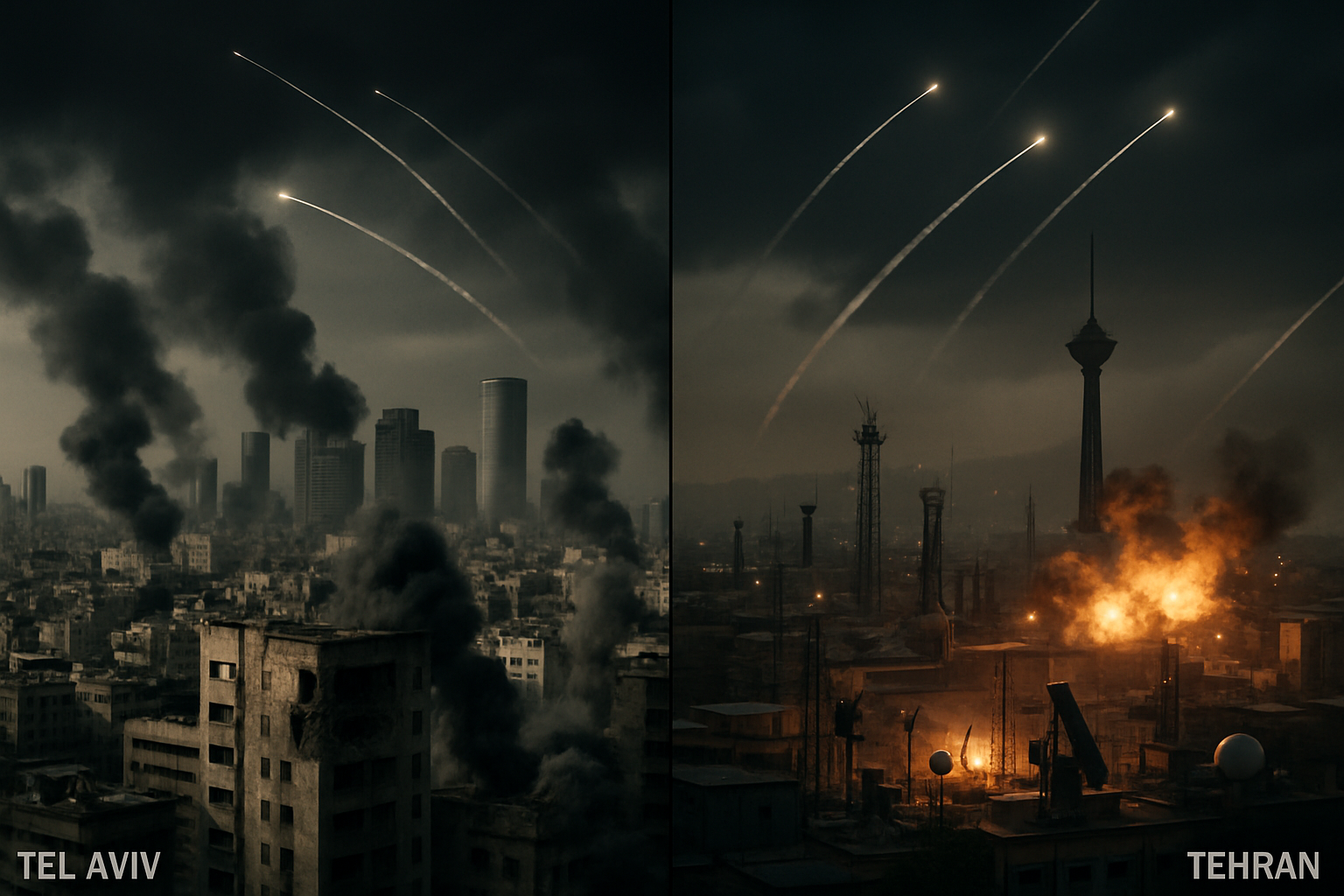
Iran launched devastating hypersonic missile strikes on Israeli cities including Tel Aviv Saturday evening, injuring at least 15 people, while Israel conducted its most intensive bombardment of Tehran since the beginning of the three-week Middle East war.
The exchange of direct military strikes marks the most dangerous escalation since the conflict began March 1 with the death of Iran's Supreme Leader Ali Khamenei in US-Israeli "Operation Epic Fury." Iran's Islamic Revolutionary Guard Corps (IRGC) used advanced Khorramshahr-4 and Qadr missiles equipped with cluster bomb warheads that scattered dozens of smaller explosives across wide areas of Tel Aviv and other Israeli cities.
Tel Aviv Under Fire
Israel's emergency service Magen David Adom (MDA) confirmed that at least 15 people sustained injuries in the ballistic missile attack on Tel Aviv, with most victims suffering light injuries. The Iranian missiles used cluster warheads carrying half-ton explosive payloads that created devastating damage patterns across the city.
"These attacks represent a dangerous escalation,"
— Lebanese President Joseph Aoun
The strikes targeted areas near critical infrastructure, with one missile hitting close to Tel Aviv's Savidor Center railway station, forcing the suspension of the Jerusalem-Herzliya train line. The Jerusalem train line has since restarted after repairs to platforms damaged by cluster munitions.
Israel's Military Response
Israeli forces responded with what Prime Minister Benjamin Netanyahu described as "systematic strikes" against Iranian military targets across Tehran. The Israeli Defense Forces (IDF) conducted parallel strikes on Iranian Intelligence Ministry headquarters and Internal Security Forces emergency centers, representing the most comprehensive targeting of Iranian government infrastructure since the war began.
Netanyahu personally contacted mayors of affected Israeli cities to coordinate emergency responses, promising full government support for rescue operations. Israeli defense systems were penetrated by Iran's hypersonic capabilities and unconventional flight patterns, highlighting vulnerabilities in the Iron Dome air defense network.
Global Reach of Iranian Missiles
In a demonstration of expanding operational capabilities, Iran simultaneously fired ballistic missiles at the UK-US military base Diego Garcia in the Indian Ocean, approximately 4,000 kilometers from Iranian territory. While both missiles failed to hit their target, the strikes represent the furthest projection of Iranian military power during the current conflict.
The Diego Garcia targeting signals Iran's attempt to challenge Western power projection capabilities far beyond the Middle East, affecting global strategic calculations about regional conflict containment.
European Territory Under Attack
Iranian forces have also struck RAF Akrotiri in Cyprus - marking the first attack on European territory since World War II. This unprecedented escalation prompted the deployment of an international naval coalition including HMS Dragon and Spanish frigates to protect European assets in the eastern Mediterranean.
Energy Infrastructure Warfare
The current escalation comes amid a broader energy war, with Israel having previously struck Iran's South Pars gas field - the world's largest natural gas reservoir providing 70% of Iran's gas supply. Iran retaliated by attacking Qatar's Ras Laffan Industrial City, which handles approximately 20% of global LNG exports, causing "extensive damage" according to Qatari officials.
Oil prices have surged past $100 per barrel as Iran has effectively closed the Strait of Hormuz through naval mining, blocking 40% of global seaborne oil transit. The International Energy Agency has released a record 400 million barrels from strategic reserves - the largest intervention in the agency's 50-year history.
Aviation Crisis Reaches Peak
The conflict has created an unprecedented global aviation crisis, with over 18,000 flights cancelled worldwide - the most extensive disruption since COVID-19. Eight Middle Eastern countries have simultaneously closed their airspace, with Dubai International Airport, the world's busiest, remaining completely shut down due to missile damage.
Major carriers including Emirates, Air France-KLM, and Wizz Air have suspended operations indefinitely, affecting hundreds of thousands of passengers globally and severing critical Asia-Europe flight corridors.
Trump's 48-Hour Ultimatum
President Trump has issued his most explicit energy infrastructure threat, posting on Truth Social a demand that Iran "FULLY OPEN, WITHOUT THREAT, the Strait of Hormuz, within 48 HOURS" or the US will "hit and obliterate their various POWER PLANTS, STARTING WITH THE BIGGEST ONE FIRST." The ultimatum represents unprecedented energy warfare threatening civilian infrastructure.
Nuclear Diplomacy Collapse
The current military escalation emerged from the complete breakdown of nuclear negotiations despite achieving "broad agreement on guiding principles" in Geneva talks - the most significant diplomatic progress since the 2018 JCPOA collapse. The fundamental disagreement over scope proved insurmountable, with Iran excluding ballistic missiles and regional proxies as "red lines" while the US demanded comprehensive agreements including missiles, armed groups, and human rights issues.
Iran continues enriching uranium to 60% purity with over 400 kilograms of material approaching weapons-grade levels, sufficient for multiple nuclear weapons if weaponized.
Succession Crisis in Iran
Following Supreme Leader Khamenei's death March 1, Iran faces its first hereditary succession in the Islamic Republic's 47-year history. Mojtaba Khamenei, the late leader's son, has been appointed as the new Supreme Leader, consolidating Revolutionary Guards control over governance during the active warfare.
This shift from clerical to military governance represents a fundamental transformation of Iran's political structure, with CIA assessments suggesting unprecedented military influence over state decisions.
Regional Coalition Under Strain
The unprecedented Saudi Arabia, UAE, Qatar, and Egypt coalition that had supported diplomatic solutions is now severely strained as Iranian retaliation has directly targeted member territories. Egyptian President Sisi condemned attacks on "sisterly Arab countries" while warning of "comprehensive chaos" spreading across the region.
Congressional Opposition Mounting
In Washington, bipartisan lawmakers are demanding answers about strategy, costs, and the potential for ground troop deployment. Senator Richard Blumenthal stated he is "more concerned than ever" about boots on the ground. Operation Epic Fury has cost $11.3 billion in its first week alone, with Pentagon operations extending through September - far beyond initial 4-6 week timelines.
The conflict's unpopularity is "almost unprecedented" for early-stage military operations, with only 25% American public support according to recent polling.
Humanitarian Crisis Deepening
Iran's Red Crescent reports over 787 civilian casualties from US-Israeli strikes, including the devastating Minab elementary school attack that killed between 53-85 students and staff. The Pentagon has confirmed US responsibility for elementary school strikes involving 165-185 student casualties due to "outdated targeting data."
International evacuations have reached Arab Spring 2011 levels, with Australia reporting 115,000 nationals trapped in the region and Germany attempting to extract 30,000 stranded tourists.
Global Economic Disruption
The conflict has exposed fundamental vulnerabilities in global supply chains dependent on Gulf logistics networks. Manufacturing in automotive, electronics, and textiles sectors faces severe disruption. Pakistan's stock exchange suffered its largest single-day decline in history at -8.97%, while airlines are implementing emergency fuel surcharges as jet fuel costs have jumped from $85-90 to $150-200 per barrel.
Template-Setting Crisis
UN Secretary-General António Guterres has called this "the greatest test of multilateral cooperation and crisis management in the modern era." The rapid transition from diplomatic breakthrough to military confrontation demonstrates the fragility of crisis management mechanisms in the multipolar era.
"The world will never be the same again,"
— Israeli analyst Naomi Bar-Yaacov
The stakes extend far beyond the Middle East, affecting regional war prevention, global energy security, nuclear governance credibility, and international law enforcement of post-WWII order principles simultaneously. Success in containing the crisis could provide a framework for future nuclear crisis resolution, while failure may accelerate military solutions for decades, encouraging proliferation globally and undermining diplomatic credibility worldwide.
As the conflict enters its fourth week, the exchange of hypersonic missiles and systematic bombardments represents the most dangerous moment since the Cold War's end, with implications extending decades beyond current events and determining diplomatic versus military solutions precedent for 21st-century territorial and nuclear disputes globally.