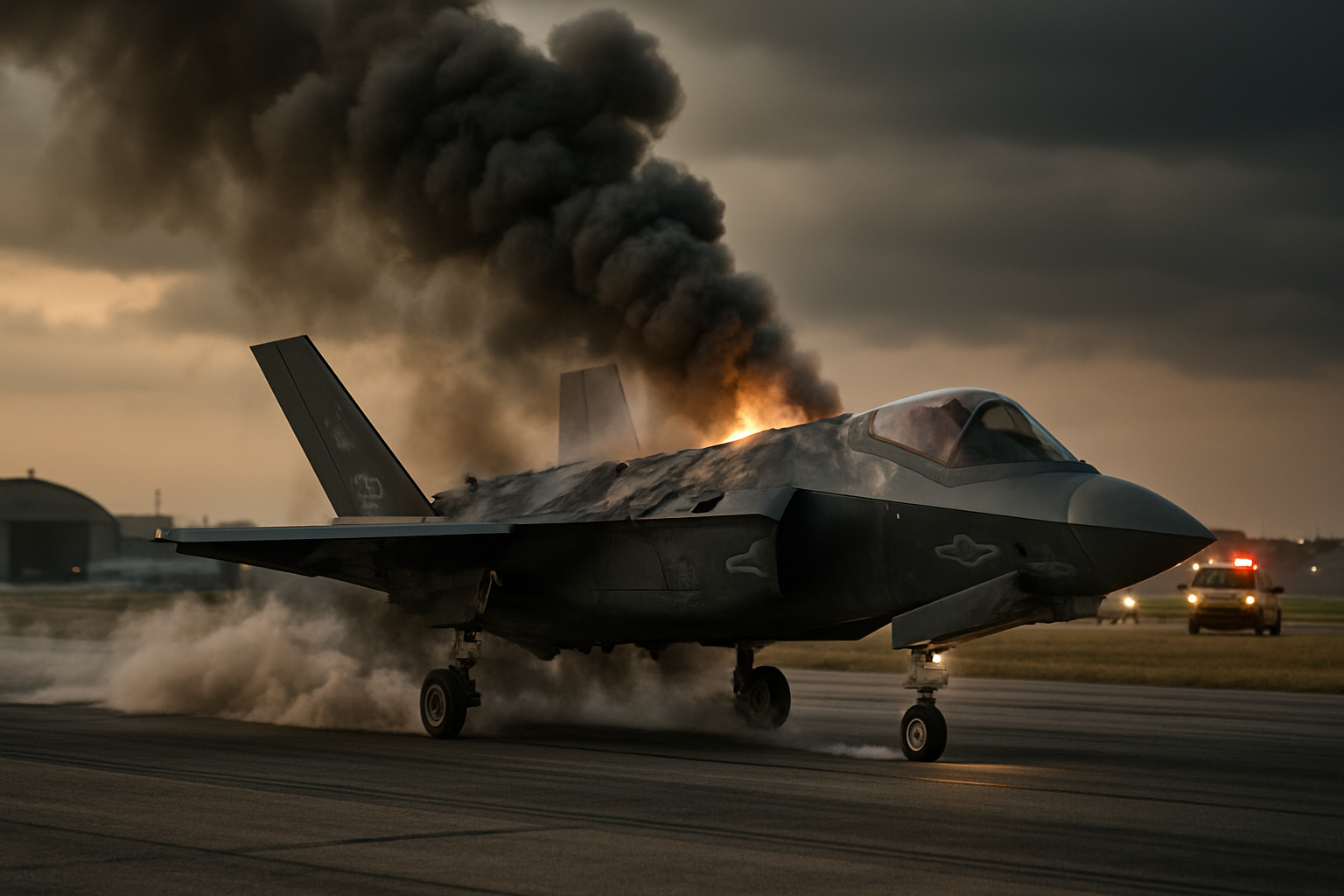
Iranian forces scored their first confirmed strike against a US F-35 stealth fighter jet on Thursday, forcing the $100 million aircraft to make an emergency landing after a combat mission over central Iran, while the Pentagon submitted a historic $200 billion funding request to sustain military operations in what has become the most dangerous international crisis since the Cold War.
US Central Command spokesman Captain Tim Hawkins confirmed the aircraft "was flying a combat mission over Iran" when it was hit by Iranian air defense systems at approximately 2:50 AM local time. The pilot landed safely and is in stable condition, marking a significant symbolic victory for Iran against American air superiority after three weeks of intensive US-Israeli bombardment.
The strike comes as the conflict has escalated far beyond its original scope, with Iran launching systematic attacks on Gulf energy infrastructure while Israeli forces target Iranian nuclear facilities and leadership. The Pentagon's $200 billion request represents the largest emergency military appropriation in recent history, with Defense Secretary Pete Hegseth stating bluntly: "It takes money to kill bad guys."
Energy Infrastructure Under Attack
Iran has dramatically expanded its military campaign beyond Israel, launching devastating attacks on energy facilities across Qatar, UAE, and Saudi Arabia. The Revolutionary Guard's "Operation True Promise 4" has abandoned previous restraints on civilian infrastructure, declaring oil and gas facilities in Gulf states "legitimate targets."
The attacks came in retaliation for Israel's "complete destruction" of Iran's South Pars gas field - the world's largest natural gas reservoir containing 70% of Iran's gas supply. QatarEnergy confirmed "extensive damage" to the Ras Laffan Industrial City, which handles approximately 20% of global LNG exports, threatening severe shortages for European consumers.
"The infraestructure of extraction and distribution of hydrocarbons has become the front line, where the capacity of the contenders to continue with a conflict that threatens to extend its effects throughout the planet is settled."
— El País International Analysis
Oil prices have surged past $110 per barrel, with Brent crude reaching $119.50 and WTI hitting $108.15 - representing an 18.98% record jump. Iran has deployed between 2,000-6,000 naval mines in the Strait of Hormuz, effectively closing the waterway that carries 40% of global seaborne oil transit.
Global Aviation Crisis
The conflict has created an unprecedented global aviation crisis, with over 18,000 flights cancelled worldwide - the most severe disruption since COVID-19. Eight Middle Eastern countries maintain simultaneous airspace closures, severing critical Asia-Europe flight corridors.
Dubai International Airport, the world's busiest with 86 million passengers annually, remains completely shut down due to missile damage. Major carriers including Emirates, Air France-KLM, and Wizz Air have suspended operations indefinitely, affecting hundreds of thousands of passengers globally.
Airlines are implementing emergency fuel surcharges as jet fuel costs have jumped from $85-90 to $150-200 per barrel, with Australian carriers Qantas and Air New Zealand announcing significant fare increases.
Nuclear Diplomacy Collapses
The current military escalation emerged from the complete breakdown of Geneva nuclear negotiations, despite what officials described as "broad agreement on guiding principles" - the most promising diplomatic opening since the JCPOA collapse in 2018.
The fundamental disagreement proved insurmountable: Iran excluded ballistic missiles and regional proxies as "red lines," demanding nuclear-only compartmentalized talks, while US Secretary of State Marco Rubio insisted on a comprehensive agreement addressing missiles, armed groups, and human rights.
Iran continues enriching uranium at 60% purity with over 400kg of weapons-grade material - sufficient for multiple nuclear weapons if weaponized. The diplomatic collapse occurs amid a broader nuclear governance crisis, with the New START treaty having expired on February 5, marking the first time in over 50 years without US-Russia nuclear constraints.
Iranian Leadership Transition
The conflict has been complicated by Iran's unprecedented wartime succession crisis. Following Supreme Leader Ali Khamenei's death on March 1, his son Mojtaba Khamenei has assumed power in the first hereditary succession in the Islamic Republic's 47-year history.
Defense Secretary Hegseth claims the new Supreme Leader is "wounded and likely disfigured" from ongoing US-Israeli strikes, though this cannot be independently verified. CIA assessments suggest the Revolutionary Guards have consolidated unprecedented control over Iranian governance, representing a fundamental shift from clerical to military leadership.
Israeli forces have systematically targeted Iranian leadership, with Foreign Minister Israel Saar claiming they eliminated officials with "$10 million bounties" including Intelligence Minister Esmail Khatib and security chief Ali Larijani, described as a "de facto leader" during the succession crisis.
Congressional Opposition Mounts
The Pentagon's $200 billion funding request faces stiff opposition in Congress, with lawmakers from both parties demanding comprehensive answers about strategy, costs, and the potential for ground troop deployment.
Senator Richard Blumenthal stated he is "more concerned than ever" about the prospect of "boots on the ground," while the conflict maintains historically low public support at just 25% - described as "almost unprecedented" for early-stage military operations.
Operation Epic Fury has already cost $11.3 billion in the first week alone, with 150 US troops wounded (8 in critical condition) and 3 confirmed killed. The Pentagon is reportedly preparing operations through September, far beyond the initial 4-6 week timeline presented to Congress.
Regional Coalition Under Strain
The unprecedented Saudi/UAE/Qatar/Egypt coalition that initially supported diplomatic solutions is severely strained as Iranian retaliation directly targets member territories. Egyptian President Abdel Fattah el-Sisi condemned attacks on "sisterly Arab countries," warning of "comprehensive chaos" spreading across the region.
Regional casualties from Iranian strikes include one civilian killed in Abu Dhabi, 32 foreign nationals injured in Kuwait airport strikes, and 8 injured in Qatar despite Patriot missile systems intercepting 65 missiles and 12 drones. Cyprus's RAF Akrotiri base was struck in the first attack on European territory since World War II.
Qatar expelled Iranian military and security attachés within 24 hours of the Ras Laffan attack, marking a complete diplomatic rupture. Kuwait has relocated Jazeera Airways operations to Saudi Arabia due to repeated drone attacks on its airports.
Humanitarian Crisis Deepens
Iran's Red Crescent reports over 787 civilian casualties from US-Israeli strikes, including a Pentagon-confirmed elementary school attack that killed 165-185 students using "outdated targeting data." The Minab school attack has drawn international condemnation and Geneva Conventions investigations.
The conflict has triggered the largest international evacuation since the Arab Spring in 2011, with Australia reporting 115,000 nationals trapped and Germany evacuating 30,000 stranded tourists. The European Union activated its ESTIA evacuation plan for Cyprus for the first time in the bloc's history.
In Lebanon, Hezbollah's entry into the conflict has resulted in 826 killed and 832,000 displaced, with systematic targeting of medical personnel resulting in 26 paramedics killed and 51 wounded - potential Geneva Conventions violations.
Economic Shockwaves
The crisis has exposed fundamental vulnerabilities in global supply chains dependent on Gulf logistics networks. Manufacturing sectors including automotive, electronics, and textiles are severely disrupted, with the Persian Gulf's role as a critical Asia-Europe trade hub completely compromised.
Stock markets have crashed worldwide, with Pakistan's KSE-100 recording an 8.97% decline - the largest single-day drop in the country's history. PayPal postponed its $1.1 billion IPO due to market volatility, while natural gas prices have surged 24% in Europe and 78% in the United States.
The International Energy Agency has released a record 400 million barrels from strategic petroleum reserves - the largest intervention in the agency's 50-year history. However, energy ministers warn this provides only temporary relief, with Qatar's Energy Minister Saad Al Kaabi cautioning that Gulf states may declare force majeure "within weeks" if the conflict continues.
International Response
UN Secretary-General António Guterres has called the crisis the "greatest test of multilateral cooperation in the modern era," while an unprecedented naval coalition including HMS Dragon and Spanish, Italian, French, Dutch, and Greek vessels has deployed to protect Cyprus following the first European territory attack since World War II.
However, Trump has rejected offers of assistance from traditional allies, telling Britain he doesn't "need people to join wars we've already won" and demanding "unconditional surrender" from Iran while claiming the right to personally choose the next Iranian Supreme Leader.
China and Russia have issued their strongest condemnations in years, with Beijing describing the strikes as "serious sovereignty violations" and Moscow warning of broader consequences for international stability.
Historical Significance
March 19, 2026, represents a watershed moment in international relations, with implications extending decades beyond current events. The rapid transition from diplomatic breakthrough to military escalation demonstrates the fragility of crisis management in the multipolar era.
The USS Charlotte submarine's sinking of the Iranian frigate IRIS Dena marked the first enemy vessel destroyed by a US submarine since World War II, while Iran's successful strike on the F-35 represents the first time Iranian forces have hit a US aircraft since the conflict began.
Stakes include regional war prevention, global energy security, nuclear governance credibility, and international law enforcement - all tested simultaneously in what experts describe as the most consequential crisis affecting post-World War II order principles.
Looking Ahead
With no diplomatic solution visible and Trump's demands for "unconditional surrender" eliminating negotiated outcomes, the conflict appears likely to continue escalating. Iran's new Supreme Leader Mojtaba Khamenei has vowed to keep the Strait of Hormuz closed and continue Gulf attacks, while Israeli Prime Minister Netanyahu announced a "systematic plan" to "eradicate" Iran's regime with "many surprises" planned.
The template being set by this crisis will likely influence international approaches to nuclear disputes, territorial conflicts, and crisis management for the 21st century. Success in containing the conflict could provide a framework for future diplomatic interventions, while failure may accelerate military solutions globally, reshaping international relations for decades.
"This is the greatest test of multilateral cooperation in crisis management in the modern era. The decisions made in the coming days and weeks will reverberate through international relations for decades."
— UN Secretary-General António Guterres
As the conflict enters its fourth week, the world watches whether escalation can be contained or whether this crisis will fundamentally reshape the post-Cold War international order, with implications for energy security, nuclear governance, and the credibility of diplomatic solutions extending far beyond the current events in the Middle East.