Iran launched ballistic missiles at the UK-US military base Diego Garcia in the Indian Ocean while Israel struck Iran's Natanz nuclear enrichment facility, marking the most significant escalation in the three-week Middle East conflict as warfare extends thousands of kilometers beyond traditional regional boundaries.
The Iranian attack on Diego Garcia, located approximately 4,000 kilometers from Iranian territory, represents the furthest projection of Iranian military power in the current conflict and demonstrates missile capabilities that exceed what adversaries previously believed possible, according to Iranian state media. The missiles did not hit their target, with one failing in flight while a US warship fired an interceptor at the second, according to The Wall Street Journal.
Nuclear Facility Under Attack
In a coordinated response, US and Israeli forces targeted Iran's Natanz uranium enrichment facility Saturday morning, marking the first direct strike on Iranian nuclear infrastructure during the escalating conflict. Iran's Atomic Energy Organization confirmed no radioactive leaks occurred and residents face no immediate danger, while the International Atomic Energy Agency (IAEA) reported no increases in off-site radiation levels.
The Natanz facility has been central to Iran's nuclear program, where the country continues uranium enrichment at 60% purity with over 400 kilograms of weapons-grade material sufficient for multiple nuclear weapons if weaponized. The IAEA has warned of "maximum restraint" needed to avoid nuclear accidents as the conflict escalates.
"The Iranian attack on the Diego Garcia air base suggested Tehran has in its stockpile missiles that can go farther than it had previously acknowledged."
— 9News Australia, March 21, 2026
Global Crisis Unprecedented Scale
The conflict, now in its fourth week, has created the most severe international crisis since the Cold War. Over 18,000 flights have been cancelled worldwide - the most extensive disruption since COVID-19 - as eight Middle Eastern countries maintain simultaneous airspace closures. Dubai International Airport, the world's busiest, remains completely shut down from missile damage.
Oil prices have surged past $100 per barrel as Iran has effectively closed the Strait of Hormuz, through which 40% of global seaborne oil transit flows. The International Energy Agency has released a record 400 million barrels from strategic reserves in the largest intervention in the agency's 50-year history.
European Territory Attacked for First Time Since WWII
Iranian drones struck RAF Akrotiri in Cyprus, marking the first attack on European territory since World War II and fundamentally altering the conflict's scope. This has prompted an unprecedented naval coalition response, with HMS Dragon, Spanish frigates, and vessels from Italy, France, the Netherlands, and Greece deploying to protect European interests.
The European Union activated its ESTIA crisis evacuation mechanism for the first time in the bloc's history, as Cyprus coordinates the largest international evacuation since the Arab Spring of 2011. Australia has 115,000 nationals trapped in the region, while Germany is evacuating 30,000 stranded tourists.
Iranian Leadership Crisis
Following the confirmed death of Supreme Leader Ali Khamenei on March 1, Iran has undergone its first hereditary succession in the Islamic Republic's 47-year history. Mojtaba Khamenei, the former leader's son, has been appointed as the new Supreme Leader, consolidating Revolutionary Guards control over governance during active warfare.
CIA assessments suggest this represents a fundamental shift from clerical to military governance, with the Revolutionary Guards gaining unprecedented influence over Iranian state apparatus during the constitutional crisis created by wartime succession.
Operation Epic Fury Costs Mount
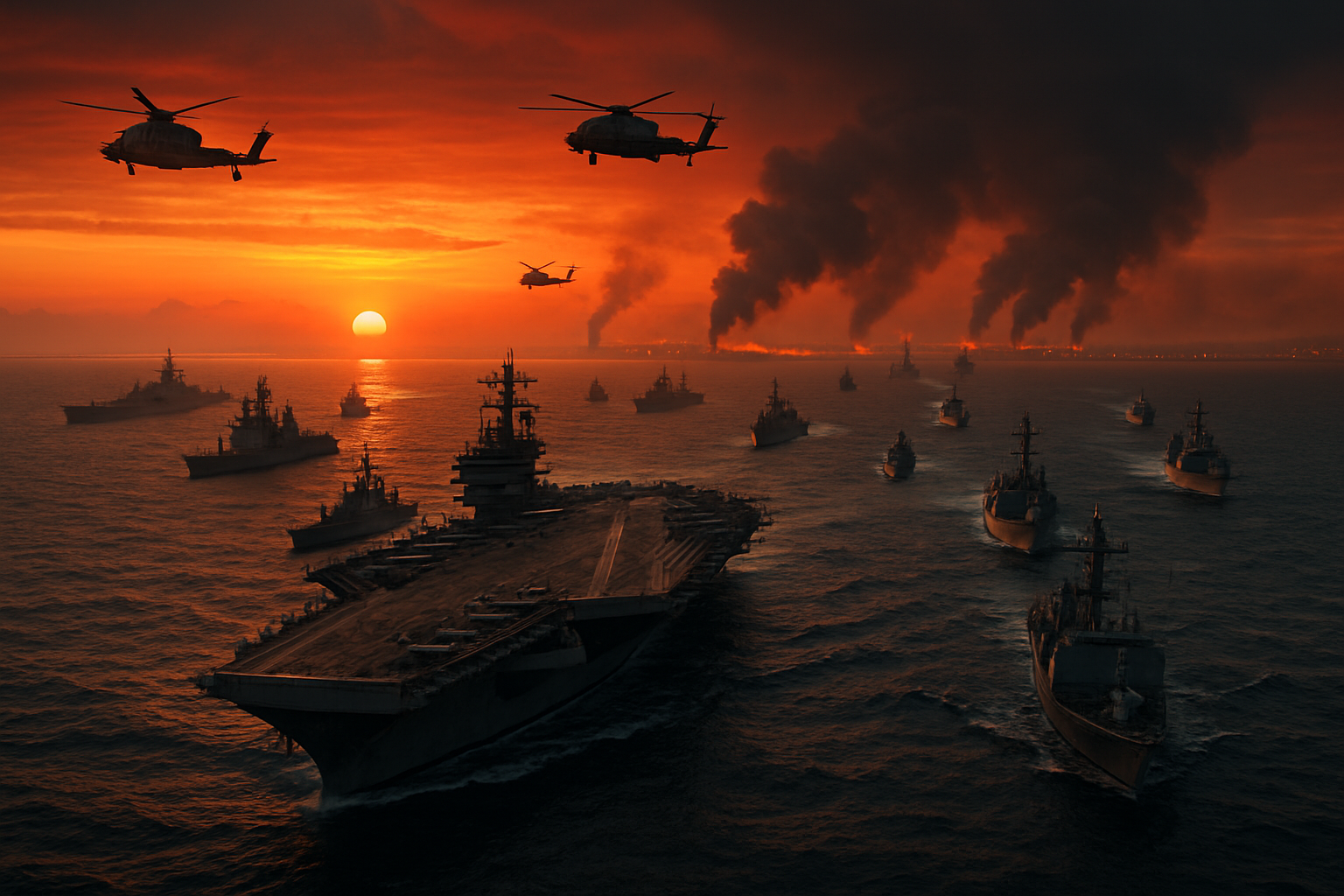
The US-Israeli campaign "Operation Epic Fury," the largest coordinated military operation since the 2003 Iraq invasion, has cost $11.3 billion in its first week alone. The operation employs dual-carrier deployment of the USS Gerald Ford and USS Abraham Lincoln, representing approximately one-third of the active US Navy fleet.
First US casualties have been confirmed: three service members killed and five wounded, marking the first American deaths in the largest Middle East operation since 2003. The Pentagon has prepared operations through September, far beyond the initial 4-6 week timeline.
"Israel's defense minister threatened a surge in attacks against Iran on Saturday and Britain condemned Iran for targeting a joint UK-US base in the Indian Ocean as the war in the Middle East entered its fourth week."
— 9News Australia, March 21, 2026
Regional Coalition Under Strain
Iran's "Operation True Promise 4" systematic retaliation campaign has severely strained the unprecedented regional coalition of Saudi Arabia, UAE, Qatar, and Egypt that had supported diplomatic solutions. Iranian attacks have directly targeted member territories, with casualties reported across the Gulf:
- UAE: 1 civilian killed in Abu Dhabi from missile debris, Dubai International Airport shut down
- Kuwait: 32 foreign nationals injured in airport drone strikes
- Qatar: 8 injured despite intercepting 65 missiles and 12 drones with Patriot systems
- Cyprus: RAF Akrotiri base struck in first European territory attack since WWII
Egyptian President Sisi has condemned attacks on "sisterly Arab countries" while warning of "comprehensive chaos" spreading across the region.
Nuclear Diplomacy Collapse
The current military escalation emerged from the complete breakdown of nuclear negotiations despite achieving "broad agreement on guiding principles" in Geneva - the most significant progress since the 2018 JCPOA collapse. Iran maintained ballistic missiles and regional proxies as "red lines" excluded from nuclear-only talks, while the US demanded comprehensive agreements including missiles, armed groups, and human rights.
The crisis occurs amid broader nuclear governance breakdown, with the New START treaty having expired on February 5, marking the first time in over 50 years without US-Russia nuclear constraints. UN Secretary-General António Guterres has warned that nuclear risks are at their "highest in decades."
Humanitarian Crisis Mounting
Iran's Red Crescent reports over 787 civilian casualties from US-Israeli strikes, including a devastating attack on Minab elementary school that killed 53-85 students and staff. The Pentagon has confirmed US responsibility for the school strike, citing "outdated targeting data."
Lebanon has been drawn into the conflict as Hezbollah joined fighting in retaliation for Khamenei's death, completely collapsing the November 2024 ceasefire that had held for over a year. Lebanese casualties have reached 826 killed with 832,000 displaced, while systematic targeting of medical personnel has resulted in 26 paramedics killed and 51 wounded.
Congressional Opposition Intensifies
Bipartisan lawmakers in Congress are demanding comprehensive briefings on strategy, costs, and potential ground troop deployment. Senator Richard Blumenthal stated he is "more concerned than ever" about the prospect of "boots on the ground." The conflict enjoys historically low public support at just 25% approval among Americans.
Financial markets have emerged as the "ultimate constraint" on escalation, with Pakistan's KSE-100 suffering an 8.97% decline - the largest single-day drop in the country's history. The PayPal IPO worth $1.1 billion has been postponed due to market volatility.
Template-Setting Historical Moment
UN Secretary-General Guterres has called the crisis the "greatest test of multilateral cooperation and crisis management in the modern era." The rapid transition from diplomatic breakthrough to military confrontation demonstrates the fragility of crisis management mechanisms in the multipolar era.
The stakes include regional war prevention, global energy security, nuclear governance credibility, and international law enforcement under post-WWII order principles - all being tested simultaneously. Success in containment could provide a framework for future nuclear crisis resolution, while failure may accelerate military solutions globally, encouraging proliferation and undermining diplomatic credibility worldwide.
Energy Architecture Under Threat
The Persian Gulf crisis has exposed the fundamental vulnerability of global supply chains dependent on strategic chokepoints. Manufacturing sectors including automotive, electronics, and textiles face severe disruption as the region serves as a critical Asia-Europe trade hub.
Airlines have implemented emergency fuel surcharges as jet fuel costs surge from $85-90 per barrel to $150-200. Natural gas prices have increased 24% in Europe and 78% in the United States, while Qatar has halted LNG production representing approximately 20% of global exports.
The March 21, 2026 escalation represents a watershed moment in international relations, determining the precedent for diplomatic versus military solutions in 21st-century territorial and nuclear disputes. Most consequentially, this crisis affects Middle East stability, global energy architecture evolution, and conflict resolution approaches with implications extending decades beyond current events, fundamentally testing the sustainability of the post-Cold War international order.