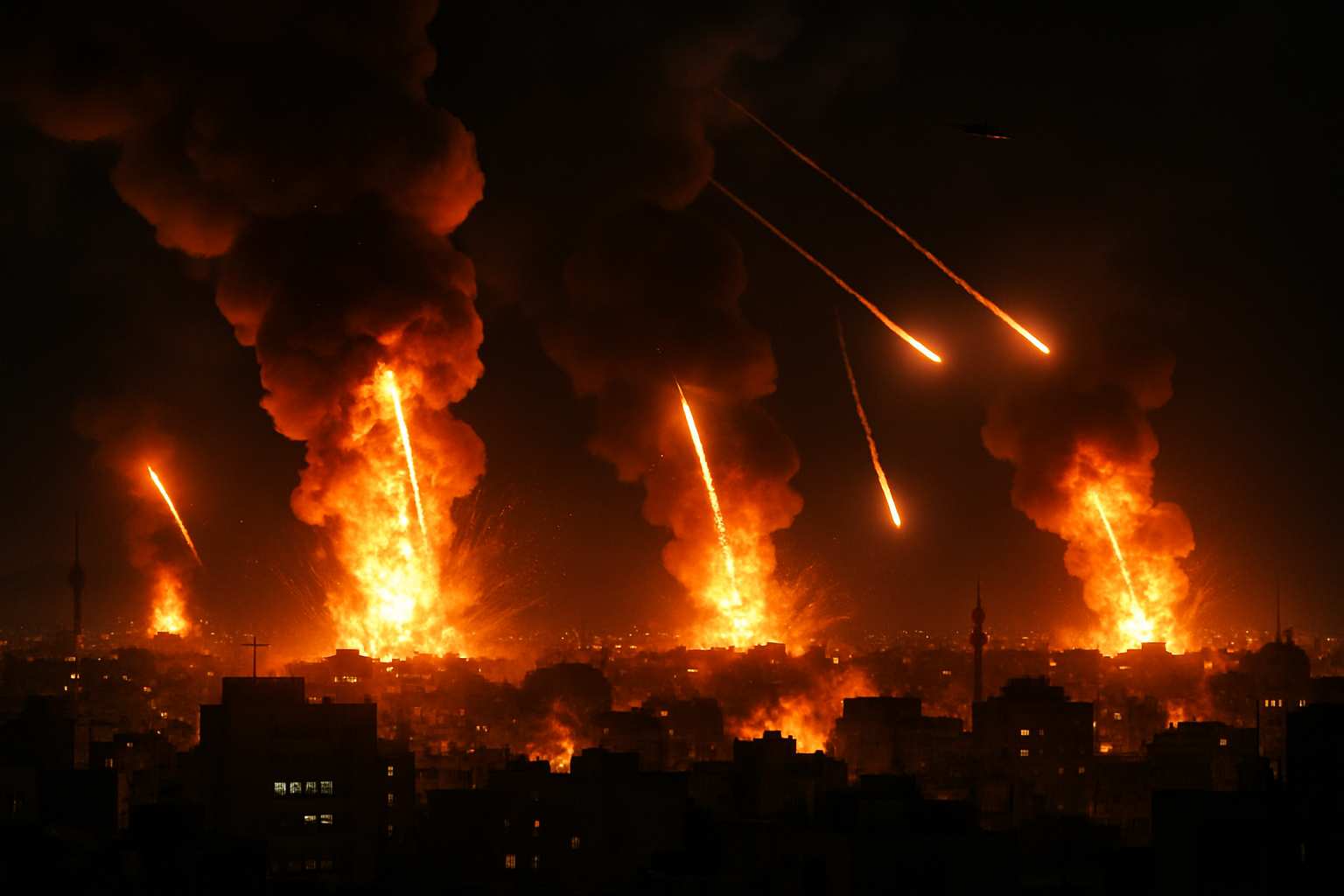
The United States and Israel have launched their heaviest coordinated strikes yet against Iran on day eleven of the escalating Middle East conflict, while Iranian forces threaten to mine the strategically crucial Strait of Hormuz, raising the specter of a global energy crisis that could devastate the world economy.
The devastating new wave of bombardment represents the most intense phase yet of "Operation Epic Fury," the largest US-Israeli military campaign since the 2003 Iraq invasion, which has already consumed $5.6 billion in the first 48 hours alone according to Pentagon estimates.
Unprecedented Military Escalation
Intelligence sources confirm that Iranian Revolutionary Guard forces have begun placing naval mines in the Strait of Hormuz, through which approximately 20% of global oil production transits daily. The narrow 34-kilometer waterway represents one of the world's most critical energy chokepoints, with any disruption capable of sending oil prices soaring and triggering widespread economic chaos.
US officials, speaking on condition of anonymity to CNN and CBS News, reported detecting "dozens" of mines being deployed by small Iranian vessels in recent days. Each vessel is capable of carrying two to three mines, with Iran's total stockpile estimated between 2,000 to 6,000 naval mines accumulated over years of preparation for this scenario.
"If for any reason mines were placed, and they are not removed forthwith, the military consequences to Iran will be at a level never seen before,"
— President Donald Trump, Truth Social
In response to the mining threat, the US military announced it had destroyed 16 Iranian mine-laying vessels in the strait. Central Command released footage showing precision strikes against the Iranian flotilla, describing the operation as necessary to "ensure freedom of navigation" through one of the world's most vital shipping lanes.
Operation True Promise 4 Intensifies
Iran's retaliation campaign, dubbed "Operation True Promise 4," has now reached its 37th wave according to Iranian Revolutionary Guard statements. The systematic targeting of US and Israeli assets across the region has expanded beyond military installations to include civilian infrastructure and diplomatic facilities.
The human cost continues to mount dramatically. Iranian Red Crescent officials report that casualties from US-Israeli strikes have now exceeded 787 civilians killed, while Pentagon sources confirm approximately 140 US service members have been wounded since the conflict began, with eight in critical condition.
Regional allies have been drawn into the expanding conflict despite their initial diplomatic support for negotiations. The UAE has confirmed one civilian death from missile debris in Abu Dhabi, while Kuwait International Airport remains closed after suffering 32 casualties from Iranian drone strikes. Qatar's advanced Patriot missile defense systems successfully intercepted 65 Iranian missiles and 12 drones, though eight civilians were injured by falling debris.
Global Economic Impact Mounting
The conflict's economic ramifications are being felt worldwide as oil prices surge past $80 per barrel, representing a 10% increase since hostilities began. Natural gas prices have spiked 24% in Europe and 78% in the United States, while over 150 commercial tankers worth billions in cargo remain stranded in the Persian Gulf as major shipping companies suspend operations.
The aviation industry faces its worst crisis since COVID-19, with more than 18,000 flights cancelled worldwide. Eight Middle Eastern countries have simultaneously closed their airspace, creating unprecedented disruption to the Europe-Asia flight corridor. Dubai International Airport, the world's busiest hub handling 86 million passengers annually, remains completely shuttered due to missile damage.
Supply Chain Disruption Spreads
Major shipping giants Maersk and Mediterranean Shipping Company have suspended all Persian Gulf operations indefinitely. Qatar has halted liquefied natural gas production, which represents approximately 20% of global exports, following Iranian strikes on energy infrastructure. The disruption extends far beyond energy markets, affecting manufacturing supply chains for automotive, electronics, and textile industries dependent on Gulf logistics networks.
Iranian Leadership in Crisis
The death of Supreme Leader Ali Khamenei on March 1 has created an unprecedented succession crisis occurring during active warfare. The three-member transitional council consisting of President Masoud Pezeshkian, judiciary head Gholamhossein Mohseni-Ejei, and a Guardian Council representative continues managing the country under extraordinary circumstances.
Intelligence assessments suggest Iran's Assembly of Experts is likely to select a Revolutionary Guard member as the next Supreme Leader, representing a historic shift from clerical to military governance. Mojtaba Khamenei, the deceased leader's son, has emerged as a favored candidate in what would mark the first hereditary succession in the Islamic Republic's 47-year history.
Nuclear Diplomacy Remains Collapsed
The military escalation occurred despite what diplomats described as the most promising nuclear negotiations in years. Geneva talks had achieved a "broad agreement on guiding principles" in February, representing the most significant progress since the 2018 collapse of the Joint Comprehensive Plan of Action (JCPOA).
However, fundamental disagreements over scope proved insurmountable. Iran maintained that ballistic missiles and regional proxy relationships were "red lines" to be excluded from nuclear-only negotiations, while the United States demanded a comprehensive agreement addressing missiles, armed groups, and human rights issues.
Iran continues enriching uranium at 60% purity, approaching the 90% threshold required for weapons-grade material. Intelligence estimates suggest Iran possesses over 400 kilograms of highly enriched uranium, sufficient for multiple nuclear weapons if weaponized.
Congressional Pressure Intensifies
On Capitol Hill, lawmakers from both parties are demanding clearer answers about the administration's strategy, costs, and potential for ground troop deployment. Senator Richard Blumenthal stated he is "more concerned than ever" about the possibility of American boots on the ground, while the conflict's unpopularity has reached what political analysts describe as "almost unprecedented" levels for military operations in their early stages.
The Pentagon has quietly prepared contingency plans extending operations through September, far beyond the Trump administration's initial four-to-six-week timeline. White House Press Secretary Karoline Leavitt announced the US is "well on the way toward controlling Iranian airspace" but declined to provide specific metrics for measuring success.
International Response and Evacuations
The international community has launched the largest coordinated evacuation effort since the Arab Spring of 2011. Australia reports 115,000 nationals trapped in the region, while Germany has 30,000 stranded tourists. The European Union activated its ESTIA evacuation plan for Cyprus for the first time in the bloc's history after Iranian drones struck RAF Akrotiri, marking the first attack on European territory since World War II.
Multiple countries have ordered immediate evacuations from Iran, with Sweden and Serbia citing "extremely uncertain" security conditions. The crisis has prompted unprecedented naval coalition deployments, with HMS Dragon, Spanish frigates, and vessels from Italy, France, the Netherlands, and Greece mobilizing to protect European interests.
Regional Coalition Under Strain
The unprecedented Arab coalition that had supported diplomatic engagement—including Saudi Arabia, the UAE, Qatar, and Egypt—faces severe strain as Iranian retaliation directly targets member territories. Egyptian President Abdel Fattah el-Sisi condemned attacks on "sisterly Arab countries" while warning of "comprehensive chaos" spreading across the region.
Saudi officials have privately warned Iran through diplomatic channels against continued attacks on the kingdom's energy infrastructure, marking a significant hardening of Riyadh's position despite initial support for negotiations.
Looking Ahead: Critical Decisions
As the conflict enters its second week, the international community faces what UN Secretary-General António Guterres called the "greatest test of multilateral cooperation and crisis management in the modern era." The decisions made in coming days will establish precedents for 21st-century conflict resolution, potentially determining whether diplomatic or military solutions become the preferred approach for future international crises.
The stakes extend far beyond the Middle East. Success in containing the crisis could provide a framework for managing future nuclear disputes and territorial conflicts. Failure risks accelerating military solutions globally, encouraging nuclear proliferation, and fundamentally undermining diplomatic credibility in an increasingly multipolar world.
With global energy security, nuclear governance credibility, and post-World War II international order principles all being tested simultaneously, March 2026 may prove to be a watershed moment in international relations, with implications extending decades beyond the current crisis.