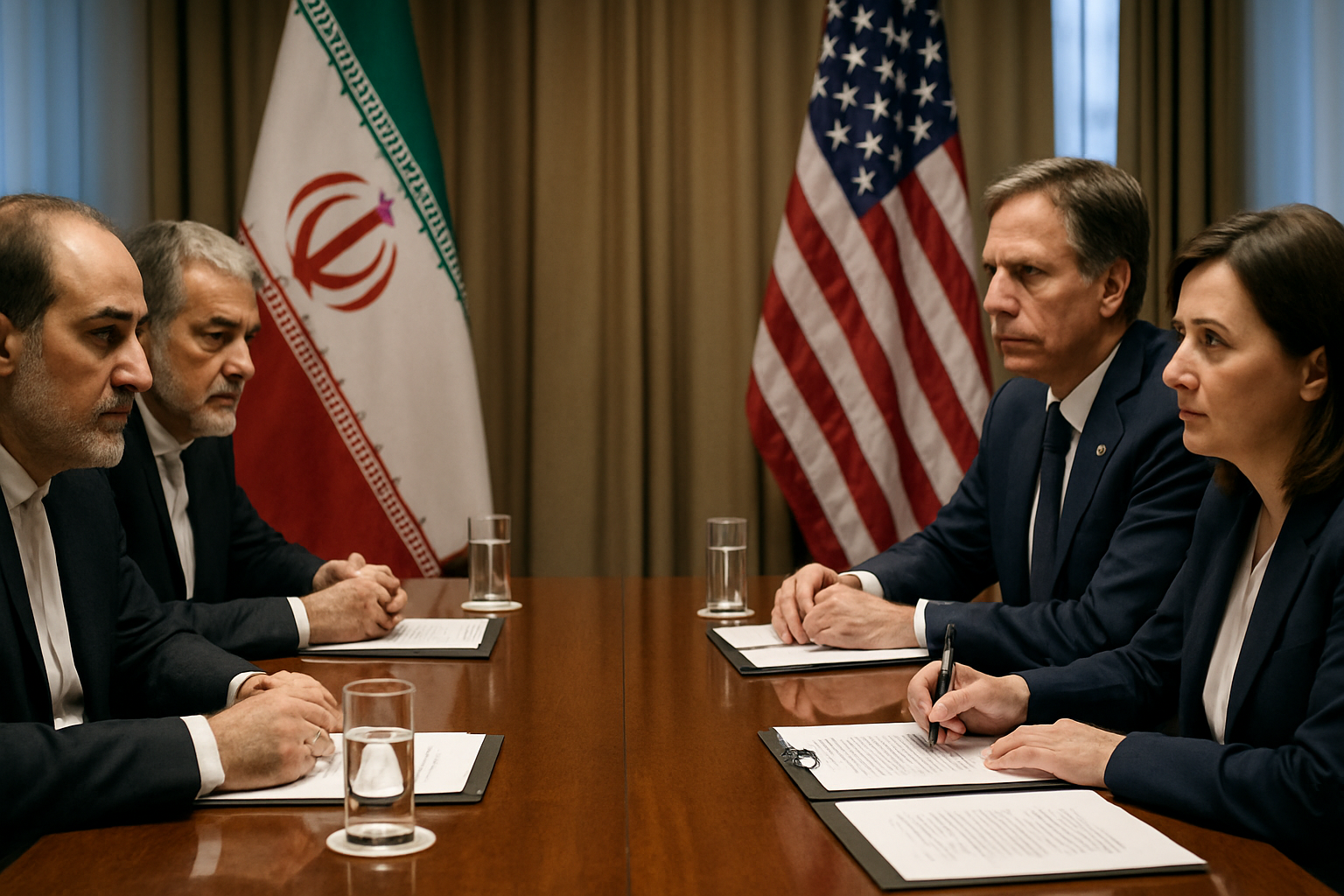
Iran's President Masoud Pezeshkian declared Tuesday that his nation has the "necessary will" to end the month-long war with the United States and Israel, marking the most significant diplomatic opening since the crisis began March 1, even as the conflict shows dangerous signs of escalation with threats against major American technology companies.
The Iranian president's statement, which immediately boosted U.S. stock markets, came after intensive strikes on Iranian territory and followed a stark warning from Iran's powerful Islamic Revolutionary Guard Corps threatening retaliation against leading American tech firms including Google, Meta, and Apple if more Iranian leaders are killed in targeted operations.
Mixed Signals as War Enters Second Month
Pezeshkian's comments represent the strongest indication of Iranian interest in ending hostilities since the conflict erupted following the death of Supreme Leader Ali Khamenei on March 1. However, the president stressed that Tehran is seeking "essential conditions" and "guarantees the conflict would not flare up again," highlighting the complex dynamics surrounding any potential resolution.
The diplomatic signals come as the war has expanded far beyond its Middle Eastern origins, with Iranian drones striking Cyprus's RAF Akrotiri base - marking the first attack on European territory since World War II - and prompting an unprecedented naval coalition response from HMS Dragon and vessels from Spain, Italy, France, the Netherlands, and Greece.
"We have the necessary will to end this war, but we need guarantees that this aggression will not be repeated."
— President Masoud Pezeshkian, Iran
Revolutionary Guards Issue Tech Company Ultimatum
In a dramatic escalation of threats, Iran's Revolutionary Guards announced Tuesday they would target 18 leading U.S. technology and defense companies operating in the Middle East if more Iranian officials are assassinated. The warning specifically named Apple, Google, Meta, Microsoft, and Tesla among others.
"These companies, starting from 8pm Tehran time on Wednesday, April 1, should expect the destruction of their relevant units in exchange for every assassination in Iran," the Guards said in a statement released through the Tasnim news agency, which is close to Iranian authorities.
The threat represents a significant expansion of the conflict's scope, potentially drawing major American corporations directly into the military confrontation that has already claimed thousands of lives across the Middle East.
Trump's Military Pressure Campaign
Despite Iranian diplomatic overtures, President Donald Trump has maintained his demands for Iran's "unconditional surrender" and continued to advocate for military pressure. According to media reports, Trump has been considering expanded military action while Persian Gulf allies, led by Saudi Arabia and the United Arab Emirates, are privately urging him to continue prosecuting the war until Iran is "decisively defeated."
The U.S. has deployed an unprecedented naval presence in the region, with the USS Gerald Ford and USS Abraham Lincoln carrier groups representing approximately one-third of the active U.S. Navy fleet positioned within striking distance of Iran. Additional reports suggest the deployment of the USS George H.W. Bush would bring a third carrier group to the region.
European allies, however, have grown increasingly resistant to American military operations. France and Italy have joined Spain in pushing back against U.S.-Israeli military actions, with sources indicating growing concerns about the war's trajectory among NATO partners.
Global Economic and Humanitarian Crisis
The conflict has created an unprecedented global crisis affecting multiple sectors. Over 18,000 flights have been cancelled worldwide - the most severe aviation disruption since COVID-19 - as eight Middle Eastern countries maintain simultaneous airspace closures. Dubai International Airport, the world's busiest, remains shuttered due to missile damage.
Oil prices have surged past $100 per barrel for the first time since 2014, with Iran's mining of the Strait of Hormuz effectively closing the waterway that carries 40% of global seaborne oil transit. The International Energy Agency has released a record 400 million barrels from strategic reserves in its largest intervention in the agency's 50-year history.
The humanitarian toll continues to mount, with Iran's Red Crescent reporting over 787 civilian casualties from U.S.-Israeli strikes. International evacuations have reached the largest scale since the Arab Spring of 2011, with Australia reporting 115,000 nationals trapped in the region and Germany evacuating 30,000 tourists.
Diplomatic Communications Amid Warfare
Iran's Foreign Minister Abbas Araghchi confirmed to Al Jazeera that Tehran has been receiving direct messages from U.S. Middle East envoy Steve Witkoff, though he emphasized these do not constitute formal negotiations. "I receive messages from Witkoff directly, but this doesn't mean we are in negotiations with Washington," Araghchi stated.
China and Pakistan have proposed a five-point peace plan calling for an immediate ceasefire, the opening of safe passage through the Strait of Hormuz, and a UN-mediated peace agreement. Chinese Foreign Minister Wang Yi and Pakistan's Ishaq Dar pledged to "make new efforts" toward advancing peace talks during their meeting in Beijing.
Iranian Leadership Transition Under Fire
The conflict has unfolded against the backdrop of an unprecedented succession crisis in Iran. Following Ali Khamenei's death, his son Mojtaba Khamenei has emerged as the new Supreme Leader - marking the first hereditary succession in the Islamic Republic's 47-year history. Intelligence assessments suggest the Revolutionary Guards have consolidated unprecedented control over the Iranian government, representing a shift from clerical to military governance during active warfare.
The succession has occurred as Israeli forces have systematically targeted Iranian leadership, with confirmed deaths including Defense Minister Aziz Nasirzadeh, IRGC Chief Mohammad Pakpour, and dozens of senior officials. The targeting of leadership figures has prompted the Revolutionary Guards' threats against U.S. technology companies.
Nuclear Dimensions of the Crisis
The current military confrontation emerged from the complete collapse of nuclear negotiations despite what had been described as a "broad agreement on guiding principles" - the most significant diplomatic progress since the 2018 JCPOA collapse. Iran continues enriching uranium to 60% purity with over 400 kilograms of weapons-grade material, approaching the threshold for multiple nuclear weapons if weaponized.
The crisis is unfolding against the broader context of nuclear governance breakdown, with the New START treaty between the U.S. and Russia having expired in February 2026 - marking the first time in over 50 years without nuclear constraints between the superpowers.
Congressional and Public Opposition
Within the United States, the conflict faces historically low public support at just 25% approval - described by experts as "almost unprecedented" for early-stage military operations. Senator Richard Blumenthal has expressed being "more concerned than ever" about the potential deployment of ground troops as Pentagon operations are now planned to continue through September, far beyond the initial 4-6 week timeline.
Operation Epic Fury has cost $11.3 billion in its first week alone, with daily expenditures running at nearly $1 billion. The conflict has resulted in the first American military casualties, with 3 service members confirmed killed and 150 wounded, including 8 in critical condition.
Regional Coalition Under Strain
The unprecedented diplomatic coalition of Saudi Arabia, UAE, Qatar, and Egypt that had initially supported negotiations is now severely strained as Iranian retaliation has directly targeted their territories. Egypt's President Abdel Fattah el-Sisi condemned Iran's attacks on "sisterly Arab countries," warning of "comprehensive chaos" spreading across the region.
Kuwait has been forced to relocate airline operations to Saudi Arabia due to repeated drone attacks, while the UAE has suspended some operations under Iranian pressure despite offering to join international forces to reopen the Strait of Hormuz.
Template-Setting Moment for 21st Century Diplomacy
UN Secretary-General António Guterres has called the crisis the "greatest test of multilateral cooperation in crisis management of the modern era." The rapid transition from diplomatic breakthrough to military confrontation demonstrates the fragility of crisis management mechanisms in the multipolar era.
The stakes extend far beyond the Middle East, affecting global energy security, nuclear governance credibility, international law enforcement, and post-World War II order principles. Success in containing the crisis could provide a framework for future nuclear dispute resolution, while failure may accelerate the preference for military solutions over diplomacy for decades to come.
March 31, 2026, represents a critical juncture where Iranian diplomatic signals coincide with escalating military threats and expanding regional involvement. The outcome will establish precedents for international approaches to territorial and nuclear disputes globally, determining whether diplomatic solutions remain viable for modern international crises or whether military confrontation becomes the preferred template for 21st-century conflict resolution.