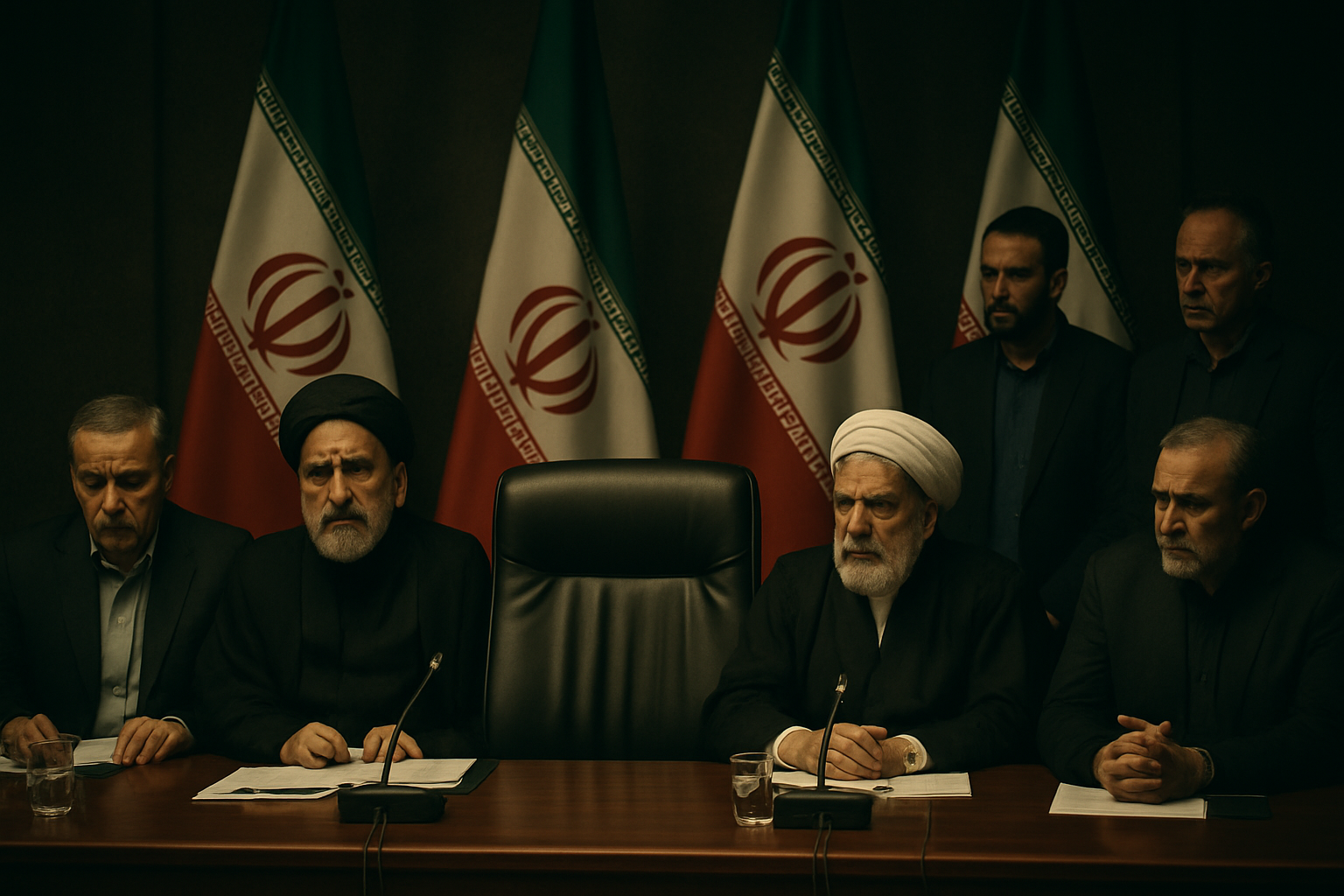
Iran's Supreme National Security Council confirmed the deaths of security chief Ali Larijani and Basij force commander Gholamreza Soleimani in Israeli airstrikes, marking a significant escalation in the ongoing Iran-Israel war that has entered its eighteenth day with unprecedented global consequences.
The confirmation came hours after Israeli Defense Minister Israel Katz announced the elimination of both high-ranking Iranian officials, describing Larijani as the "Secretary of the Supreme National Security Council" and Soleimani as "the head of the Basij — Iran's central repression apparatus." The deaths represent the most senior Iranian casualties since Supreme Leader Ali Khamenei was killed on March 1, triggering the current regional crisis.
Major Leadership Vacuum in Iranian Regime
Ali Larijani, 67, was considered the de facto leader of Iran following the succession crisis that emerged after Khamenei's assassination. A veteran politician and architect of Iran's security policy, Larijani had served as a close adviser to the late Supreme Leader and was widely believed to be coordinating Tehran's war effort against Israel and its allies.
The Iranian National Security Council's statement confirmed that Larijani "obtained the sweet grace of martyrdom" and was killed alongside his son Morteza, security aide Ali Reza Bayat, and several bodyguards during what Iranian media described as a strike on his daughter's house in the Pardis area of Tehran.
"After a lifetime of struggle for the advancement of Iran and the Islamic Revolution, he finally achieved his long-awaited goal and responded to the divine call, achieving the sweet grace of martyrdom in the trench of service."
— Iran's Supreme National Security Council statement
Gholamreza Soleimani, who led the Basij paramilitary force responsible for internal security and protest suppression, was simultaneously eliminated in the coordinated strikes. The Basij has been instrumental in maintaining regime control through domestic repression, making Soleimani's death particularly significant for Iran's internal stability.
Escalating Regional War Context
The assassinations occur within the broader context of Operation Epic Fury, the largest US-Israeli coordinated military campaign since 2003, which has cost $11.3 billion in its first week. The conflict began following the death of Supreme Leader Ali Khamenei on March 1, ending his 37-year rule and creating a constitutional succession crisis that elevated his son Mojtaba Khamenei to power — the first hereditary succession in the Islamic Republic's 47-year history.
Iran has responded with Operation True Promise 4, with the Islamic Revolutionary Guard Corps declaring "no red lines remain" in their systematic targeting of Israeli and US assets across the region. The Iranian retaliation has caused casualties across multiple countries: one civilian killed in the UAE, 32 injured in Kuwait airport strikes, and eight wounded in Qatar despite Patriot missile interceptions.
Global Crisis Intensifies
The conflict has triggered an unprecedented global aviation crisis, with over 18,000 flights cancelled worldwide — the most extensive disruption since COVID-19. Eight Middle Eastern countries have simultaneously closed their airspace, while Dubai International Airport, the world's busiest with 86 million annual passengers, remains completely shut down due to missile damage.
Energy markets have been severely disrupted, with oil prices surging past $100 per barrel as Iran has effectively closed the Strait of Hormuz with naval mines, affecting 40% of global oil transit. The International Energy Agency has released a record 400 million barrels from strategic reserves in its largest intervention in the agency's 50-year history.
European Territory Attacked
In an unprecedented escalation, Iranian drones struck RAF Akrotiri in Cyprus — the first attack on European territory since World War II. This has prompted an extraordinary naval coalition response, with HMS Dragon, Spanish frigates, and vessels from Italy, France, the Netherlands, and Greece deploying to protect European interests.
The European Union has activated its ESTIA evacuation plan for Cyprus for the first time in the bloc's history, fundamentally altering the scope of the conflict and drawing NATO allies into defensive preparations.
Congressional and International Pressure
The escalating crisis has prompted unprecedented congressional scrutiny, with bipartisan lawmakers demanding answers about strategy, costs, and the potential for ground troop deployment. Senator Richard Blumenthal expressed being "more concerned than ever" about boots on the ground, while conflict unpopularity has reached "almost unprecedented" levels with only 25% American public support.
President Trump has demanded Iran's "unconditional surrender" and claimed the right to personally choose Iran's next Supreme Leader, representing the most direct assertion of American control over Iranian affairs since 1979. This hardline position has effectively eliminated diplomatic solution possibilities.
Nuclear Diplomacy Collapse
The current military confrontation emerged from the complete breakdown of Geneva negotiations, despite achieving "broad agreement on guiding principles" — the most diplomatic progress since the 2018 JCPOA collapse. The fundamental scope disagreement proved insurmountable, with Iran excluding ballistic missiles and proxy groups as "red lines" while the US demanded comprehensive talks covering missiles, armed groups, and human rights.
Iran continues 60% uranium enrichment with over 400 kilograms of weapons-grade material, sufficient for multiple nuclear weapons if weaponized. The crisis occurs amid broader nuclear governance breakdown, with the New START treaty having expired for the first time in over 50 years without US-Russia constraints.
Humanitarian Crisis and Evacuations
The conflict has generated the largest international evacuation since the Arab Spring of 2011, with Australia reporting 115,000 nationals trapped and Germany 30,000 tourists stranded. Iran's Red Crescent reports over 787 civilian casualties from US-Israeli strikes, including the devastating Minab school attack that killed 53-85 students and staff, drawing international condemnation for potential Geneva Conventions violations.
In Lebanon, Hezbollah's decision to join the conflict has resulted in 826 killed and 832,000 displaced, with systematic targeting of medical personnel resulting in 26 paramedics killed and 51 wounded, raising serious international humanitarian law concerns.
Regional Coalition Under Strain
The unprecedented Saudi Arabia, UAE, Qatar, and Egypt coalition that had supported diplomatic solutions is now severely strained as Iranian retaliation has directly targeted member territories. Egyptian President Sisi condemned attacks on "sisterly Arab countries," warning of "comprehensive chaos" spreading across the region.
Gulf states find themselves caught between their alliance with the United States and mounting Iranian pressure, fundamentally challenging decades-old security arrangements in the region.
Template-Setting Crisis
UN Secretary-General António Guterres has described the crisis as "the greatest test of multilateral cooperation and crisis management in the modern era." The rapid transition from diplomatic breakthrough to military confrontation demonstrates the fragility of crisis management mechanisms in the multipolar era.
March 2026 represents a watershed moment in Middle Eastern geopolitics, with implications extending decades beyond current events. The crisis tests regional war prevention, global energy security, nuclear governance credibility, and international law enforcement mechanisms simultaneously.
Looking Ahead
The deaths of Larijani and Soleimani remove key pillars of the Iranian regime's security apparatus during its most vulnerable period since the 1979 revolution. With diplomatic channels completely broken and Trump's unconditional surrender demands eliminating negotiated solutions, the trajectory points toward prolonged military confrontation with global consequences.
The stakes could not be higher: success in containing the crisis could provide a framework for future nuclear crisis resolution, while failure may accelerate military solutions for decades, encouraging proliferation globally and undermining diplomatic credibility worldwide.
As the conflict enters its third week, the international community faces the most consequential test of 21st-century conflict resolution, with implications for global energy security, nuclear governance, and the fundamental principles of the post-World War II international order.