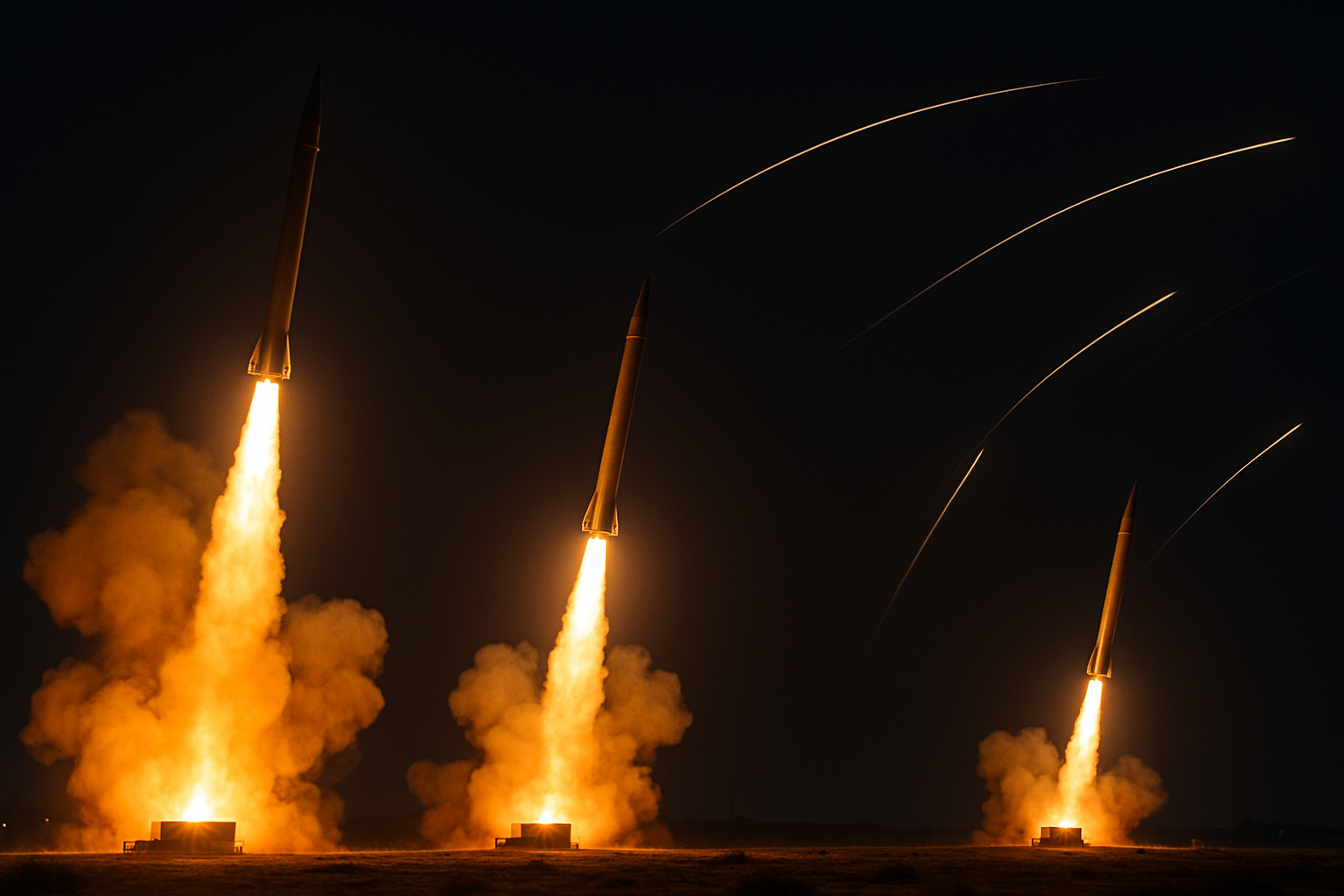
Iran launched one of its most intensive missile barrages against Israel in weeks on Wednesday evening, forcing millions of Israelis into shelters as families prepared for Passover Seder celebrations, marking a dramatic escalation in the month-long Middle East conflict that has already claimed thousands of lives.
The Israeli Defense Forces reported at least 10 ballistic missiles fired from Iranian territory, along with coordinated Hezbollah attacks from Lebanon, creating a multi-front assault that sent air raid sirens wailing across central and northern Israel. The timing of the attacks—coinciding with the start of the Jewish holiday—appeared deliberately calculated to maximize psychological impact on Israeli society.
Casualties and Damage Mounting
According to Palestinian sources, one Israeli civilian was killed in the missile strikes, while Iranian and Qatari media reported at least 14 people injured across several Israeli cities. The attacks caused significant damage to homes, vehicles, and a children's playground in residential areas, though Israeli air defense systems successfully intercepted the majority of incoming projectiles.
Al Jazeera confirmed this represented "one of Iran's largest missile barrages in weeks," demonstrating Tehran's continued capacity for long-range strikes despite nearly four weeks of intensive US-Israeli bombardment under Operation Epic Fury—the largest coordinated Middle Eastern military campaign since the 2003 Iraq invasion.
The missile barrage comes as the conflict has already exacted a devastating toll across the region. Iran's Red Crescent Society reports over 787 civilian casualties from US-Israeli strikes, while regional coalition partners including the UAE, Kuwait, and Qatar have also suffered casualties from Iranian retaliation under "Operation True Promise 4."
Trump's Contradictory Ceasefire Claims
In a dramatic diplomatic contradiction, President Donald Trump claimed via Truth Social on Wednesday that Iran has requested a ceasefire, stating: "Iran's New Regime President, much less Radicalized and far more intelligent than his predecessors, has just asked the United States of America for a CEASEFIRE!"
However, Iran's Foreign Ministry spokesperson immediately rejected Trump's assertion as "false and baseless," highlighting the deep information warfare dimensions of the crisis. Trump conditioned any ceasefire consideration on Iran fully reopening the Strait of Hormuz, which currently remains effectively closed due to Iranian naval mining operations affecting 40% of global oil transit.
"We will consider their ceasefire request when Hormuz Strait is open, free, and clear. Until then, we will do what we have to do."
— Donald Trump, US President
Trump's comments came just hours before his scheduled primetime address to the nation, suggesting either last-minute diplomatic developments or deliberate psychological warfare tactics ahead of his speech.
Nuclear Succession Crisis Deepens
The escalation occurs amid an unprecedented constitutional crisis in Iran following the confirmed death of Supreme Leader Ali Khamenei on March 1st, ending his 37-year rule. His son, Mojtaba Khamenei, has emerged as the new Supreme Leader in the first hereditary succession in the Islamic Republic's 47-year history.
Intelligence assessments suggest the Revolutionary Guards have consolidated unprecedented control over Iranian governance during the wartime succession, representing a fundamental shift from clerical to military leadership. This transition has coincided with Iran's most aggressive military posture in decades, including systematic attacks on regional US allies and the first strikes on European territory since World War II.
Global Economic and Aviation Crisis
The conflict has triggered unprecedented global disruptions, with over 18,000 flights cancelled worldwide—the most severe aviation crisis since COVID-19. Eight Middle Eastern countries maintain simultaneous airspace closures, effectively severing critical Europe-Asia air corridors.
Oil prices have surged past $100 per barrel, with analysts warning of potential increases toward $200 as Iran's mining of the Strait of Hormuz continues. The International Energy Agency has authorized its largest-ever strategic petroleum reserve release of 400 million barrels—double the response to the 2022 Ukraine crisis.
Major shipping companies including Maersk and MSC have suspended Persian Gulf operations, with over 150 tankers carrying billions of dollars in cargo currently stranded. Airlines have implemented emergency fuel surcharges as jet fuel costs jumped from $85-90 to $150-200 per barrel.
Regional Coalition Under Extreme Strain
The unprecedented Saudi-UAE-Qatar-Egypt diplomatic consensus that initially supported nuclear negotiations has come under severe pressure as Iranian retaliation has directly targeted coalition member territories. Egyptian President Abdel Fattah el-Sisi condemned attacks on "sisterly Arab countries," warning of "comprehensive chaos" spreading across the region.
The UAE reported one civilian killed in Abu Dhabi from missile debris, while Kuwait International Airport suffered drone strikes injuring 32 people. Qatar intercepted 65 missiles and 12 drones using Patriot systems, though 8 people were injured by falling fragments. These attacks represent a fundamental challenge to decades-old Gulf security arrangements.
European Territory Attacked for First Time Since WWII
In a historic escalation, Iranian drones struck RAF Akrotiri in Cyprus—marking the first attack on European territory since World War II. The assault prompted an unprecedented naval coalition response, with HMS Dragon and Spanish frigates joining vessels from Italy, France, the Netherlands, and Greece in protecting European interests.
The European Union activated its ESTIA crisis mechanism for the first time in the bloc's history, demonstrating how the Middle East conflict has fundamentally altered European security calculations and expanded far beyond its original bilateral scope.
Congressional Opposition Mounts
On Capitol Hill, bipartisan pressure is intensifying against the Trump administration's war strategy. Senator Richard Blumenthal expressed being "more concerned than ever" about potential ground troop deployment, while the conflict maintains historically low public support at just 25%.
Operation Epic Fury has already cost $11.3 billion in its first week alone, with Pentagon operations planned through September—far beyond the initial 4-6 week timeline suggested by the White House. The financial markets have emerged as what analysts call the "ultimate constraint" on continued escalation.
Nuclear Diplomacy Collapse
The current military confrontation emerged from the complete breakdown of nuclear negotiations despite achieving "broad agreement on guiding principles"—the most significant diplomatic progress since the 2018 JCPOA collapse. However, fundamental scope disagreements proved insurmountable, with Iran maintaining its ballistic missiles and regional proxies as "red lines" excluded from nuclear-only talks.
The United States demanded comprehensive agreements including missiles, armed groups, and human rights issues. Iran continues uranium enrichment at 60% purity with over 400 kilograms of weapons-grade material—sufficient for multiple nuclear weapons if weaponized.
The crisis occurs amid broader nuclear governance breakdown, as the New START treaty expired in February 2026—the first time in over 50 years without US-Russia nuclear constraints. UN Secretary-General António Guterres has warned that nuclear risks are at their "highest in decades."
Humanitarian Crisis Deepening
International evacuations have reached the largest scale since the 2011 Arab Spring, with Australia reporting 115,000 nationals trapped in the region and Germany extracting 30,000 tourists. Multiple countries have ordered immediate evacuations from Iran citing "extremely uncertain" security conditions.
The humanitarian toll continues mounting, with particular international condemnation over the Pentagon-confirmed strike on an Iranian elementary school that killed 165-185 students—described by officials as resulting from "outdated targeting data." Geneva Convention investigations into potential war crimes are underway.
In Lebanon, Hezbollah's entry into the conflict has completely collapsed the November 2024 ceasefire, with over 832,000 people displaced and systematic targeting of medical personnel resulting in 26 paramedics killed.
Template-Setting Crisis for 21st Century
UN Secretary-General António Guterres has characterized the crisis as the "greatest test of multilateral cooperation in the modern era." The rapid transition from diplomatic breakthrough to military escalation demonstrates what analysts describe as the fragility of crisis management mechanisms in the multipolar era.
The stakes extend far beyond the immediate participants, affecting regional war prevention, global energy security, nuclear governance credibility, and post-WWII international order principles simultaneously. Success in containing the crisis could provide a framework for future nuclear dispute resolution, while failure may accelerate military approaches to international conflicts for decades.
Looking Ahead: Critical Juncture
As Trump prepares his primetime address to the nation, the contradictory signals on ceasefire negotiations highlight the complex information warfare dynamics of modern conflicts. Iran's massive missile barrage during Passover, followed by immediate diplomatic denials of ceasefire requests, demonstrates the challenges facing any potential resolution.
With oil markets in crisis, global aviation networks paralyzed, and nuclear proliferation risks at historic highs, the coming days will prove decisive in determining whether this crisis can be contained or will escalate into a broader regional war with worldwide implications extending decades beyond current events.
The template-setting nature of this crisis affects not only Middle Eastern stability but fundamental questions about diplomatic versus military solutions in 21st-century international relations, making it one of the most consequential geopolitical developments since the end of the Cold War.