Iran has named Mojtaba Khamenei, son of the late Supreme Leader Ali Khamenei, as the Islamic Republic's new supreme leader as the devastating Middle East war enters its tenth day, with the death toll now exceeding 1,300 casualties and global markets in turmoil.
The appointment marks the first hereditary succession in the Islamic Republic's 47-year history, consolidating Revolutionary Guards control over Iran's governance as the conflict with Israel and the United States escalates to unprecedented levels. Australian media reports confirm Iranian casualties have passed 1,300, while global stock markets continue their precipitous decline amid the worst international crisis since the Cold War.
Historic Leadership Transition Amid Warfare
Iran's Assembly of Experts reached consensus on Mojtaba Khamenei's appointment following the confirmed death of his father, Supreme Leader Ali Khamenei, in the March 1 US-Israeli "Operation Epic Fury" strikes. The younger Khamenei's elevation represents a dramatic shift from clerical to military governance, with CIA assessments suggesting Revolutionary Guards members now hold unprecedented influence over the Islamic Republic.
The constitutional crisis has been managed by a three-member transitional council comprising President Masoud Pezeshkian, judiciary head Mohseni Ejei, and a Guardian Council representative. The leadership transition occurs under active warfare conditions, an unprecedented situation in modern Middle Eastern history.
"This appointment breaks decades of Islamic Republic tradition," noted regional analysts, as the succession consolidates hardline military influence at the expense of traditional clerical authority structures that have governed Iran since 1979.
Massive Retaliation Campaign Spreads Across Region
Iran's Revolutionary Guards continue "Operation True Promise 4," their massive retaliation campaign declaring "no red lines remain" in systematic targeting of US and Israeli assets across the Middle East. The latest wave of attacks has struck multiple countries simultaneously, including the historic first attack on European territory since World War II.
"Iran fired missiles towards Israel and several Gulf nations, after the Islamic republic named Mojtaba Khamenei as its new supreme leader"
— RFI International News
NATO air defense systems intercepted a second Iranian ballistic missile targeting Turkey, highlighting the conflict's expansion beyond traditional Middle Eastern boundaries. Turkish Defense Ministry statements confirm debris fell near Gaziantep with no casualties reported, marking Iran's continued violation of NATO airspace.
Regional casualties continue mounting across Gulf states: UAE reports one civilian killed in Abu Dhabi with Dubai International Airport remaining shuttered, Kuwait reports 32 foreign nationals injured from airport drone strikes, and Qatar intercepted 65 missiles and 12 drones using Patriot systems with 8 injured from falling debris.
Global Aviation Crisis Reaches Critical Point
The international aviation industry faces its most severe disruption since COVID-19, with over 18,000 flights cancelled worldwide as eight Middle Eastern countries maintain simultaneous airspace closures. Dubai International Airport, the world's busiest with 86 million annual passengers, remains completely shut down from missile damage.
Major carriers including Emirates, Air France-KLM, and Wizz Air have suspended operations indefinitely, affecting hundreds of thousands of passengers globally. The closure of Middle Eastern airspace has severed critical Europe-Asia flight routes, forcing complex and expensive rerouting through alternate corridors.
French President Emmanuel Macron's emergency visit to Cyprus, where a Shahed drone struck a British air base last week, demonstrates European solidarity in the face of Iran's unprecedented territorial violations. The deployment of French warships to the eastern Mediterranean signals Europe's commitment to defending NATO allies against further Iranian aggression.
Energy Markets in Chaos as Oil Infrastructure Targeted
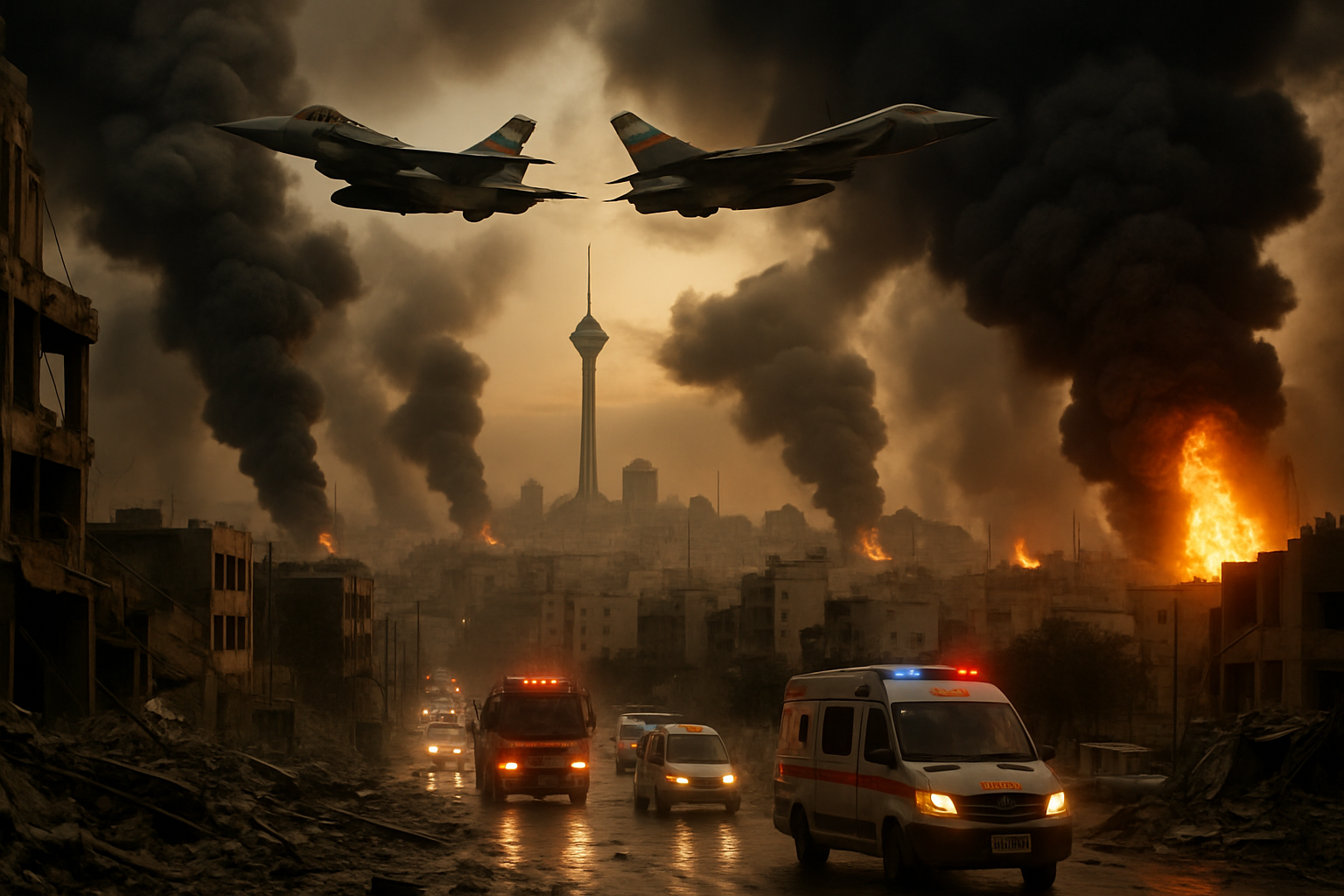
US-Israeli forces have struck five strategic oil installations around Tehran, creating massive fires and toxic black rain affecting nearly 10 million residents. The targeting of Iran's energy infrastructure represents a significant escalation in "Operation Epic Fury," the largest coordinated US-Israeli campaign since the 2003 Iraq invasion.
Oil prices have surged 10% past $80 per barrel as Iran declared the Strait of Hormuz "unsafe," effectively closing the waterway that handles 40% of global seaborne oil transit. Over 150 tankers carrying billions of dollars in cargo remain stranded in the Persian Gulf, with major shipping companies Maersk and MSC suspending all operations in the region.
Natural gas prices have spiked 24% in Europe and 78% in the United States, while Qatar has halted LNG production following Iranian infrastructure strikes. The energy crisis threatens to push household costs significantly higher, with UK authorities warning of £160 annual increases for average households.
Unprecedented Military Escalation
The conflict has expanded far beyond traditional Middle Eastern boundaries, with the US submarine USS Charlotte sinking the Iranian frigate IRIS Dena off Sri Lanka, killing over 80 crew members. This marks the first enemy vessel sunk by a US submarine since World War II, according to Defense Secretary Pete Hegseth's characterization of it as a "quiet death."
Operation Epic Fury has cost an estimated $3.7 billion in its first week alone, averaging $891.4 million daily, making it one of the most expensive military operations in recent history. The dual-carrier deployment of USS Gerald Ford and USS Abraham Lincoln represents approximately one-third of the US Navy's active fleet concentrated in Middle Eastern waters.
The conflict has produced the first US military casualties, with Central Command confirming 3 American service members killed and 5 wounded - the first combat deaths in the largest Middle East operation since 2003.
International Community Mobilizes Historic Evacuation
The international community has launched the largest coordinated evacuation since the Arab Spring of 2011, with Australia reporting 115,000 nationals trapped in the region and Germany coordinating the extraction of 30,000 stranded tourists. Multiple countries have ordered immediate evacuations from Iran citing "extremely uncertain" security conditions.
The European Union activated its ESTIA evacuation plan for Cyprus for the first time in history following Iranian drone strikes on RAF Akrotiri - the first attack on European territory since World War II. An unprecedented naval coalition including HMS Dragon, Spanish frigates, and vessels from Italy, France, Netherlands, and Greece has deployed to protect European interests.
"Hezbollah said on Monday its fighters clashed with Israeli troops in eastern Lebanon during an Israeli airborne raid overnight, in what would be the second such operation in the area in recent days"
— Lebanese Military Sources
Lebanon has been pulled into the regional conflict as Hezbollah opened fire in retaliation for Iran's Supreme Leader's death, marking the most serious breach of the November 2024 ceasefire. Israeli strikes have killed at least 12 people in southern Lebanese towns, with hundreds of thousands displaced as the conflict spreads.
Nuclear Diplomacy Lies in Ruins
The military escalation represents the complete collapse of nuclear diplomacy despite recent breakthrough achievements. Geneva talks had achieved "broad agreement on guiding principles" - the most progress since the JCPOA collapse in 2018 - but fundamental disagreements over scope proved insurmountable.
Iran insisted on excluding ballistic missiles and proxy groups as "red lines" for nuclear-only discussions, while the United States demanded comprehensive agreements including missiles, armed groups, and human rights issues. Iran continues uranium enrichment at 60% purity with over 400 kilograms of weapons-grade material, sufficient for multiple nuclear weapons if weaponized.
The crisis occurs against the backdrop of the New START treaty expiration on February 5 - the first time in over 50 years that the United States and Russia operate without nuclear constraints - creating what UN Secretary-General António Guterres calls the "highest" nuclear risks in decades.
Congressional Scrutiny Intensifies
Bipartisan lawmakers in Congress are demanding comprehensive answers on strategy, costs, and the potential for ground troop deployment as Operation Epic Fury extends far beyond initial timelines. Senator Richard Blumenthal expressed being "more concerned than ever" about the prospect of "boots on the ground" following classified Pentagon briefings.
The conflict's unpopularity is described as "almost unprecedented" in its early stages, with only 25% of Americans supporting the strikes according to recent polling. Financial markets are emerging as the "ultimate constraint" on continued escalation, with Pakistan's stock market suffering its largest single-day decline in history at -8.97%.
Pentagon documents suggest military operations are planned through September, far beyond President Trump's initial 4-week timeline, raising concerns about mission scope and potential for prolonged regional warfare.
Trump's Regime Change Demands
President Trump has made his most explicit demands for Iranian regime change since taking office, claiming the right to personally choose Iran's next Supreme Leader while rejecting Mojtaba Khamenei as a "lightweight." His "unconditional surrender" demands via Truth Social represent the most direct assertion of American control over Iranian internal affairs since the 1979 revolution.
The president's policy has evolved from nuclear-focused concerns to comprehensive political transformation objectives, eliminating possibilities for negotiated diplomatic solutions. Trump's direct appeals to the Iranian people to "take back their country" represent unprecedented intervention in Iran's domestic politics.
Template-Setting Crisis for the 21st Century
UN Secretary-General António Guterres has characterized the Middle East crisis as the "greatest test of multilateral cooperation and crisis management in the modern era." The rapid transition from promising diplomatic breakthrough to full-scale military confrontation demonstrates the fragility of crisis management in the multipolar era.
The stakes of containing this escalation extend far beyond the Middle East, affecting global energy security, nuclear governance credibility, international law enforcement, and post-World War II order principles. Success or failure in preventing broader regional war will determine international approaches to conflict resolution for decades to come.
Supply chains dependent on Gulf networks are severely disrupted, affecting manufacturing in automotive, electronics, and textiles industries globally. The Persian Gulf's role as a critical Asia-Europe trade hub has been completely compromised, exposing fundamental vulnerabilities in global economic systems to geopolitical shocks.
Humanitarian Crisis Deepens
Iranian Red Crescent reports indicate over 787 civilian casualties from US-Israeli strikes, with international human rights organizations demanding Geneva Convention violation investigations. The tragic attack on Minab elementary school, which killed between 53-85 students and staff during regular hours, has become a symbol of the diplomatic failure and human cost of the conflict.
Lebanese casualties are mounting as Israeli strikes target Hezbollah positions, with the Lebanese Health Ministry confirming significant civilian deaths including children. The humanitarian crisis is compounded by the massive displacement of populations and overwhelmed medical facilities across the region.
As the Middle East war enters its second week, the international community faces unprecedented challenges in managing a crisis that threatens to reshape global geopolitics for generations. The appointment of Mojtaba Khamenei as Iran's new Supreme Leader consolidates hardline positions just as diplomatic solutions appear increasingly elusive, setting the stage for potentially prolonged regional warfare with worldwide implications.