Iran's Supreme Leader Ali Khamenei has been officially confirmed killed in the largest coordinated US-Israeli military operation since 2003, triggering massive retaliatory strikes across the Middle East and the most dangerous international crisis since the Cold War ended.
Iranian state media confirmed Tuesday morning that the 86-year-old Khamenei died "at his place of work" in Tehran while "performing official duties" during the unprecedented "Operation Epic Fury" airstrikes. The operation has plunged the region into chaos, with over 18,000 flights cancelled worldwide and oil prices surging 10% to $80 per barrel.
Operation Epic Fury: Unprecedented Scale
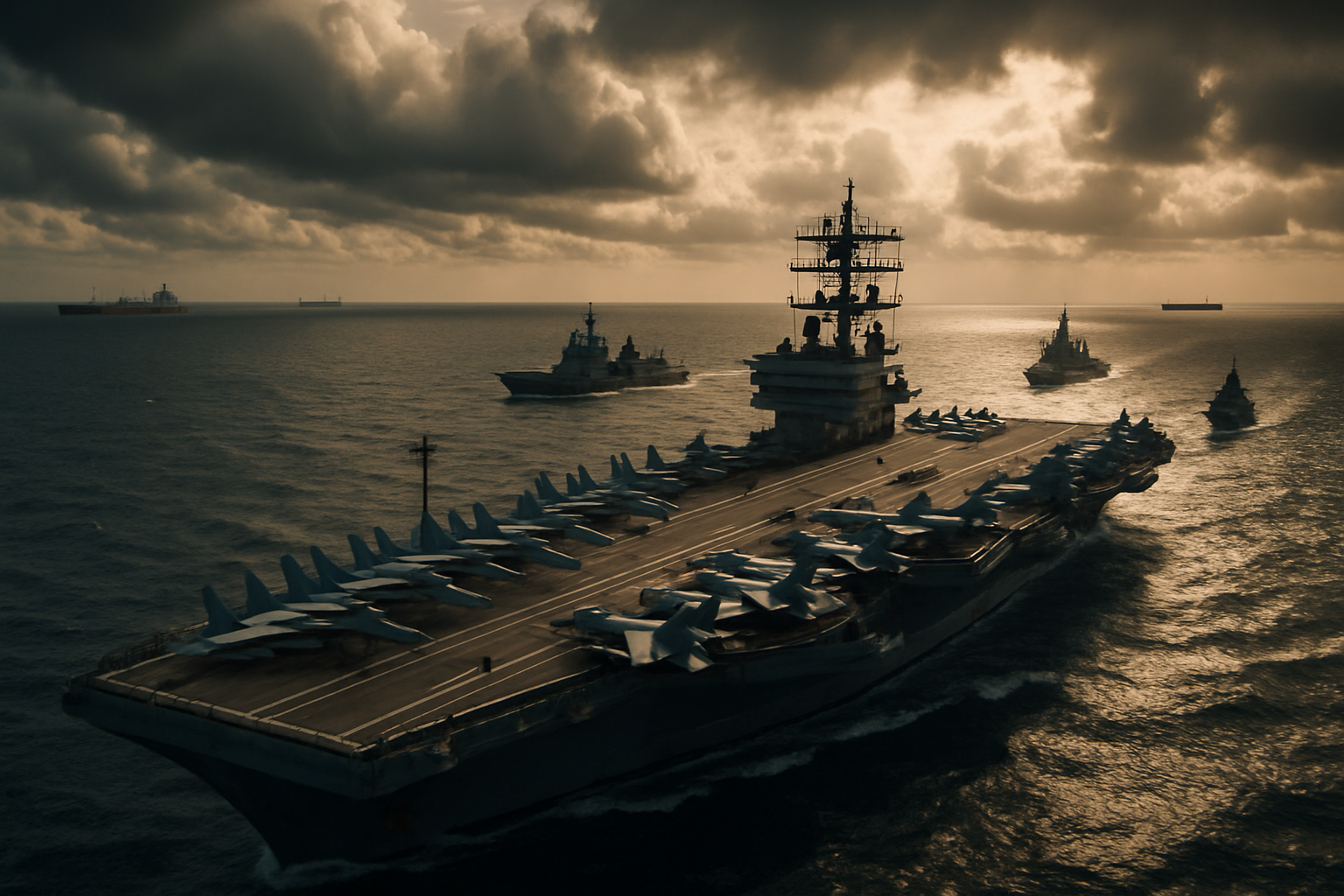
The coordinated strikes involved an unprecedented dual-carrier deployment of the USS Gerald R. Ford and USS Abraham Lincoln, representing approximately one-third of the active US Navy fleet positioned just 800 kilometers from Iran's coast. This marks the largest American naval presence in the Middle East since the 2003 Iraq invasion.
President Trump confirmed Khamenei's death hours before Iranian media via Truth Social, calling him "one of the most evil people in History" and declaring it the "single greatest chance for the Iranian people to take back their country." The operation also eliminated Iran's Defense Minister Aziz Nasirzadeh, IRGC Chief Mohammad Pakpour, senior aide Ali Shamkhani, and over 40 high-ranking officials.
"We vernichten die Bedrohung durch dieses Terrorregime" (We destroy the threat from this terrorist regime)
— Donald Trump, responding to Iranian threats
Tragically, the strikes also killed Khamenei's family members, including his daughter, son-in-law, and granddaughter, according to Fars News Agency reports.
Iran's Massive Retaliation: "No Red Lines Remain"
Iran's Islamic Revolutionary Guard Corps launched "Operation True Promise 4" in immediate retaliation, declaring that "no red lines remain" and targeting US and Israeli assets across the region. The coordinated counterattacks have caused casualties across multiple nations:
- UAE: One civilian killed in Abu Dhabi from missile debris; Dubai International Airport completely shut down
- Kuwait: Airport drone strikes injured employees and 32 foreign nationals
- Qatar: Eight injured from fragments despite intercepting 65 missiles and 12 drones with Patriot systems
- Bahrain: Fifth Fleet headquarters targeted
- Israel: Residential strike in Beit Shemesh killed 9 and wounded 28
The IRGC has also threatened to "set ablaze" any shipping attempting to pass through the Strait of Hormuz, through which 40% of global oil passes.
Global Aviation Crisis
The conflict has triggered the most extensive flight disruption since COVID-19, with Iran, Iraq, Israel, UAE, Qatar, Syria, Kuwait, and Bahrain simultaneously closing their airspace. Major carriers including Emirates, Air France-KLM, Wizz Air, and Bulgaria Air have suspended Middle East operations.
Dubai International Airport, the world's busiest, sustained missile damage and remains completely shut down, affecting hundreds of thousands of passengers globally. The Middle East serves as a critical hub connecting Europe and Asia, making the disruption particularly severe.
Nuclear Diplomacy's Complete Collapse
The military escalation follows the dramatic breakdown of nuclear negotiations that had achieved the most significant progress since the 2018 JCPOA collapse. Despite Geneva talks reaching "broad agreement on guiding principles," fundamental disagreements proved insurmountable.
Iran had excluded ballistic missiles and regional proxies as "red lines" from nuclear-only discussions, while the US insisted on comprehensive agreements including missiles, armed groups, and human rights issues. Iran continues enriching uranium at 60% purity, approaching the 90% weapons-grade threshold, with over 400 kilograms of enriched material.
Constitutional Crisis and Succession
Iran has activated its constitutional succession protocol, establishing a three-member transitional council comprising President Pezeshkian, judiciary head Mohseni Ejei, and Guardian Council jurist Arafi. The Assembly of Experts, consisting of 88 clerics, will select a permanent successor.
CIA assessments suggest a Revolutionary Guards member will likely be chosen as the next Supreme Leader, indicating a potential shift toward even more hardline military influence. The transition ends Khamenei's 37-year rule since 1989.
In Tehran, spontaneous celebrations erupted with residents dancing at bus stops and organizing car parades while chanting "tyrant no more." However, pro-government demonstrations in southern Iran have called for vengeance.
First US Military Casualties
US Central Command confirmed the first American casualties of Operation Epic Fury, with three service members killed and five wounded. This represents the first confirmed US deaths in the largest Middle East military operation since 2003.
"Major combat operations continue and our responsive actions are ongoing," CENTCOM stated, indicating the conflict may be entering a prolonged phase. The names of fallen soldiers are being withheld pending family notification.
Regional Coalition Under Strain
The unprecedented coalition of Saudi Arabia, UAE, Qatar, and Egypt that had backed diplomatic efforts now faces severe strain as Iranian retaliation targets member territories. Egyptian President Sisi condemned attacks on "sisterly Arab countries," warning of "comprehensive chaos."
Multiple nations have ordered emergency evacuations, with Sweden and Serbia advising immediate departure from Iran due to "extremely uncertain" security conditions.
Energy Markets in Crisis
Global energy markets are facing severe disruption as Iran threatens to close the Strait of Hormuz, a critical chokepoint handling 40% of global oil transit. Major shipping companies Maersk and MSC have suspended operations, with over 150 tankers anchored in the Persian Gulf worth billions of dollars.
Natural gas prices have surged 24% in Europe and 78% in the US, while Qatar has halted LNG production at facilities struck by Iranian missiles.
International Response
The UN Security Council has convened an emergency session following requests from France, China, Russia, Colombia, and Bahrain. Secretary-General António Guterres warned of a "serious threat to international peace and security," cautioning about "a chain of events no one can control."
Russia condemned what Foreign Minister Lavrov called "reckless actions by Washington and West Jerusalem" as violations of international law. China issued its strongest condemnation in years, describing the assassination as a "serious violation of Iran's sovereignty and security."
Nuclear Governance Crisis Context
The crisis unfolds against the backdrop of a broader nuclear governance breakdown. The New START treaty expired on February 5, marking the first time in over 50 years without US-Russia nuclear constraints. Combined with China's nuclear expansion, the international community faces what UN officials describe as nuclear risks at their "highest levels in decades."
Historical Significance
March 2, 2026, marks what many analysts consider the most dangerous moment since the Cold War ended. The rapid transition from diplomatic breakthrough to military confrontation demonstrates the fragility of modern crisis management in the multipolar era.
The killing of Khamenei represents a potential turning point in Middle Eastern geopolitics, ending an era that began with Iran's 1979 Islamic Revolution and its subsequent transformation into a major regional power opposing US influence.
Success in containing the escalation could provide a template for future nuclear crisis resolution, while failure may accelerate military solutions reshaping geopolitics for decades, encouraging nuclear proliferation elsewhere and undermining diplomatic credibility worldwide.
The coming days will determine whether this remains a contained regional confrontation or expands into a broader Middle Eastern war with global implications affecting energy markets, supply chains, and the fundamental principles of the post-World War II international order.