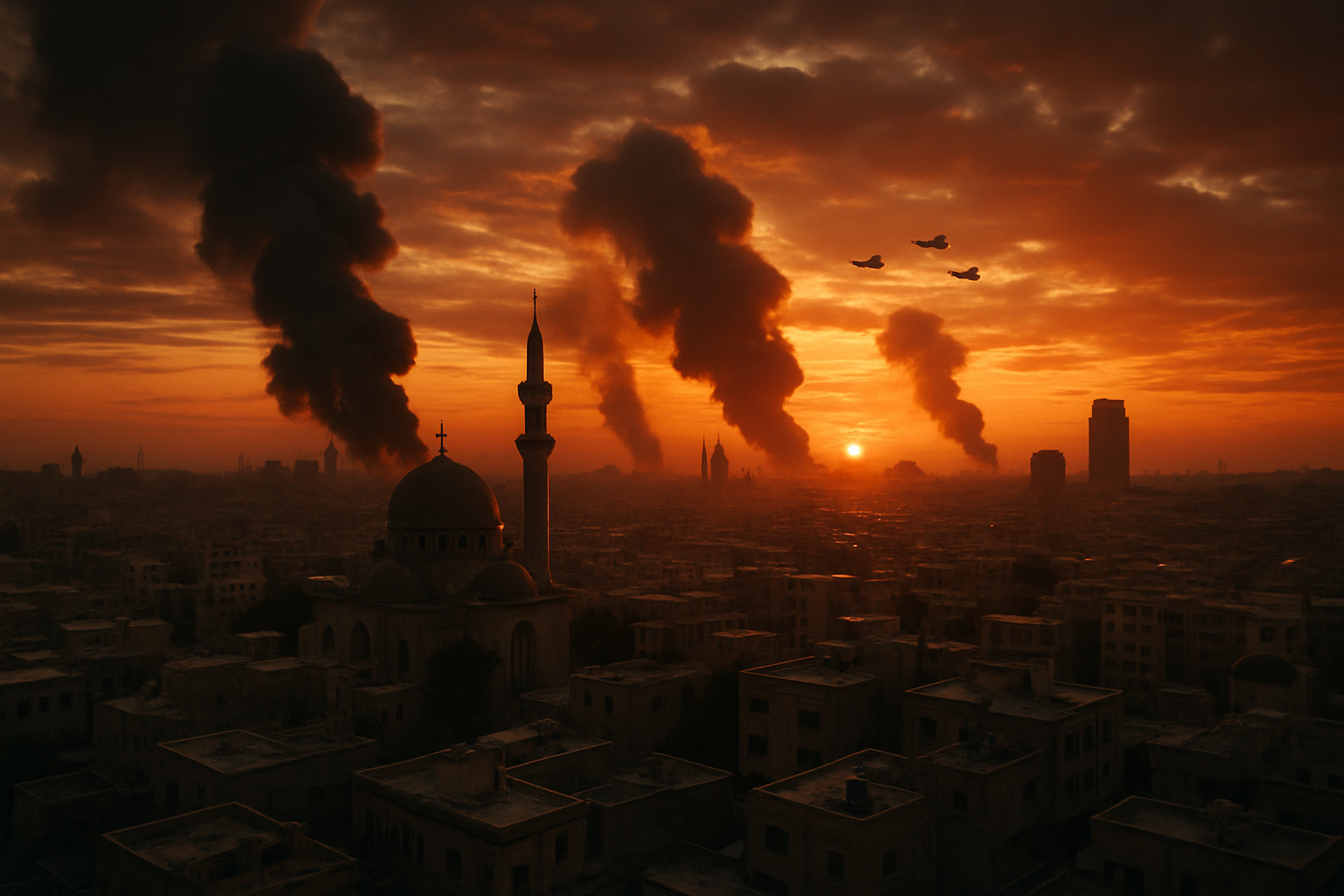
The Iran-Israel war escalated dramatically into its second week Sunday as Iranian forces continued systematic attacks across Gulf states while Israel struck oil storage facilities in Tehran for the first time, marking a dangerous new phase in what analysts call the most serious Middle East crisis since the Cold War ended.
Iran's Revolutionary Guards launched fresh missile and drone attacks targeting Saudi Arabia, Kuwait, and Qatar overnight, while Iranian President Masoud Pezeshkian issued an unprecedented apology to neighboring countries for civilian casualties. The attacks came despite Trump administration demands for Iran's "unconditional surrender" and threats of even more devastating military action.
In a significant development, Israeli forces conducted their most intensive bombardment of Tehran oil infrastructure Saturday evening, with multiple storage depots and refining facilities hit by airstrikes. Dramatic footage showed massive fires raging at the Shahran oil depot in northern Tehran, marking the first time Israel has directly targeted Iranian energy facilities in the capital since the conflict began.
Regional Coalition Under Severe Strain
The unprecedented coalition of Saudi Arabia, UAE, Qatar, and Egypt that had previously supported diplomatic solutions now faces its gravest challenge as Iranian retaliation has directly targeted member territories. At least one civilian was killed in Abu Dhabi from missile debris, while Kuwait reported 32 injured at its international airport from drone strikes.
"We are witnessing comprehensive chaos spreading across the region,"
— Egyptian President Abdel Fattah al-Sisi
Saudi Arabia delivered a stark warning to Tehran through diplomatic channels before President Pezeshkian's Saturday apology, telling Iran that continued attacks on the kingdom and its energy sector could trigger direct Saudi retaliation. The message was conveyed by Saudi Foreign Minister Prince Faisal bin Farhan in a call to his Iranian counterpart Abbas Araqchi.
Arab foreign ministers convened an emergency video conference Sunday to address what they termed the "dangerous escalation" following Iranian attacks on Arab territories. The crisis has fundamentally altered the regional security architecture that had remained relatively stable for decades.
Global Aviation Crisis Deepens
The conflict has created the most extensive aviation disruption since COVID-19, with over 18,000 flights cancelled worldwide as eight Middle Eastern countries maintain closed airspace simultaneously. Dubai International Airport, the world's busiest by international passengers, remains completely shut down following missile damage.
Major carriers including Emirates, Air France-KLM, and Wizz Air have suspended operations indefinitely, stranding hundreds of thousands of passengers globally. The crisis has exposed the vulnerability of the Middle East as a critical aviation hub connecting Europe and Asia.
Energy Security Reaches Critical Point
Oil prices surged past $80 per barrel, marking a 10% increase as Iran declared the Strait of Hormuz "unsafe for shipping," effectively threatening the waterway through which 40% of global seaborne oil transits. Over 150 tankers worth billions of dollars in cargo remain stranded in the Persian Gulf as shipping giants Maersk and MSC suspended operations.
Natural gas prices have soared 24% in Europe and 78% in the United States, while Qatar has halted LNG production due to Iranian attacks on energy infrastructure. The crisis threatens to disrupt global supply chains far beyond energy markets, affecting manufacturing in automotive, electronics, and textiles industries.
International Evacuations Intensify
The largest coordinated evacuation since the 2011 Arab Spring is underway, with Australia reporting 115,000 nationals trapped in the region and Germany working to evacuate 30,000 stranded tourists. The European Union activated its ESTIA evacuation plan for Cyprus for the first time as Iranian drones struck RAF Akrotiri, marking the first attack on European territory since World War II.
Sweden and Serbia have ordered immediate evacuations from Iran citing "extremely uncertain" security conditions, while the United States has closed its embassy in Kuwait indefinitely and evacuated non-essential personnel from 15 Middle Eastern countries.
Nuclear Diplomacy Collapse
The military escalation followed the complete breakdown of nuclear negotiations despite Geneva talks achieving what Iranian Foreign Minister Abbas Araghchi called "broad agreement on guiding principles" - the most significant diplomatic progress since the JCPOA collapse in 2018.
The fundamental disagreement that torpedoed diplomacy remained unchanged: Iran insisted on nuclear-only talks while excluding ballistic missiles and regional proxies as "red lines," while the United States demanded comprehensive agreements covering missiles, armed groups, and human rights issues.
Iran continues enriching uranium to 60% purity with over 400 kilograms of material - approaching weapons-grade levels and sufficient for multiple nuclear weapons if weaponized, according to nuclear experts.
Congressional Pressure Mounts
Bipartisan lawmakers in Washington are demanding answers about strategy, costs, and the potential for ground troop deployment. Senator Richard Blumenthal expressed being "more concerned than ever" about the possibility of American boots on the ground.
The conflict's unpopularity among Americans has been described as "almost unprecedented" for military operations in their early stages, with financial markets emerging as the "ultimate constraint" on further escalation. Pakistan's stock market suffered its largest single-day decline in history, falling 8.97%.
Iranian Leadership Crisis
Following Supreme Leader Ali Khamenei's confirmed death on March 1, Iran's three-member transitional council continues managing the country under wartime conditions. The Assembly of Experts is selecting a permanent successor, with CIA assessments suggesting a Revolutionary Guards member is likely to be chosen, indicating a shift toward hardline military influence.
The crisis has created the Islamic Republic's first succession transition during active warfare, fundamentally altering the decision-making process at Iran's highest levels.
Global Implications
The crisis occurs against the backdrop of broader nuclear governance breakdown, with the New START treaty between the US and Russia having expired February 5 - marking the first time in over 50 years without nuclear constraints between the superpowers. UN Secretary-General António Guterres has warned that nuclear risks are at their "highest in decades."
International observers describe the current crisis as "template-setting" for 21st-century conflict resolution, with success or failure likely to influence diplomatic versus military approaches to territorial and nuclear disputes worldwide.
Humanitarian Concerns
Iran's Red Crescent has reported over 787 civilian casualties from US-Israeli airstrikes, while the targeting of schools and civilian infrastructure has drawn international condemnation for potential war crimes. The bombing of Minab elementary school, which killed dozens of students and staff, has become a symbol of the conflict's human cost.
Looking Ahead
With President Trump demanding Iran's "unconditional surrender" and claiming the right to personally choose Iran's next Supreme Leader, diplomatic solutions appear increasingly remote. Pentagon officials have prepared for operations lasting through September, far beyond initial timelines.
The crisis represents the most dangerous international moment since the Cold War ended, with stakes including regional war prevention, global energy security, nuclear governance credibility, and the enforcement of post-WWII international order principles being tested simultaneously.
As the conflict enters its second week, the world faces what experts describe as the greatest test of multilateral cooperation and crisis management in the modern era, with implications extending decades beyond current events and potentially reshaping international approaches to conflict resolution for the 21st century.