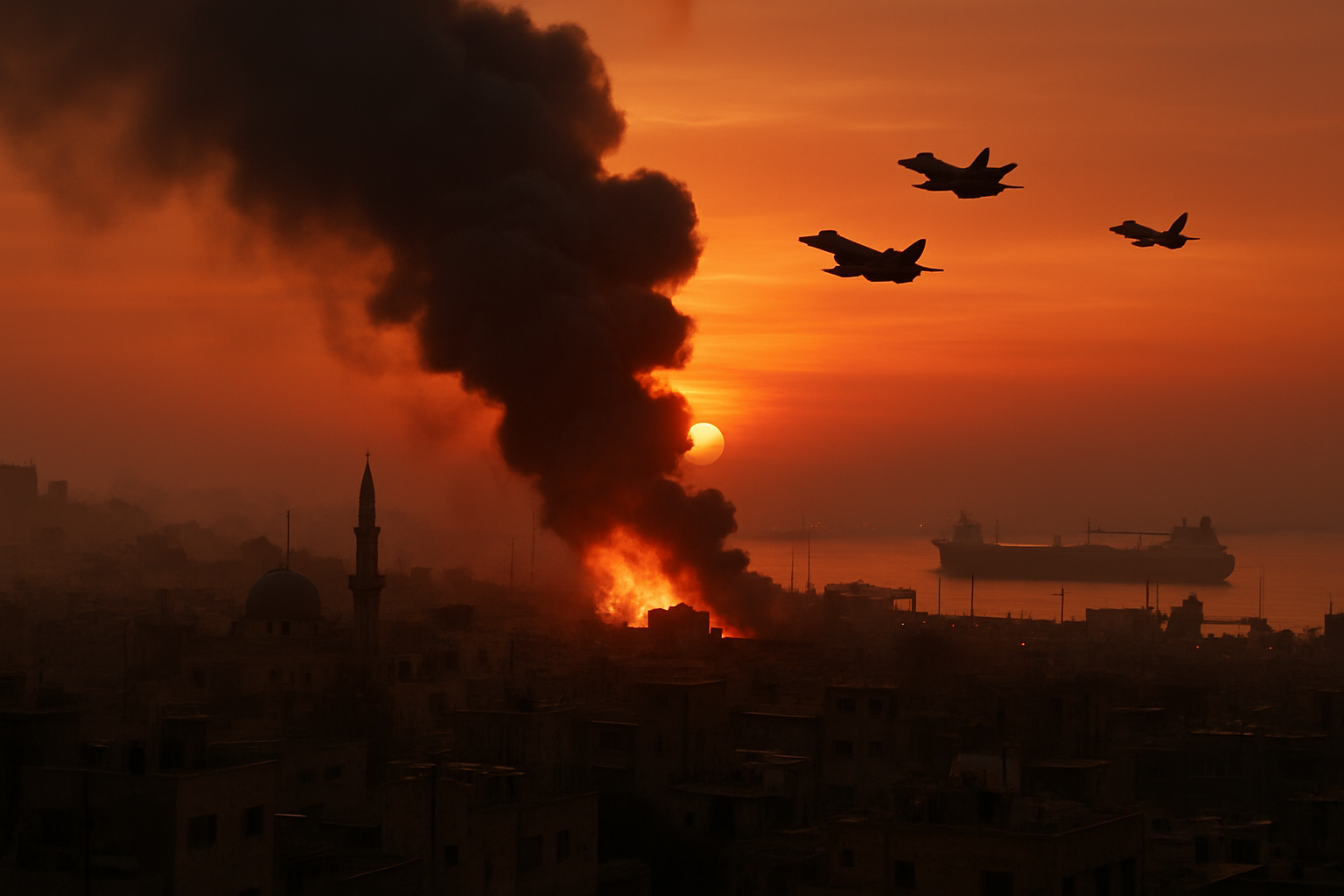
The most dangerous international crisis since the Cold War entered its fourteenth day with explosive developments as US Defense Secretary Pete Hegseth claimed Iran's new Supreme Leader Mojtaba Khamenei has been "wounded and likely disfigured" in ongoing strikes, while oil prices surge past $100 per barrel amid Iran's continued closure of the critical Strait of Hormuz.
Speaking at a press conference Friday morning, Hegseth declared that Khamenei is "scared, injured, on the run" following the coordinated US-Israeli Operation Epic Fury that has devastated Iranian infrastructure since February 28. The Defense Secretary's remarks came just one day after Mojtaba Khamenei issued his first public statement since assuming power following his father Ali Khamenei's death on March 1 - marking the first hereditary succession in the Islamic Republic's 47-year history.
Supreme Leader's Condition Under Scrutiny
The new Supreme Leader's statement, notably delivered through written text read by a television presenter rather than appearing in person, has raised questions about his physical condition. Hegseth questioned why Khamenei would issue "a declaration in writing" if he were truly in control, suggesting the regime is attempting to project strength while managing internal chaos.
"He's wounded and likely disfigured," Hegseth stated emphatically. "The fact that he's issuing written statements instead of appearing publicly tells us everything we need to know about his current state."
Iranian officials have not responded to the US claims about Mojtaba Khamenei's condition, maintaining their policy of strict information control since the conflict began. The succession to his father represents an unprecedented shift from clerical to military governance, with CIA assessments suggesting the Revolutionary Guards now exercise unprecedented control over the Iranian state apparatus.
Energy Markets in Crisis
Global energy markets continued their dramatic surge as Iran maintained its effective blockade of the Strait of Hormuz, the critical waterway carrying approximately 40% of global seaborne oil transit. Crude oil prices breached the $100 per barrel threshold for the first time since 2014, with Iranian officials warning prices could reach $200 per barrel if the conflict intensifies.
The International Energy Agency (IEA) has released a record 400 million barrels from strategic petroleum reserves - the largest intervention in the agency's 50-year history - in an attempt to stabilize markets. However, the release has done little to calm investor fears as Iran continues deploying naval mines throughout the strategic waterway using its estimated stockpile of 2,000-6,000 mines.
Natural gas prices have surged by 24% in Europe and 78% in the United States, while Qatar's liquefied natural gas production - representing approximately 20% of global exports - remains halted due to Iranian infrastructure attacks. Major shipping companies Maersk and MSC have suspended all Persian Gulf operations, leaving over 150 tankers stranded with billions of dollars in cargo.
Aviation Industry Paralyzed
The global aviation industry faces its most severe crisis since COVID-19, with over 18,000 flights cancelled worldwide. Eight Middle Eastern countries maintain simultaneous airspace closures, creating an unprecedented disruption to international travel and commerce.
Dubai International Airport, the world's busiest by international passenger traffic with 86 million annual passengers, remains completely shuttered from missile damage. Major carriers including Emirates, Air France-KLM, and Wizz Air have suspended operations indefinitely, affecting hundreds of thousands of passengers globally and severing critical Europe-Asia flight corridors.
Operation Epic Fury Costs Mount
The massive US-Israeli military campaign, dubbed Operation Epic Fury, has now cost American taxpayers $11.3 billion in its first week alone, making it the most expensive military operation since the 2003 Iraq invasion. Pentagon sources confirm 150 US service members have been wounded, with 8 in critical condition and 3 confirmed killed - the first American combat deaths in the largest Middle East operation since 2003.
The operation achieved a historic milestone when the USS Charlotte submarine sank the Iranian frigate IRIS Dena off Sri Lanka, killing over 80 crew members. This marks the first enemy vessel sunk by a US submarine since World War II, according to Defense Secretary Hegseth, who characterized it as demonstrating America's "global military reach."
Regional Casualties Escalate
Iran's systematic retaliation campaign, Operation True Promise 4, has caused casualties across the Gulf region under the Revolutionary Guard's declaration that "no red lines remain." The campaign has struck multiple nations: one civilian killed in Abu Dhabi with Dubai International Airport shutdown, 32 foreign nationals injured in Kuwait airport strikes, and 8 wounded in Qatar despite successful Patriot missile interceptions of 65 missiles and 12 drones.
Most significantly, Iranian drones struck RAF Akrotiri in Cyprus - marking the first attack on European territory since World War II. This unprecedented escalation has prompted a massive naval coalition response, with HMS Dragon and frigates from Spain, Italy, France, the Netherlands, and Greece deploying to protect European interests.
French Military Casualties
The conflict claimed its first French military casualty when Adjutant-Chief Arnaud Frion was killed in a drone attack in Iraqi Kurdistan. President Emmanuel Macron confirmed the death while maintaining France's position remains "purely defensive" in the Middle East war. The pro-Iranian group Ashab Al-Kahf has threatened French interests, warning they are "under targeting fire."
Macron emphasized that France's defensive role "does not justify attacking it at all," as he prepared for discussions with Iraqi Prime Minister Mohammed Shia al-Sudani about the deteriorating security situation.
Congressional Opposition Intensifies
Bipartisan opposition in Congress continues mounting as lawmakers demand comprehensive briefings on strategy, costs, and potential ground troop deployments. Senator Richard Blumenthal expressed being "more concerned than ever" about the prospect of boots on the ground, while the Pentagon quietly prepares operations extending through September - far beyond the administration's initial 4-6 week timeline.
Public support for the conflict remains at historically low levels, with only 25% of Americans supporting the military action according to recent polling. Financial markets have emerged as what experts call the "ultimate constraint" on further escalation, with stock markets crashing worldwide. Pakistan's KSE-100 index recorded its largest single-day decline in history at -8.97%.
Trump's Hardline Stance
President Trump has maintained his demand for Iran's "unconditional surrender," claiming the right to personally choose Iran's next Supreme Leader while rejecting Mojtaba Khamenei as a "lightweight." The President's explicit regime change objectives represent the most direct assertion of American control over Iranian internal affairs since the 1979 revolution.
"We are completely destroying the Iranian terrorist regime, militarily, economically, and otherwise," Trump declared, comparing the situation to his previous interventions in Latin America. This policy evolution from nuclear-focused concerns to comprehensive political transformation effectively eliminates any diplomatic solution possibilities.
Humanitarian Crisis Deepens
The Iranian Red Crescent reports over 787 civilian casualties from US-Israeli strikes, including the tragic Minab elementary school attack that killed between 53-85 students and staff. The incident has drawn international condemnation and calls for Geneva Conventions investigations, with images of children's backpacks and schoolbooks in the rubble becoming symbols of the conflict's human cost.
International evacuations have reached the largest scale since the Arab Spring in 2011, with Australia reporting 115,000 nationals trapped in the region and Germany coordinating the evacuation of 30,000 tourists. The European Union has activated its ESTIA crisis response mechanism for Cyprus for the first time in the bloc's history.
Nuclear Diplomacy in Ruins
The collapse of nuclear diplomacy represents one of the most significant diplomatic failures in recent history. Despite achieving what negotiators described as "broad agreement on guiding principles" in Geneva talks - the most progress since the JCPOA collapse in 2018 - fundamental disagreements over scope proved insurmountable.
Iran had insisted on nuclear-only discussions while excluding ballistic missiles and proxy relationships as "red lines," while the US demanded comprehensive agreements covering missiles, armed groups, and human rights issues. Iran continues uranium enrichment at 60% purity with over 400 kilograms of weapons-grade material - sufficient for multiple nuclear weapons if weaponized.
The diplomatic breakdown occurs against the broader context of nuclear governance crisis, with the New START treaty between the US and Russia having expired on February 5 - the first time in over 50 years without bilateral nuclear constraints between the superpowers.
Regional Coalition Under Strain
The unprecedented diplomatic coalition of Saudi Arabia, UAE, Qatar, and Egypt that had supported the nuclear negotiations now faces severe strain as Iranian retaliation directly targets member territories. Egyptian President Abdel Fattah el-Sisi condemned attacks on "sisterly Arab countries," warning of "comprehensive chaos spreading across the region."
The Gulf states find themselves caught between their security alliance with the United States and the reality of Iranian strikes on their territories, fundamentally altering regional security calculations that have governed Middle Eastern stability for decades.
Global Supply Chain Disruption
Manufacturing sectors dependent on Gulf logistics networks face severe disruption, particularly automotive, electronics, and textiles industries. The Persian Gulf's role as a critical trade hub connecting Asia and Europe has been completely compromised, exposing fundamental vulnerabilities in global supply chains to geopolitical shocks.
Major corporations have postponed significant financial activities due to market volatility, with PayPal's $1.1 billion IPO among high-profile casualties of the economic turbulence.
Template-Setting Historical Moment
UN Secretary-General António Guterres has characterized the crisis as the "greatest test of multilateral cooperation and crisis management in the modern era." The rapid transition from diplomatic breakthrough to military confrontation demonstrates the fragility of crisis management mechanisms in the multipolar era.
The March 2026 watershed moment will likely determine precedents for 21st-century conflict resolution, affecting whether diplomatic or military solutions become the preferred approach for future territorial and nuclear disputes globally. The stakes include regional war prevention, global energy security, nuclear governance credibility, and international law enforcement mechanisms that have governed the post-World War II order.
Looking Ahead
As the conflict enters its third week, the international community faces critical decisions about containment versus broader regional war. The template-setting implications extend far beyond the current crisis, potentially reshaping international approaches to conflict resolution, energy security architecture, and diplomatic credibility worldwide.
The coming days will prove decisive in determining whether this remains a contained regional confrontation or escalates into a broader Middle Eastern war with global implications extending decades beyond the current events. With nuclear governance in crisis, energy markets in chaos, and diplomatic channels strained to breaking point, March 2026 represents a potential turning point in international relations that will reverberate through the 21st century.