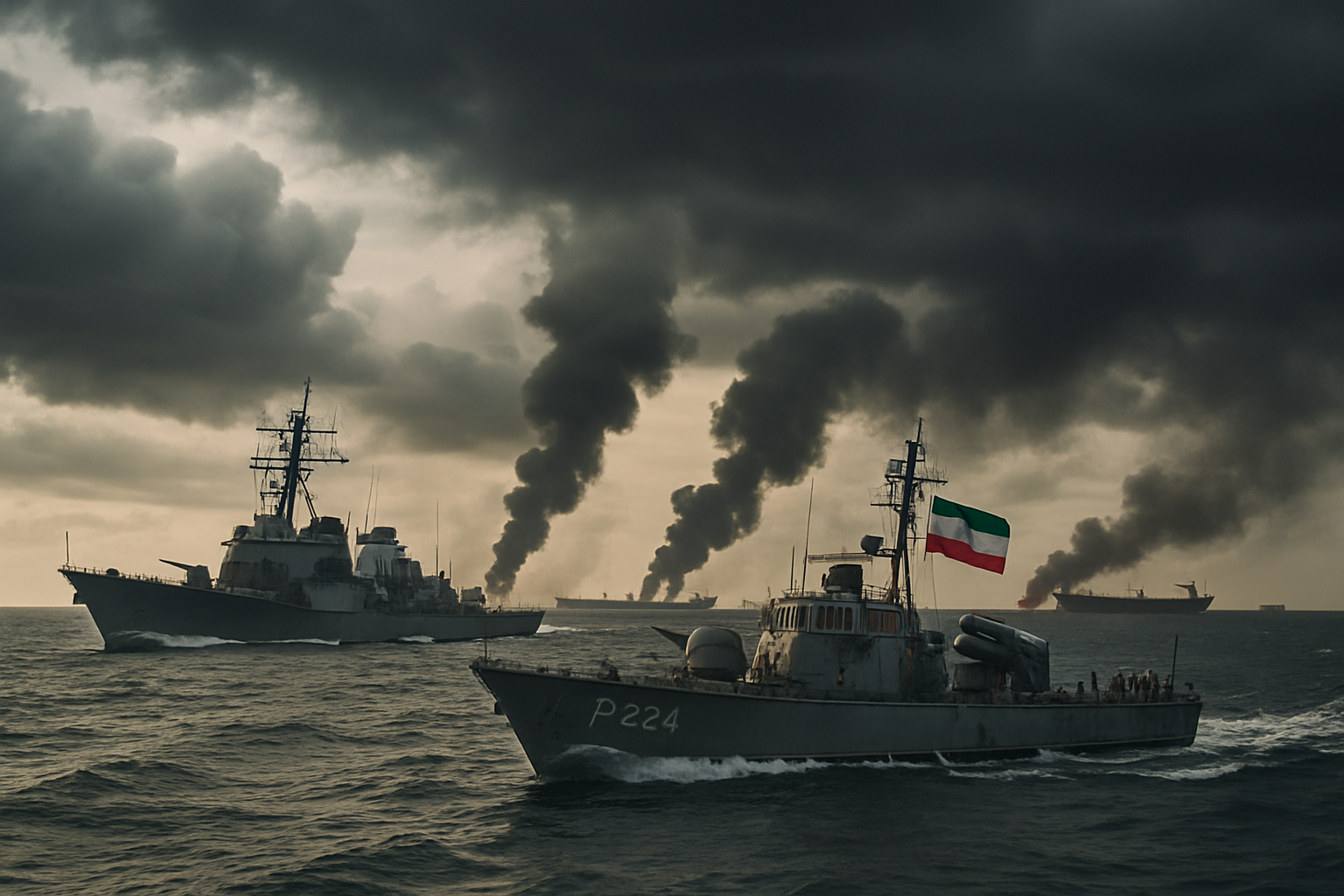
Iran's newly appointed Supreme Leader Mojtaba Khamenei has vowed to keep the Strait of Hormuz closed in his first official statement since assuming power, while Israel launched what officials described as "large-scale bombing campaigns of great magnitude" against Tehran, marking a dangerous escalation in the Middle East conflict now entering its second week.
The unprecedented hereditary succession - the first in the Islamic Republic's 47-year history - comes as the region faces its most dangerous crisis since the Cold War, with global energy markets in chaos and over 18,000 flights cancelled worldwide.
Mojtaba Khamenei's First Statement
Speaking through Iranian state television, the new Supreme Leader declared that "the leverage of closing the Strait of Hormuz should be used" and warned that "attacks on Gulf countries will continue." The statement marks the first time the new leader has spoken publicly since his father Ali Khamenei was killed in US-Israeli strikes on March 1.
According to Australian media sources, Mojtaba Khamenei's appointment consolidates Revolutionary Guards control over Iranian governance, representing a dramatic shift from clerical to military leadership during active warfare. The CIA has suggested that Revolutionary Guards members now wield unprecedented influence over the Islamic Republic's governance structure.
"Iran reserves the right to ensure the security of navigation in the vital maritime corridor, and all ships wishing to pass through the Strait of Hormuz must coordinate with Iranian forces."
— Esmaeil Baghaei, Iranian Foreign Ministry Spokesman
Israeli Massive Bombing Campaign
Israeli Prime Minister Benjamin Netanyahu announced during a press conference that Israel is "in the process of crushing Iran and Hezbollah," describing a "systematic plan" to "eradicate" Iran's regime. The Israeli military reported targeting "infrastructures of the Iranian terrorist regime" in the capital, using what witnesses described as the most intensive bombardment since the war began.
French media reported that the Israeli army specifically targeted "infrastructures of the Iranian terrorist regime" in Tehran, with residents describing the attacks as the "worst since the war started." The bombing campaign represents what CNN sources called the "second phase" of Operation Epic Fury, now focusing on energy infrastructure.
Russian media provided extensive coverage of the escalation, with President Trump warning Iran would be "hit very hard" as Iranian forces launched their 27th wave of Operation True Promise 4 retaliation strikes.
Global Energy Crisis Deepens
The closure of the Strait of Hormuz, which carries 40% of the world's seaborne oil transit, has created an unprecedented global energy crisis. Oil prices have surged past $80 per barrel, with analysts warning they could reach $200 if the conflict continues to escalate.
Over 150 tankers worth billions in cargo remain stranded in the Persian Gulf, with major shipping companies Maersk and MSC suspending all operations. Natural gas prices have increased by 24% in Europe and 78% in the United States, while Qatar has halted LNG production - representing roughly 20% of global exports.
- Over 18,000 flights cancelled globally - the most severe disruption since COVID-19
- Eight Middle Eastern countries maintaining simultaneous airspace closures
- Dubai International Airport, the world's busiest, remains completely shut down from missile damage
- Major carriers including Emirates, Air France-KLM, and Wizz Air have suspended operations indefinitely
International Response and Evacuations
The crisis has prompted the largest international evacuation operation since the Arab Spring in 2011, with Australia reporting 115,000 nationals trapped in the region and Germany struggling to evacuate 30,000 stranded tourists. The European Union activated its ESTIA evacuation protocol for Cyprus for the first time in the bloc's history after Iranian drones struck RAF Akrotiri - the first attack on European territory since World War II.
An unprecedented naval coalition has formed, with HMS Dragon, Spanish frigates, and vessels from Italy, France, the Netherlands, and Greece deploying to protect European interests in the Eastern Mediterranean.
Congressional Scrutiny Intensifies
In Washington, bipartisan lawmakers are demanding answers about the Trump administration's strategy, costs, and potential ground troop deployment. Senator Richard Blumenthal stated he is "more concerned than ever" about the possibility of "boots on the ground," while the Pentagon has quietly prepared for operations extending through September - far beyond the administration's initial 4-6 week timeline.
The conflict's unpopularity has reached "almost unprecedented" levels, with only 25% of Americans supporting the military strikes according to recent polling. Financial markets are emerging as the "ultimate constraint" on further escalation, with global stock indices experiencing severe volatility.
Nuclear Diplomacy Collapse
The military escalation followed the complete breakdown of nuclear diplomacy, despite Geneva talks achieving what negotiators called "broad agreement on guiding principles" - the most progress since the JCPOA collapse in 2018. However, fundamental disagreements proved insurmountable, with Iran maintaining that ballistic missiles and regional proxies were "red lines" excluded from nuclear-only discussions, while the US demanded comprehensive agreements covering missiles, armed groups, and human rights issues.
Iran continues enriching uranium to 60% purity, with over 400 kilograms of weapons-grade material - sufficient for multiple nuclear weapons if weaponized. The crisis unfolds amid broader nuclear governance challenges following the February 5 expiration of the New START treaty between the US and Russia, marking the first time in over 50 years without nuclear constraints between the superpowers.
Regional Coalition Under Strain
The unprecedented coalition of Saudi Arabia, UAE, Qatar, and Egypt that had supported diplomatic solutions is now under severe strain as Iranian retaliation has directly targeted member territories. Egyptian President Abdel Fattah el-Sisi condemned attacks on "sisterly Arab countries," warning of "comprehensive chaos" spreading across the region.
Regional casualties continue to mount, with the UAE confirming one civilian killed in Abu Dhabi, Kuwait reporting 32 injured from airport strikes, and Qatar managing to intercept 65 missiles and 12 drones using Patriot systems, though 8 people were injured by fragments.
Template-Setting Historical Moment
UN Secretary-General António Guterres has called the crisis the "greatest test of multilateral cooperation and crisis management in the modern era." The rapid transition from promising diplomatic breakthroughs to full-scale military confrontation demonstrates what experts describe as the fragility of crisis management in the multipolar era.
The conflict represents a watershed moment for 21st-century international relations, with implications extending far beyond the Middle East. Success in containing the escalation could provide a framework for future nuclear crisis resolution, while failure may encourage military solutions over diplomatic ones, potentially reshaping global approaches to conflict resolution for decades to come.
"This crisis will determine whether we can prevent regional wars, maintain global energy security, and preserve the credibility of nuclear governance and international law enforcement mechanisms established after World War II."
— UN Secretary-General António Guterres
Looking Ahead
As the crisis enters its second week, the stakes could not be higher. The conflict now affects global energy architecture, aviation networks, nuclear proliferation mechanisms, and fundamental principles of the post-World War II international order. With Mojtaba Khamenei's hardline stance on maintaining the Strait of Hormuz closure and Israel's intensifying bombing campaigns, the international community faces critical decisions that will reverberate through international relations for decades.
The coming days will determine whether this crisis remains a contained regional confrontation or escalates into a broader Middle Eastern war with worldwide implications for energy markets, supply chains, and the future of diplomatic versus military solutions to international disputes.