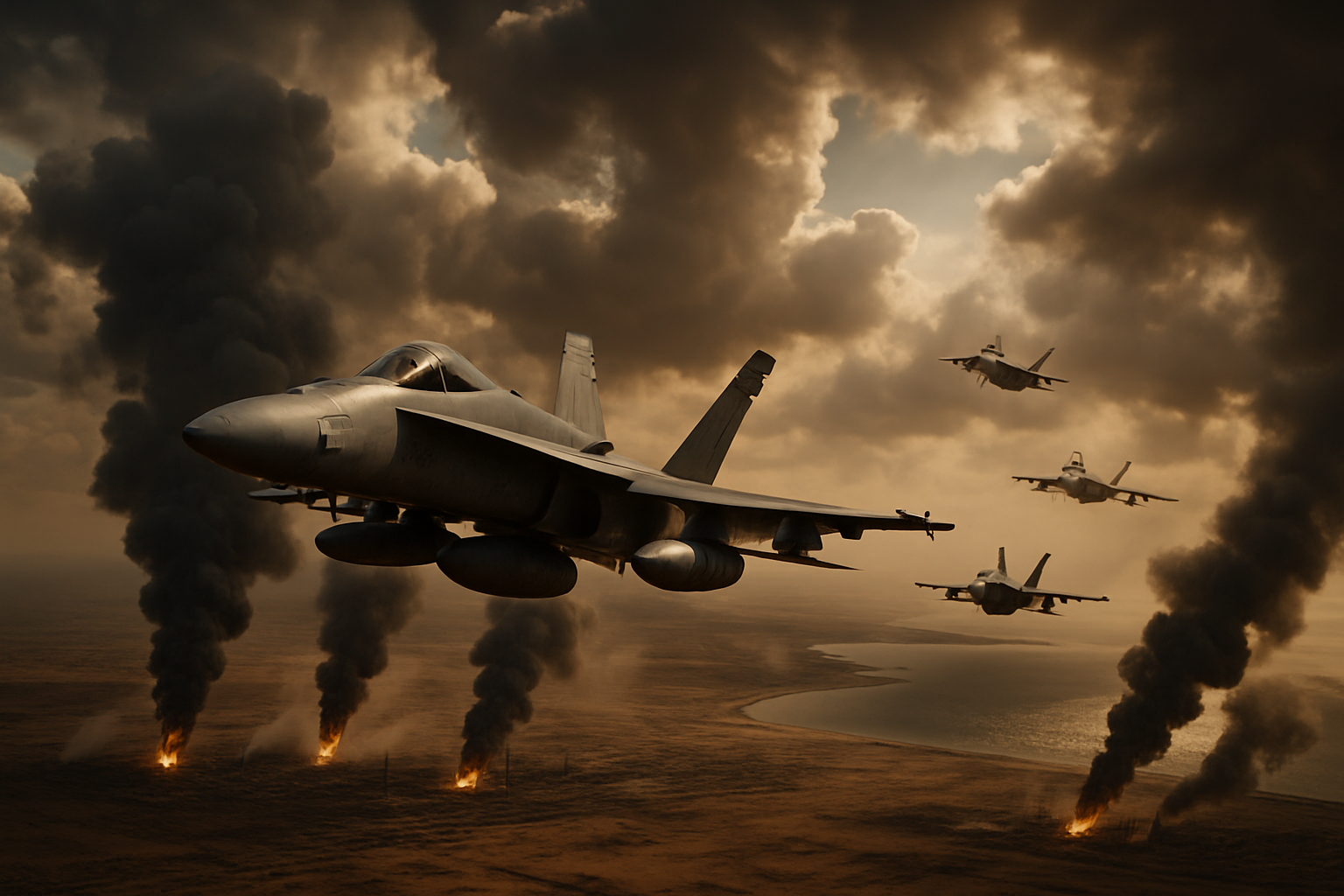
The Iran-Israel war has reached a dangerous new escalation as Iranian forces shot down multiple US military aircraft attempting a rescue mission, while Russia evacuated 198 workers from Iran's Bushehr nuclear plant following nearby airstrikes, raising unprecedented nuclear safety concerns.
Iranian Revolutionary Guard forces claimed to have destroyed several US aircraft on Sunday, including two Black Hawk helicopters and a C-130 military transport aircraft, during what Tehran described as a joint operation involving aerospace forces, ground units, and popular militias. The incident occurred during a US mission to rescue an F-15 fighter pilot who had been shot down over Iran's Isfahan province.
Nuclear Crisis Deepens
The conflict has taken an alarming turn with reports of strikes near Iran's nuclear infrastructure. Russia's state nuclear agency Rosatom confirmed the emergency evacuation of 198 workers from the Bushehr nuclear power plant following what sources described as a "U.S.-Israeli airstrike" in the area. This marks the first time nuclear facility workers have been evacuated due to nearby military action, raising serious concerns about potential radiological disasters.
The Bushehr plant, Iran's only operational nuclear power station, is located in southwestern Iran and was built with Russian assistance. The evacuation underscores how the expanding conflict is threatening critical civilian infrastructure across the region.
Regional Infrastructure Under Attack
The war has systematically targeted energy and government facilities across the Gulf states. Iranian drone strikes hit Kuwait's Ministry of Oil complex and the headquarters of Kuwait Petroleum Corporation, causing significant material damage but no reported casualties. Emergency response teams and firefighters were deployed to contain fires at the targeted facilities.
In a coordinated regional assault, Iran launched attacks on critical infrastructure across multiple countries. Kuwait's electricity and water ministry reported that two power stations and water desalination plants were targeted by Iranian drones, resulting in severe material damage and forcing two electricity generation units offline, though no human casualties were reported.
"During a joint operation involving Aerospace, Ground Force, Popular Units, Basij and Police command, enemy aircraft were destroyed."
— Iranian Revolutionary Guard Statement
Global Energy Markets in Crisis
The systematic targeting of energy infrastructure has created the most severe global energy crisis since the 1970s oil shocks. Critical infrastructure across the Gulf region came under sustained Iranian attack, with damage reported at civilian facilities in the United Arab Emirates, Bahrain, and Kuwait. The Persian Gulf, which handles 40% of global seaborne oil transit, has become increasingly dangerous for commercial shipping.
Asian markets are experiencing severe disruption as 84% of oil transiting through the Strait of Hormuz was destined for the region. Countries across Asia face acute shortages, fuel rationing, and long queues at gas stations as supply chains breakdown under the pressure of the ongoing conflict.
Trump Administration Response
President Donald Trump has issued stark ultimatums to Iran, demanding the country reopen the Strait of Hormuz within 48 hours or face "all Hell." The dramatic escalation in rhetoric comes as US and Iranian forces conduct intensive search operations for the downed American airman, while diplomatic efforts have completely broken down.
The conflict represents the largest US-Israeli coordinated military operation since the 2003 Iraq invasion, with dual-carrier deployments and extensive air campaigns targeting Iranian infrastructure. However, congressional opposition is mounting, with lawmakers demanding answers about strategy, costs, and the potential for ground troop deployment.
Humanitarian Crisis Mounts
The war has triggered massive civilian displacement and casualties across the region. Israeli airstrikes near Saida in southern Lebanon killed seven people, including six members of the same family, as the conflict spreads beyond its original Iran-Israel boundaries. The strike occurred in Kfar Hatt, located more than 40 kilometers from the Israeli border, indicating the expanding scope of military operations.
Thousands of civilians across multiple countries are trapped in conflict zones, with Australia reporting 115,000 nationals requiring evacuation and Germany struggling to extract 30,000 stranded tourists. The scale of international evacuations has reached levels not seen since the Arab Spring of 2011.
Anti-War Protests in Israel
The prolonged conflict has sparked significant domestic opposition within Israel itself. Hundreds of protesters demonstrated against the Iran war in multiple Israeli cities, with a major gathering in Tel Aviv's HaBima Square. Police forcibly dispersed the demonstration, though some protesters continued their demonstration even during rocket attack alerts, highlighting the depth of public concern about the escalating conflict.
The protests reflect growing war fatigue and concern about the expanding scope of military operations, as what began as targeted strikes has evolved into a comprehensive regional conflict affecting multiple countries and threatening global energy security.
International Implications
The Iran-Israel war has created what UN Secretary-General António Guterres called "the greatest test of multilateral cooperation in the modern era." The conflict has exposed dangerous vulnerabilities in global energy infrastructure, with the 21-mile Strait of Hormuz proving to be a critical single point of failure for the world's energy supply.
The breakdown of nuclear diplomacy, despite earlier progress in Geneva talks, has eliminated diplomatic solutions and raised serious questions about international crisis management in the multipolar era. The conflict's expansion to include attacks on European territory (Cyprus) has fundamentally altered NATO's security calculations and prompted unprecedented naval coalition responses.
As the war enters its most dangerous phase, with nuclear facilities threatened and US aircraft shot down, the international community faces critical decisions about intervention, energy security, and the future of diplomatic conflict resolution in the 21st century.