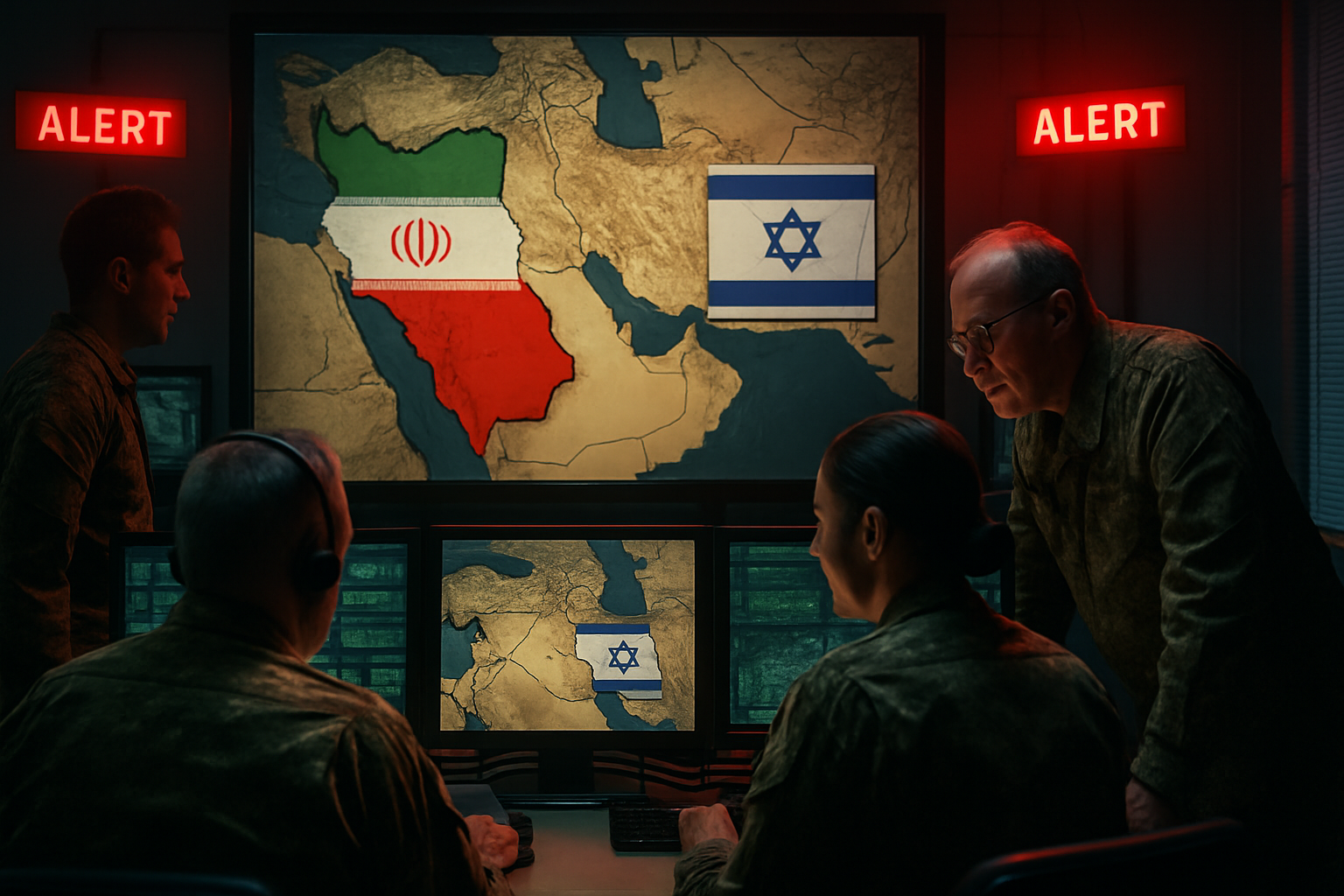
The Iran-Israel conflict has reached unprecedented levels of escalation as President Donald Trump urged allied nations to send warships to secure the Strait of Hormuz, while Iranian forces continue systematic strikes across the Middle East in what officials describe as the most dangerous international crisis since the Cold War.
As the conflict enters its second week following the death of Iran's Supreme Leader Ali Khamenei on March 1, the regional crisis has evolved into a global emergency affecting energy markets, aviation networks, and international security. Trump's latest appeal for a multinational naval coalition comes as oil prices surge past $80 per barrel and Iran effectively closes the world's most critical oil transit route.
Trump's Diplomatic Push for International Support
In a statement to NBC News, President Trump revealed he has received commitments from "several countries" to help secure shipping through the Strait of Hormuz, which carries approximately 40% of global seaborne oil. The president specifically mentioned hopes that China, France, Japan, and South Korea would contribute naval vessels to defend the strategic waterway.
"We need a team effort to reopen this key waterway," Trump told reporters, describing the initiative as essential for global economic stability. "Countries that depend on Gulf oil must step up and help keep these sea lanes open."
— Donald Trump, US President
The diplomatic initiative comes as Prime Minister Sanae Takaichi prepares for a summit with Trump in Washington next week, putting Japan in a particularly complex position regarding potential military involvement in the Middle East.
Iran's Regional Retaliation Campaign
Iran's Islamic Revolutionary Guard Corps (IRGC) has launched what it calls "Operation True Promise 4," declaring that "no red lines remain" in targeting US and Israeli assets across the region. The campaign has resulted in casualties across multiple Gulf states and represents the most significant expansion of conflict beyond Iran's borders in decades.
Regional casualties from Iranian strikes include one civilian killed in Abu Dhabi, 32 foreign nationals injured in Kuwait airport drone attacks, and eight wounded in Qatar despite Patriot missile systems intercepting 65 missiles and 12 drones. Most significantly, Iranian forces struck RAF Akrotiri in Cyprus, marking the first attack on European territory since World War II.
Tehran's strategy appears aimed at pressuring the unprecedented Saudi-UAE-Qatar-Egypt coalition that had previously supported diplomatic solutions. Egyptian President Abdel Fattah el-Sisi condemned Iranian attacks on "sisterly Arab countries," warning of "comprehensive chaos" spreading across the region.
Global Aviation Crisis Deepens
The conflict has triggered the most extensive aviation disruption since COVID-19, with over 18,000 flights cancelled worldwide. Eight Middle Eastern countries have simultaneously closed their airspace, including Iran, Iraq, Israel, UAE, Qatar, Syria, Kuwait, and Bahrain.
Dubai International Airport, the world's busiest by international passenger traffic, remains completely shut down following missile damage. Major carriers including Emirates, Air France-KLM, and Wizz Air have suspended Middle Eastern operations indefinitely, affecting hundreds of thousands of passengers globally and severely disrupting the critical Europe-Asia air corridor.
Energy Markets in Turmoil
Iran's closure of the Strait of Hormuz has created a global energy crisis, with over 150 tankers stranded in the Persian Gulf carrying billions of dollars worth of cargo. Major shipping companies Maersk and MSC have suspended operations in the region, while Qatar has halted LNG production, threatening European energy supplies.
Natural gas prices have surged 24% in Europe and 78% in the United States, with UK households facing potential energy bill increases of £160 annually. The International Energy Agency has released a record 400 million barrels from strategic reserves in the largest intervention in the agency's 50-year history.
Iran's Leadership Transition Under Fire
Following the confirmed death of Ali Khamenei in US-Israeli "Operation Epic Fury," Iran's Assembly of Experts has appointed Mojtaba Khamenei, the former Supreme Leader's son, as his successor. This marks the first hereditary succession in the Islamic Republic's 47-year history and represents a significant shift from clerical to military-influenced governance.
CIA assessments suggest that Revolutionary Guards members now wield unprecedented influence over Iranian state apparatus, indicating a fundamental transformation in the country's power structure during the ongoing conflict.
International Diplomatic Responses
The crisis has prompted unprecedented diplomatic mobilization, with UN Secretary-General António Guterres calling it "the greatest test of multilateral cooperation in the modern era." Emergency sessions of the UN Security Council have seen strong condemnation from Russia and China, while European Union member states have activated emergency evacuation protocols.
France has offered to host direct Israel-Lebanon talks in Paris as Hezbollah's involvement threatens to expand the conflict further. The November 2024 ceasefire between Israel and Hezbollah has completely collapsed, with Lebanese casualties reaching 826 killed and over 832,000 displaced.
Nuclear Diplomacy Breakdown
The current military escalation emerged from the complete collapse of nuclear negotiations in Geneva, despite achieving what Iranian Foreign Minister Abbas Araghchi called "broad agreement on guiding principles" - the most significant diplomatic progress since the JCPOA collapse in 2018.
The fundamental disagreement centered on scope: Iran excluded ballistic missiles and regional proxies as "red lines" for nuclear-only talks, while US Secretary of State Marco Rubio insisted on a comprehensive agreement including missiles, armed groups, and human rights issues. Iran continues uranium enrichment at 60% purity with over 400kg of material approaching weapons-grade levels.
Congressional Scrutiny Intensifies
Bipartisan lawmakers in Washington are demanding answers on the administration's Iran war strategy, costs, and potential ground troop deployment. Senator Richard Blumenthal expressed being "more concerned than ever" about the possibility of boots on the ground, while the conflict's unpopularity has been described as "almost unprecedented" for early-stage military operations.
Operation Epic Fury has cost $3.7 billion in its first week alone, with Pentagon sources suggesting preparations for operations extending through September, far beyond the White House's initial 4-6 week timeline.
Humanitarian Crisis and Casualties
The human cost continues to mount, with Iran's Red Crescent reporting over 787 civilian casualties from US-Israeli strikes. The tragic attack on Minab elementary school, which killed between 53-85 students and staff, has drawn international condemnation and calls for Geneva Conventions investigations.
The largest coordinated international evacuation since the Arab Spring has been launched, with Australia reporting 115,000 nationals trapped in the region and Germany struggling to repatriate 30,000 stranded tourists.
Template-Setting Crisis for the 21st Century
Military analysts and international relations experts view the rapid transition from diplomatic breakthrough to military confrontation as a defining moment for crisis management in the multipolar era. The collapse of promising negotiations raises fundamental questions about the viability of diplomatic solutions to modern nuclear crises.
The stakes extend far beyond the Middle East, affecting global energy security, nuclear governance credibility, international law enforcement, and the post-World War II international order. Success in containing the crisis could provide a framework for future conflict resolution, while failure may encourage military solutions over diplomatic approaches for decades to come.
As President Trump continues to demand Iran's "unconditional surrender" while simultaneously seeking international naval support, the coming days will prove crucial in determining whether this crisis can be contained or will escalate into a broader regional war with worldwide implications.