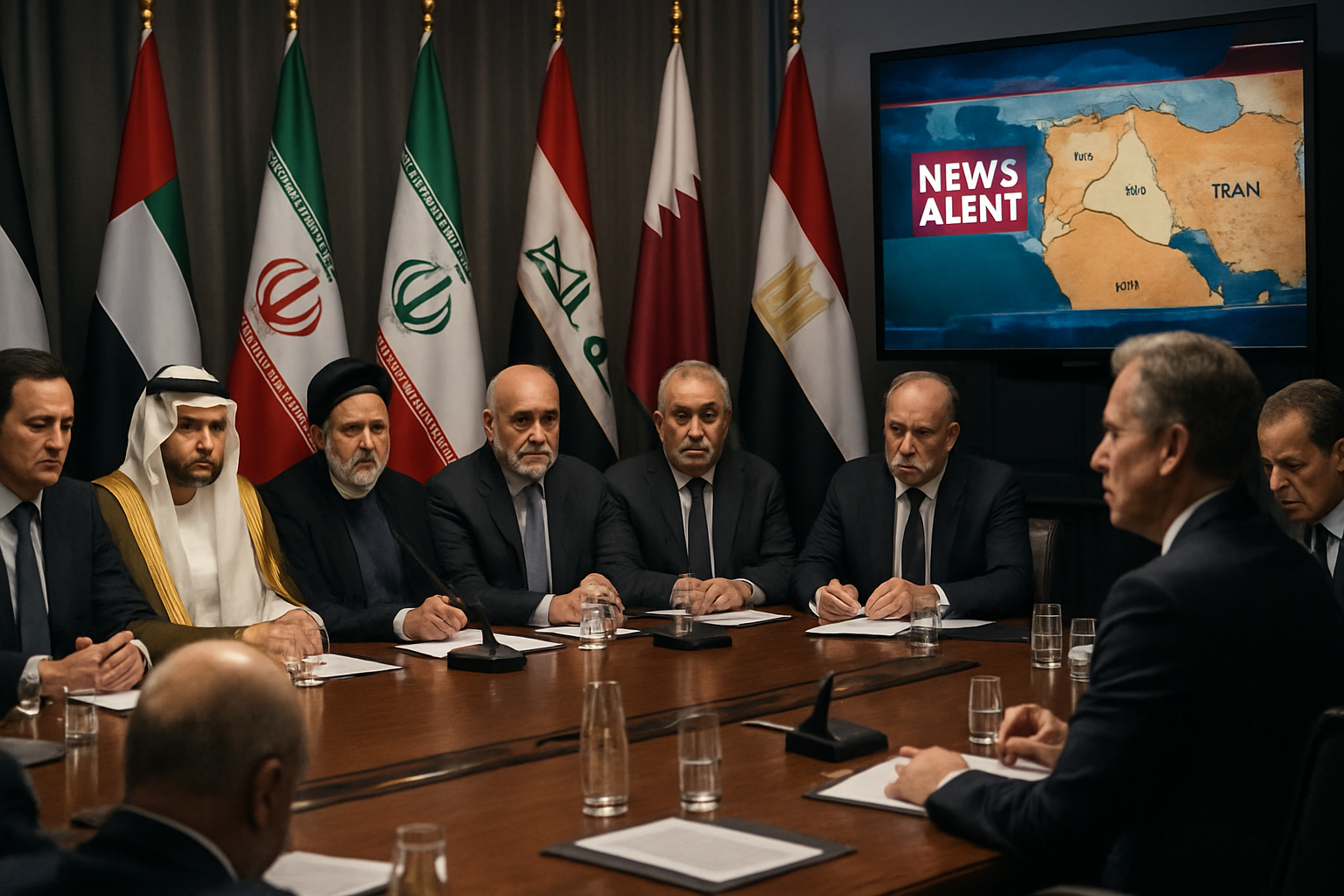
President Donald Trump's claim that Iran has requested a ceasefire has been categorically rejected by Tehran, as the month-long Middle East conflict continues to escalate with fresh missile strikes and attacks on critical infrastructure across the region.
On Wednesday morning, Trump posted on Truth Social that Iran's president had asked the United States to end the war, stating: "The new Iranian government's president is far less extremist and far more intelligent than his predecessors. They have just asked the U.S. to end the war." However, Iranian officials immediately dismissed these claims as "false and baseless."
Iran Categorically Rejects Ceasefire Claims
Iranian Foreign Ministry spokesman Esmaeil Baqaei strongly denied Trump's assertions, calling them "false and unfounded." Italian state media reported similar denials from Iranian television, with officials stating there was no truth to the American president's claims about ceasefire requests.
Trump's post included a stark warning that the United States would continue military operations until Iran reopened the Strait of Hormuz: "We will consider this once the Strait of Hormuz is open and free. Until then, we will continue to blow up Iran, as it is said, back to the Stone Age."
The Venezuelan outlet El Nacional reported Trump's additional statement that the U.S. would keep "bombing Iran until annihilation" unless shipping routes were restored. This represents the most explicit threat against Iranian civilian infrastructure since Operation Epic Fury began on February 28.
Escalating Regional Violence
Despite diplomatic claims, violence continued across the region on Wednesday. Iranian forces launched fresh missile barrages targeting northern and southern Israel, according to Afghan media reports describing it as the largest escalation since current hostilities began.
Egyptian media described Wednesday's attacks as involving a "barrage of missiles" fired from Iran and Lebanon, calling it the most extensive since the war started. The strikes targeted multiple Israeli cities and military installations, demonstrating Iran's continued offensive capabilities despite weeks of intensive bombardment.
"Iran has no immediate response to Trump's claim on social media that 'Iran's New Regime President' was seeking a ceasefire, which Trump said would only happen once the Strait of Hormuz was 'open, free, clear'."
— South China Morning Post
Strategic Waterway Remains Closed
The Strait of Hormuz, through which approximately 40% of global oil transit passes, remains effectively closed due to Iranian naval mining operations. Iran has deployed an estimated 2,000-6,000 naval mines in the critical shipping channel, stranding over 150 oil tankers worth billions in cargo.
Oil prices have surged past $100 per barrel as the energy crisis deepens, with the International Energy Agency releasing a record 400 million barrels from strategic reserves - the largest intervention in the agency's 50-year history. Natural gas prices have increased by 24% in Europe and 78% in the United States.
Infrastructure Attacks Continue
The conflict expanded beyond military targets on Wednesday, with Iran striking an oil tanker off the coasts of Qatar and Kuwait. The attacks targeted Kuwait's airport facilities, causing significant disruptions to civilian air travel in the Gulf region.
Chinese media reported that Iran hit an oil tanker near Qatar and Kuwait's airport, while Israeli airstrikes continued to batter Tehran. These attacks on civilian infrastructure mark a dangerous escalation in the scope and intensity of the conflict.
Kuwait's defense forces have handled over 90 incidents since the beginning of what they describe as "Iranian aggression," including fires caused by shrapnel and direct targeting. The Kuwait Armed Forces intercepted three cruise missiles and 15 hostile drones in the past 24 hours alone.
Global Crisis Deepens
The aviation industry faces its worst crisis since COVID-19, with over 18,000 flights cancelled worldwide. Dubai International Airport, the world's busiest with 86 million passengers annually, remains completely shut down due to missile damage. Eight Middle Eastern countries maintain simultaneous airspace closures, severing critical Europe-Asia corridors.
Major airlines including Emirates, Air France-KLM, and Wizz Air have suspended operations indefinitely, affecting hundreds of thousands of passengers globally. The disruption demonstrates the conflict's far-reaching impact on international commerce and travel.
International Diplomatic Efforts
Pakistan's Foreign Minister Ishaq Dar has been working on potential mediation efforts, with both the United States and Iran reportedly expressing confidence in Pakistan's ability to facilitate negotiations. China has offered "full support" for potential peace talks in Islamabad in the "coming days," according to diplomatic sources.
However, Iran has categorically rejected Trump's proposals as "excessive, unrealistic, and unreasonable," casting doubt on the viability of near-term diplomatic solutions. The fundamental disagreement remains: Iran insists on nuclear-only discussions while the United States demands comprehensive agreements covering ballistic missiles, regional proxies, and human rights issues.
Congressional Pressure Mounts
Trump scheduled a national address for 9 PM EST Wednesday to provide what the White House described as "an important update on Iran," fueling speculation about potential war developments. US media noted that Trump has brushed aside the need for formal agreements, telling reporters that US forces would likely leave Iran in "two or three weeks."
Congressional opposition continues to grow, with only 25% of Americans supporting the military operations according to recent polling - historically low numbers for early-stage military engagement. Senator Richard Blumenthal expressed being "more concerned than ever" about potential ground troop deployment.
Humanitarian Crisis Deepens
The Iran Red Crescent reports over 787 civilian casualties from US-Israeli strikes, including the devastating attack on a school in Minab that killed between 53-85 students and staff. The Pentagon has confirmed responsibility for elementary school strikes that killed 165-185 students due to "outdated targeting data," raising serious questions about international humanitarian law compliance.
International evacuations continue on the largest scale since the Arab Spring in 2011, with Australia reporting 115,000 nationals trapped in the region and Germany evacuating 30,000 stranded tourists and citizens.
Energy Architecture Under Threat
The conflict has exposed fundamental vulnerabilities in global energy infrastructure. The 21-mile Strait of Hormuz represents a single point of failure for modern logistics, with its closure affecting not just oil but also liquefied natural gas exports, manufacturing supply chains, and shipping routes connecting Asia and Europe.
Major shipping companies Maersk and MSC have suspended Persian Gulf operations, while Qatar has halted LNG production, threatening European gas supplies during the winter heating season. Airlines have implemented emergency fuel surcharges as jet fuel costs jumped from $85-90 to $150-200 per barrel.
Template-Setting International Crisis
UN Secretary-General António Guterres has called the current situation "the greatest test of multilateral cooperation and crisis management in the modern era." The rapid transition from diplomatic breakthrough to military confrontation demonstrates the fragility of crisis management mechanisms in the multipolar era.
The stakes extend far beyond the Middle East, affecting regional war prevention, global energy security, nuclear governance credibility, and international law enforcement. Success in containing the crisis could provide a framework for future nuclear dispute resolution, while failure may accelerate military solutions and encourage proliferation globally, undermining diplomatic credibility worldwide.
As the conflict enters its second month, the contradiction between Trump's ceasefire claims and Iran's continued military operations highlights the deep complexity of resolving this multifaceted crisis that now threatens international stability on multiple fronts.