Iranian Revolutionary Guard forces launched coordinated drone strikes against US diplomatic facilities across the Gulf region early Tuesday, targeting the American embassy in Riyadh and other consular buildings in retaliation for ongoing military operations, according to multiple government sources and eyewitness reports.
The Saudi Ministry of Defense confirmed that two drones struck a diplomatic building in Riyadh at approximately 5:30 AM local time, causing a limited fire and material damage to the US embassy compound. Black smoke was seen rising from the capital's diplomatic quarter as emergency services responded to the attack.
The strikes represent a dramatic escalation in regional tensions and mark the most significant direct targeting of US diplomatic facilities in the Gulf states since the collapse of nuclear negotiations earlier this year. The attacks appear to be part of Iran's broader "Operation True Promise 4" campaign, which has already resulted in casualties across multiple countries.
Multiple Diplomatic Targets Hit
Beyond Riyadh, Iranian drone strikes targeted US consular facilities in Kuwait, where the international airport was struck causing injuries to several employees. In Pakistan, US Marines opened fire as demonstrators stormed the American consulate in Karachi following widespread unrest triggered by recent military developments.
The Kuwait incident saw drones strike Terminal 1 of the international airport, with local authorities confirming at least three military personnel wounded at the nearby Ali Al Salem Base. Qatar successfully intercepted incoming missiles using Patriot defense systems, though eight civilians were injured by falling debris.
US Embassy officials in Kuwait announced the facility's closure "until further notice" due to "ongoing regional tensions," canceling all routine and emergency consular appointments. The State Department has urged American citizens across the region to shelter in place and consider immediate departure via commercial transportation.
Escalating Regional Crisis
These attacks follow the breakdown of what had been the most promising US-Iran diplomatic engagement in years. Despite achieving a "broad agreement on guiding principles" during Geneva talks - representing the most significant progress since the 2018 JCPOA collapse - fundamental disagreements over scope ultimately proved insurmountable.
Iran had maintained that ballistic missiles and regional proxy activities were "red lines" that should be excluded from nuclear-only talks, while the US insisted on a comprehensive agreement addressing missiles, armed groups, and human rights issues. The Iranian position of enriching uranium to 60% purity - approaching the 90% weapons-grade threshold - created additional urgency for negotiations.
The diplomatic collapse came despite unprecedented regional support, with Saudi Arabia, UAE, Qatar, and Egypt forming an extraordinary coalition backing the peace process. This Gulf consensus had been seen as crucial for preventing military confrontation, but the Iranian attacks now directly target member territories of this diplomatic alliance.
Military Response and International Reaction
The attacks prompted immediate international condemnation, with several European nations issuing urgent travel warnings for the Middle East region. The UK, France, Germany, and Poland have all advised against travel to affected areas, while multiple countries have authorized the departure of non-essential embassy personnel.
US military officials confirmed that American forces across the region remain on "highest alert" status following the embassy attacks. The unprecedented dual-carrier deployment of USS Gerald R. Ford and USS Abraham Lincoln - representing approximately one-third of the active US Navy fleet positioned 800km from Iran's coast - underscores the gravity of the current crisis.
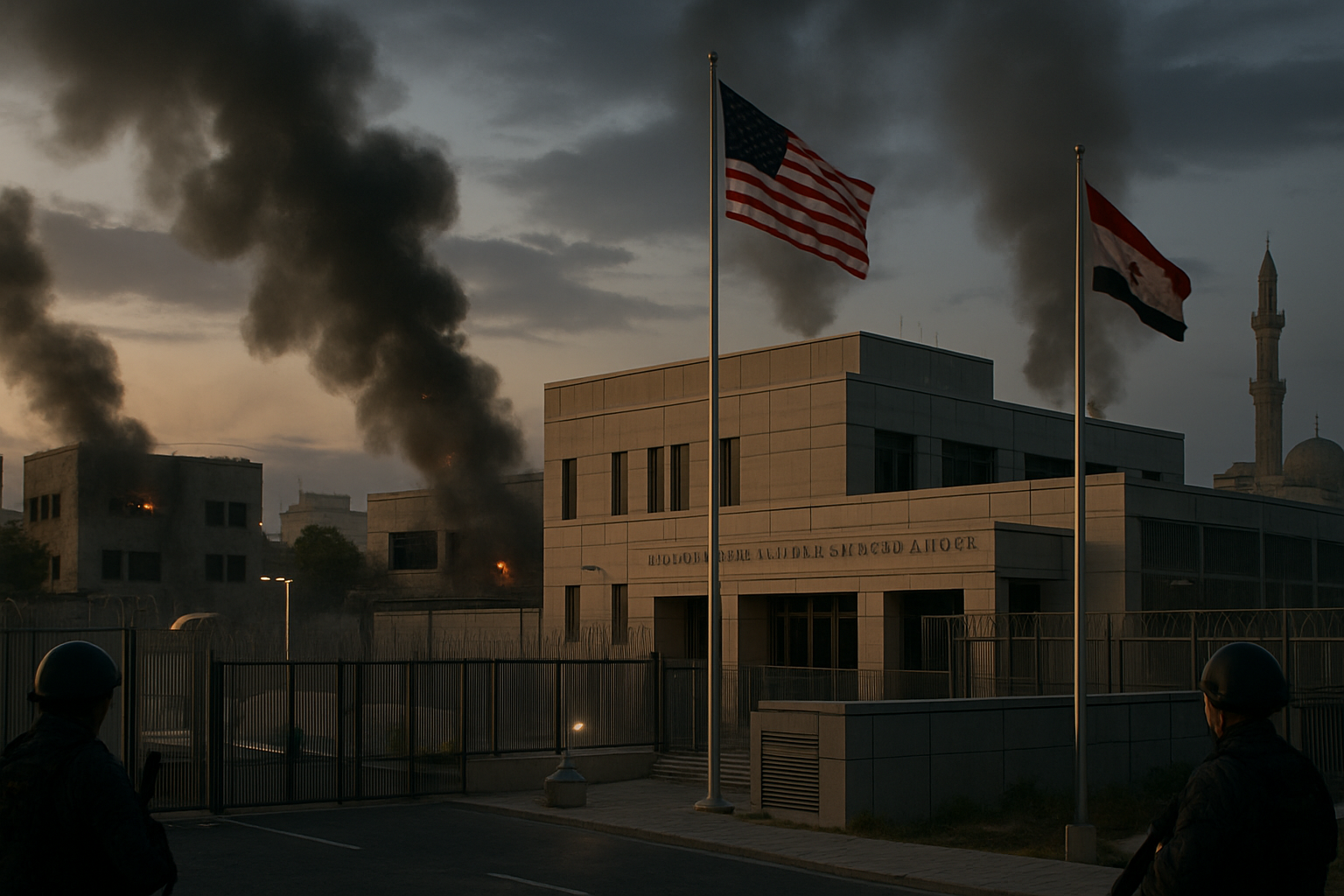
The targeting of diplomatic facilities represents a significant escalation in Iran's retaliatory strategy, moving beyond military installations to civilian and diplomatic targets. Iranian Revolutionary Guard commanders have declared that "no red lines remain" and that all US and Israeli assets in the region are now considered "legitimate targets."
Humanitarian Impact and Civilian Casualties
The human cost of the escalating conflict continues to mount, with confirmed casualties across multiple countries. In the UAE, one civilian was killed in Abu Dhabi from missile debris, while Kuwait Airport drone strikes resulted in employee injuries. The most tragic incident occurred at a girls' elementary school in Minab, Iran, where strikes killed between 53-85 students and staff members during regular school hours.
The images of children's backpacks and schoolbooks scattered among the rubble have become powerful symbols of the diplomatic failure's human cost. International human rights organizations are demanding investigations into potential Geneva Conventions violations for targeting civilian educational infrastructure.
The attacks have also created an unprecedented aviation crisis, with Iran, Iraq, Israel, UAE, and Qatar simultaneously closing their airspace to civilian traffic. Over 18,000 flights have been cancelled worldwide, making this the most extensive aviation disruption since COVID-19. Dubai International Airport, the world's busiest, was forced to completely shut down operations due to missile damage.
Economic and Energy Security Implications
The conflict's expansion has sent oil prices surging toward $100 per barrel, with Iran threatening to close the Strait of Hormuz - a critical chokepoint through which 40% of the world's seaborne oil passes daily. The Revolutionary Guard has declared the strategic waterway "unsafe," effectively closing it to commercial traffic.
Natural gas prices have spiked 24% in Europe and 78% in the United States as markets react to the supply disruption fears. Major shipping companies including Maersk and MSC have suspended operations in the region, with over 150 oil tankers now anchored in the Persian Gulf representing billions of dollars in stranded cargo.
"This represents the most significant threat to global energy security in decades. The closure of the Strait of Hormuz for any sustained period would create a global oil shock affecting all major economies."
— Senior Energy Market Analyst
Historical Context and Nuclear Governance Crisis
The current crisis occurs against the backdrop of broader nuclear governance breakdown worldwide. The New START treaty between the US and Russia expired on February 5, 2026 - marking the first time in over 50 years that the superpowers lack nuclear constraints. Combined with China's nuclear expansion and Iran's uranium enrichment approaching weapons-grade levels, UN Secretary-General António Guterres has warned that nuclear risks are at their "highest in decades."
The targeting of US diplomatic facilities represents a dangerous escalation from previous patterns of conflict, where attacks primarily focused on military installations. The shift suggests Iran's strategy has evolved to encompass civilian and diplomatic targets as part of its broader retaliation campaign.
Regional experts warn that the breakdown of the Saudi-UAE-Qatar-Egypt coalition supporting diplomacy could have lasting consequences for Middle East stability. Egypt's President Sisi condemned the attacks on "sisterly Arab countries," warning of "comprehensive chaos" if the violence continues to spread.
Looking Forward: Template-Setting Crisis
The current escalation represents what analysts are calling a "template-setting moment" for 21st-century conflict resolution. The rapid transition from promising diplomatic breakthrough to military confrontation within days demonstrates the fragility of modern crisis management mechanisms in an increasingly multipolar world.
Success in containing the current escalation could provide a framework for future nuclear crisis resolution and strengthen international non-proliferation norms. However, failure may accelerate the trend toward military solutions over diplomatic ones, potentially encouraging nuclear proliferation elsewhere and undermining diplomatic credibility in territorial and security disputes worldwide.
The international community now faces the urgent challenge of preventing further escalation while addressing the underlying issues that led to this dramatic diplomatic breakdown. With energy markets in turmoil, aviation networks disrupted, and civilian casualties mounting, the stakes for crisis resolution have never been higher.
As US diplomatic facilities across the region implement emergency security protocols and evacuate non-essential personnel, the attacks mark a watershed moment in Middle East geopolitics that will likely reshape regional security arrangements and international approaches to nuclear crisis management for decades to come.