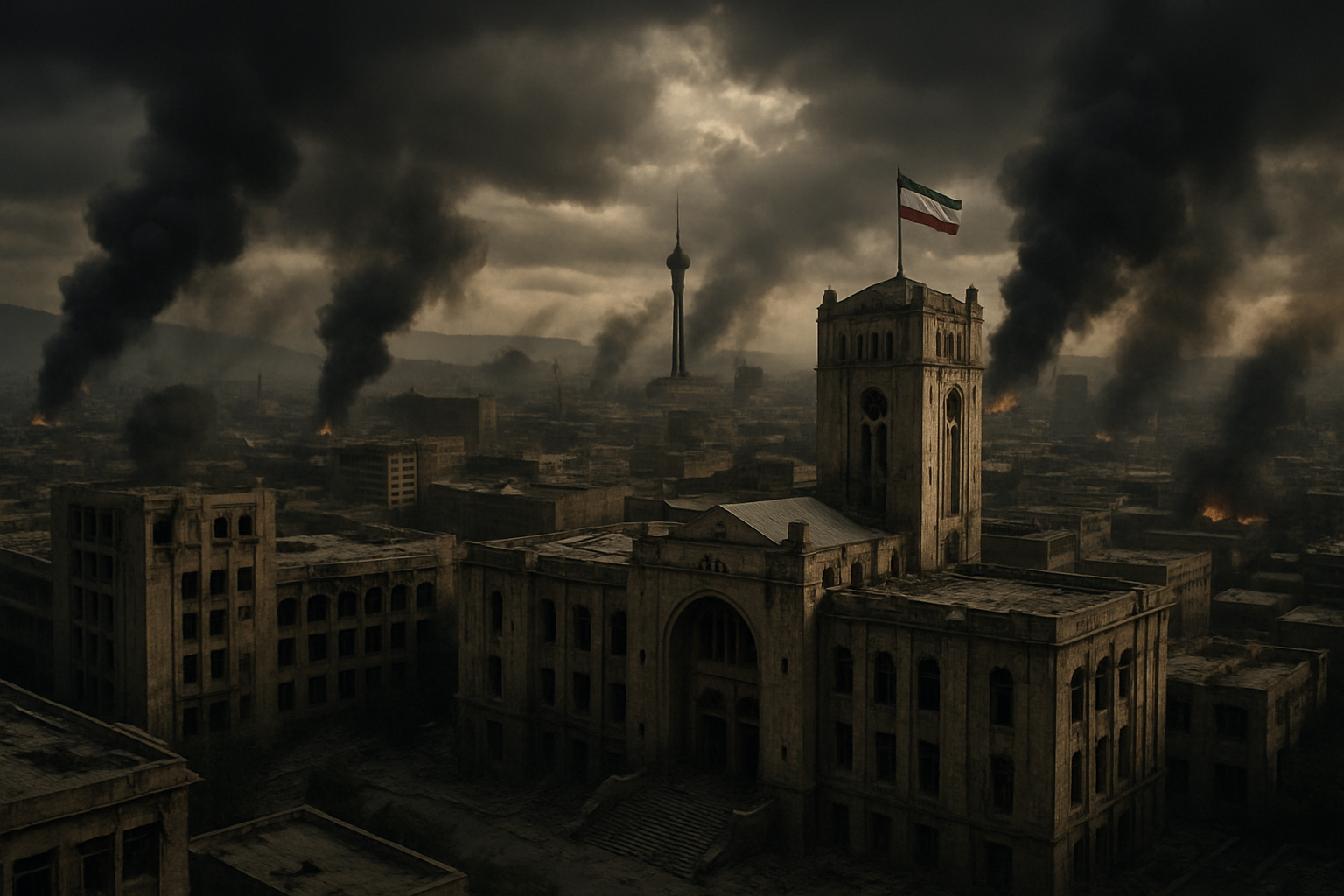
In what intelligence analysts describe as the most systematic decimation of a nation's leadership structure since World War II, coordinated US-Israeli military operations have killed Iran's Supreme Leader Ali Khamenei, security chief Ali Larijani, and dozens of senior officials over 18 days of unprecedented warfare that began March 1, 2026.
The scope of leadership elimination is staggering: from Supreme Leader Ayatollah Ali Khamenei and his immediate family members to Defense Minister Aziz Nasirzadeh, IRGC Chief Mohammad Pakpour, Intelligence Minister Esmail Khatib, and National Security Council Secretary Ali Larijani. The systematic targeting represents what Israeli Foreign Minister Gideon Saar called a "$10 million bounty campaign executed for free."
The Fall of Iran's Power Structure
The carnage began March 1 with "Operation Epic Fury," the largest US-Israeli coordinated military campaign since the 2003 Iraq invasion. Using an unprecedented dual-carrier deployment of USS Gerald R. Ford and Abraham Lincoln—representing one-third of the active US Navy fleet—strikes targeted Iran's leadership compound in Tehran during what Iranian state media described as Khamenei performing "official duties."
Confirmed deaths from the initial wave included not only Khamenei but his daughter, son-in-law, granddaughter, and daughter-in-law—a targeting of family members unprecedented in modern international relations. The elimination of Khamenei ended a 37-year rule that began in 1989 and transformed Iran into the Middle East's primary anti-American power.
"This is the most significant blow to Iranian leadership since the 1979 revolution. We're witnessing the systematic decapitation of an entire government structure during active warfare."
— Senior CIA Official, speaking anonymously
The leadership massacre continued March 17-18 with the assassination of Ali Larijani, described by analysts as Iran's "de facto leader" following Khamenei's death. Killed alongside his son Morteza and aide Ali Reza Bayat at his daughter's house in Tehran's Pardis area, Larijani's elimination removed the last stabilizing figure during Iran's constitutional succession crisis.
Revolutionary Transformation
The unprecedented scope of casualties has triggered Iran's first hereditary succession in the Islamic Republic's 47-year history. Mojtaba Khamenei, son of the deceased Supreme Leader, has emerged as the favored successor—marking a historic shift from clerical to military governance as the Revolutionary Guards consolidate unprecedented control over Iranian institutions.
A three-member transitional council comprising President Masoud Pezeshkian, judiciary head Gholamhossein Mohseni Ejei, and Guardian Council representative Ayatollah Alireza Arafi has managed the constitutional transition under active warfare conditions—a scenario Iran's founding fathers never envisioned.
Intelligence assessments suggest the Revolutionary Guards' influence in selecting the next Supreme Leader represents a fundamental transformation from theocratic to military rule. "We're witnessing the birth of a clerical monarchy rather than the theocracy that emerged in 1979," explains Dr. Mehdi Khalaji, Iran expert at the Washington Institute.
Global Crisis Unprecedented
The leadership decimation has triggered the most dangerous international crisis since the Cold War's end. Iran's "Operation True Promise 4" retaliation declared "no red lines remain," systematically targeting US and Israeli assets across the region while mining the Strait of Hormuz—a chokepoint carrying 40% of global oil transit.
The immediate global consequences are staggering: over 18,000 flights cancelled worldwide (the most since COVID-19), oil prices surging past $100 per barrel, and the International Energy Agency releasing a record 400 million barrels from strategic reserves—the largest intervention in the agency's 50-year history.
Dubai International Airport, the world's busiest with 86 million annual passengers, remains completely shut down from missile damage. Major airlines including Emirates, Air France-KLM, and Wizz Air have suspended operations indefinitely, creating an aviation black hole across eight Middle Eastern countries that have closed their airspace simultaneously.
Nuclear Diplomacy's Collapse
The systematic targeting of Iranian leadership followed the complete breakdown of nuclear negotiations despite achieving what diplomats called "broad agreement on guiding principles"—the most progress since the JCPOA's 2018 collapse. The fundamental disagreement remained unchanged: Iran demanded nuclear-only talks excluding ballistic missiles and regional proxies as "red lines," while the US insisted on comprehensive agreements covering missiles, armed groups, and human rights.
Iran continues enriching uranium at 60% purity with over 400 kilograms of weapons-grade material—sufficient for multiple nuclear weapons if weaponized. The collapse occurs amid a broader nuclear governance crisis following New START's expiration on February 5, marking the first time in over 50 years without US-Russian nuclear constraints.
Regional Coalition Under Pressure
An unprecedented regional coalition of Saudi Arabia, UAE, Qatar, and Egypt that had supported diplomatic solutions now faces severe strain as Iranian retaliation directly targets member territories. Egyptian President Abdel Fattah el-Sisi condemned attacks on "sisterly Arab countries," warning of "comprehensive chaos" spreading across the region.
The targeting represents a strategic dilemma for Gulf states caught between their US security partnerships and Iranian pressure. Kuwait has relocated airline operations to Saudi Arabia following repeated drone attacks, while the UAE reported one civilian killed in Abu Dhabi from missile debris.
For the first time since World War II, European territory came under attack when Iranian drones struck RAF Akrotiri in Cyprus, prompting an unprecedented naval coalition response including HMS Dragon, Spanish frigates, and vessels from Italy, France, the Netherlands, and Greece.
Congressional Scrutiny Mounts
The systematic elimination of Iranian leadership has triggered intense Congressional scrutiny as lawmakers demand answers about strategy, costs, and potential ground troop deployment. Operation Epic Fury's costs reached $11.3 billion in the first week alone, with Pentagon officials preparing for operations extending through September—far beyond initial timelines.
Senator Richard Blumenthal expressed being "more concerned than ever" about ground troops, while the conflict's unpopularity reaches "almost unprecedented" levels with only 25% American support. Financial markets have emerged as what analysts call the "ultimate constraint" on escalation, with Pakistan's stock market suffering its largest decline in history at -8.97%.
"We're witnessing the most expensive military operation since Iraq 2003, but with unclear objectives and no exit strategy. This is exactly what we feared."
— Senator Richard Blumenthal (D-CT)
The first US casualties—three service members killed and five wounded—mark the first confirmed American deaths in the largest Middle East operation since 2003. Additionally, USS Charlotte's sinking of Iranian frigate IRIS Dena near Sri Lanka, killing over 80 crew members, represents the first enemy vessel sunk by a US submarine since World War II.
Humanitarian Crisis Deepens
The systematic targeting has created a mounting humanitarian crisis with Iran's Red Crescent reporting over 787 civilian casualties from US-Israeli strikes. International condemnation peaked following the Pentagon's confirmation of responsibility for an elementary school strike that killed 165-185 students, described as resulting from "outdated targeting data."
The largest international evacuation since the Arab Spring has seen Australia struggling to extract 115,000 trapped citizens while Germany reports 30,000 stranded tourists. The European Union activated Cyprus's ESTIA evacuation plan for the first time in the bloc's history.
Trump's Regime Change Agenda
President Trump's demands for Iran's "unconditional surrender" and his claim to personally choose the next Supreme Leader represent the most direct assertion of American control over Iranian affairs since 1979. His rejection of Mojtaba Khamenei as a "lightweight" and policy evolution from nuclear-focused to comprehensive regime change objectives eliminate virtually all diplomatic solution possibilities.
The transformation marks a complete departure from traditional diplomatic engagement, with Trump declaring it the "single greatest chance for the Iranian people to take back their country"—language that intelligence officials describe as unprecedented in modern international relations.
Template-Setting Crisis
UN Secretary-General António Guterres has called the crisis "the greatest test of multilateral cooperation and crisis management in the modern era." The rapid transition from diplomatic breakthrough to military confrontation demonstrates what experts term the fragility of crisis management in the multipolar era.
March 2026 represents a watershed moment in international relations, determining whether diplomatic or military solutions will prevail in 21st-century conflict resolution. The systematic decimation of Iranian leadership while nuclear negotiations collapsed sets dangerous precedents for future territorial and nuclear disputes globally.
Success in containing the escalation could provide a framework for nuclear crisis resolution, while failure may accelerate military solutions over diplomacy for decades, encouraging proliferation worldwide and undermining diplomatic credibility across international systems.
The stakes extend far beyond the Middle East: regional war prevention, global energy security, nuclear governance credibility, and international law enforcement mechanisms are all being tested simultaneously in what represents the most consequential crisis affecting the post-WWII international order's sustainability.