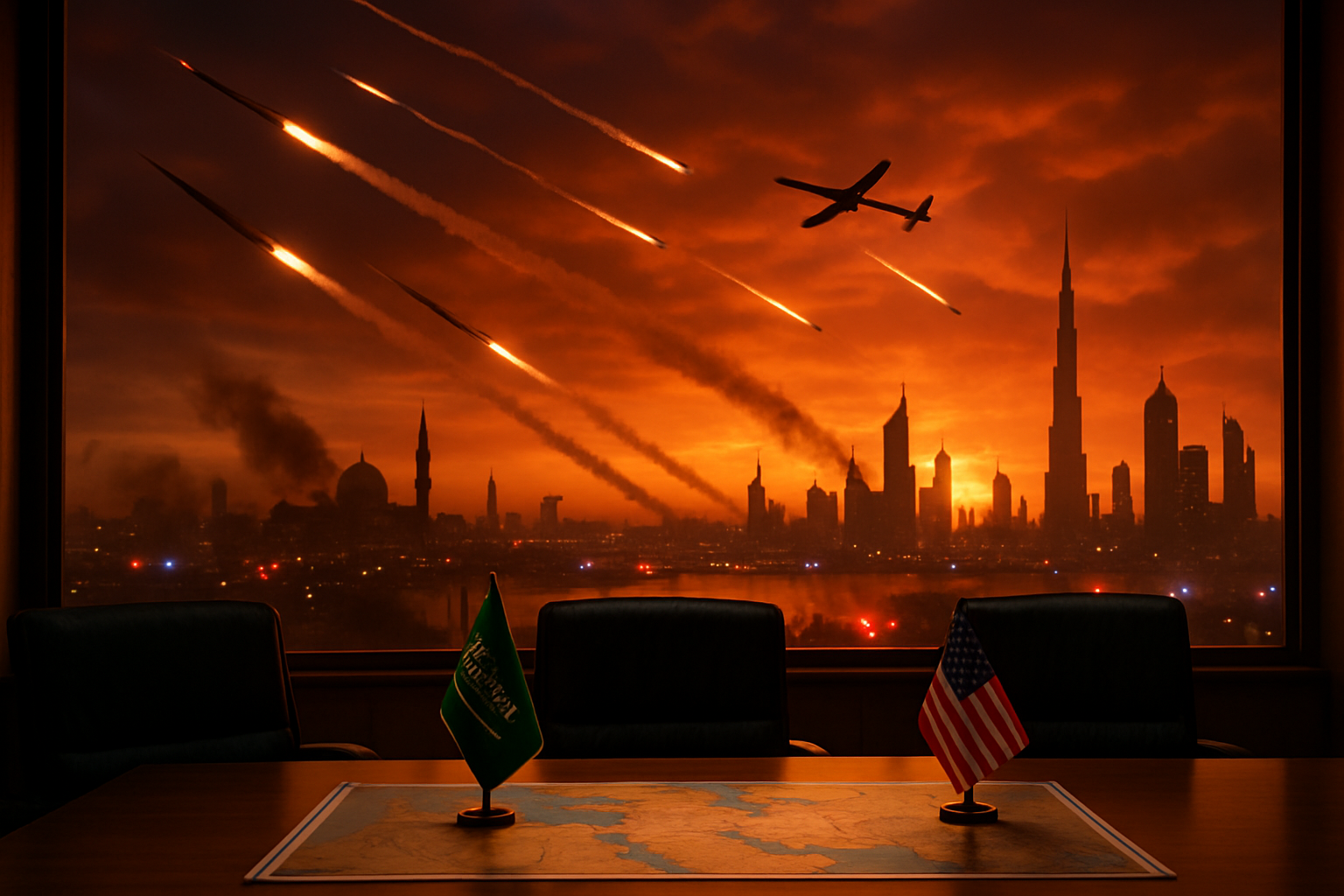
Iran launched massive coordinated missile and drone attacks across multiple Gulf countries and Israel on Sunday, March 1, 2026, killing civilians and causing widespread damage in what the Islamic Revolutionary Guard Corps declared as the beginning of an era where "no red lines remain" following the US-Israeli Operation Epic Fury strikes.
The unprecedented Iranian retaliation, dubbed "Operation True Promise 4," targeted Israel, the United Arab Emirates, Kuwait, Qatar, and Bahrain, resulting in at least 12 confirmed deaths and dozens of injuries across the region. The attacks represent the most significant escalation in Middle East tensions since the end of the Cold War and have triggered a global aviation crisis affecting hundreds of thousands of passengers worldwide.
Casualties Mount Across the Region
The deadliest single strike occurred in Beit Shemesh, just outside Jerusalem, where an Iranian ballistic missile hit a residential building, killing at least nine people and injuring 28 others, according to Israel's Magen David Adom emergency service. Two of the wounded are reported to be in serious condition, while search and rescue teams continue operations at the impact site.
In the UAE, one civilian was killed in Abu Dhabi from falling missile debris, while Dubai International Airport—the world's busiest—was forced to completely shut down after sustaining missile damage. Four airport workers were injured in the attack, affecting hundreds of thousands of passengers as the critical Middle East aviation hub suspended all operations.
Kuwait reported one death and 32 injuries, all involving foreign nationals, after Iranian drones struck Kuwait International Airport. The injured were treated at Al-Adan and Jaber hospitals, with five requiring surgical intervention. Qatar's air defense forces successfully intercepted 65 ballistic missiles and 12 drones using Patriot systems, though falling debris injured eight people.
Operation Epic Fury: The Trigger Event
The Iranian strikes came in direct response to the coordinated US-Israeli "Operation Epic Fury," launched Saturday morning and described as the largest Middle East military operation since the 2003 Iraq invasion. The operation involved an unprecedented dual-carrier deployment of the USS Gerald R. Ford and USS Abraham Lincoln, representing approximately one-third of the active US Navy fleet positioned 800 kilometers from Iran's coast.
Crucially, multiple sources have reported conflicting claims about Iran's Supreme Leader Ayatollah Ali Khamenei's fate during the strikes. While Israeli sources and President Trump claimed Khamenei was killed, Iranian Foreign Minister Abbas Araghchi denied the reports, calling them "psychological warfare" and stating Khamenei was "alive as far as I know."
However, confirmed casualties from Operation Epic Fury include Iran's Defense Minister Aziz Nasirzadeh, IRGC Chief Mohammad Pakpour, and senior aide Ali Shamkhani, along with 40+ high-ranking officials. Tragically, a strike on the Minab elementary school killed between 53-85 students and staff during regular school hours, prompting international condemnation.
Nuclear Diplomacy Collapses
The military escalation followed the complete breakdown of nuclear negotiations that had achieved what Iran's Foreign Minister Abbas Araghchi called "broad agreement on guiding principles"—the most significant diplomatic progress since the JCPOA collapse in 2018.
The talks ultimately failed due to fundamental scope disagreements that have persisted for over a decade. Iran excluded ballistic missiles and regional proxy activities as "red lines," demanding nuclear-only discussions, while US Secretary of State Marco Rubio insisted on a comprehensive agreement addressing missiles, armed groups, and human rights issues.
Iran continues enriching uranium at 60% purity—far exceeding the JCPOA's 3.67% limit and approaching the 90% weapons-grade threshold. Former IAEA inspector Dr. Yusri Abu Shadi confirmed Iran possesses over 400 kilograms of enriched uranium, making nuclear weapons "easily achievable" if the decision is made to weaponize.
Global Aviation Crisis Unprecedented
The attacks have triggered the most comprehensive regional aviation crisis since the COVID-19 pandemic. Iran, Iraq, Israel, UAE, Qatar, Syria, Kuwait, and Bahrain simultaneously closed their airspace, leading to over 18,000 flight cancellations worldwide.
Major carriers have suspended operations across the region: Emirates and Etihad face operational crises with Dubai International closed, Qatar Airways has halted flights, and Air France-KLM, Wizz Air, and Bulgaria Air have suspended Middle East operations affecting hundreds of thousands of passengers globally.
The closures have eliminated a critical Europe-Asia transit corridor, forcing complex rerouting of international flights and stranding passengers worldwide. The economic impact extends far beyond aviation, with oil prices rising on concerns about the Strait of Hormuz, through which 40% of global oil transits.
Regional Coalition Under Severe Strain
The Iranian retaliation has severely tested an unprecedented regional coalition of Saudi Arabia, UAE, Qatar, and Egypt that had supported diplomatic efforts. Egyptian President Abdel Fattah el-Sisi condemned the attacks on "sisterly Arab countries," warning of "comprehensive chaos" if the crisis escalates further.
Multiple countries have issued emergency travel warnings and begun evacuating diplomatic personnel. Sweden and Serbia ordered immediate citizen evacuations from Iran, citing "extremely uncertain" security conditions, while the US authorized departure of non-essential embassy staff from Israel.
International Response and UN Emergency Session
The UN Security Council has scheduled an emergency session following a joint request from France, China, Russia, Colombia, and Bahrain. Russia condemned what it called "reckless actions by Washington and West Jerusalem," describing them as violations of international law.
The crisis occurs against the backdrop of a broader nuclear governance crisis, with the New START treaty having expired on February 5—the first time in over 50 years without US-Russia nuclear constraints. UN Secretary-General António Guterres has warned that nuclear risks are at their "highest in decades."
Trump's Regime Change Agenda
President Trump's response has been notably aggressive, with the most explicit regime change advocacy since the 1979 Iranian Revolution. Trump directly addressed the Iranian people, urging them to "take control of your country" and describing the crisis as their "single greatest chance for freedom."
This represents a significant policy evolution from nuclear-focused negotiations to comprehensive political transformation objectives, with Pentagon sources confirming preparations for "potentially weeks-long operations" extending beyond nuclear facilities to Revolutionary Guard infrastructure.
Historical Significance and Global Implications
The events of March 1, 2026, mark what many analysts are calling the most dangerous moment since the Cold War's end. The rapid transition from intensive diplomacy to military confrontation demonstrates the fragility of modern crisis management in the multipolar era.
The stakes extend far beyond the Middle East, affecting global energy security, nuclear governance credibility, and international law enforcement mechanisms. Success in containing the escalation could provide a template for 21st-century conflict resolution, while failure may accelerate military solutions over diplomatic approaches for decades to come.
As the world watches this unprecedented crisis unfold, the coming days will be decisive in determining whether the international community can prevent regional war or whether the Middle East is entering a new era of sustained conflict with global implications that could reshape international relations for generations.