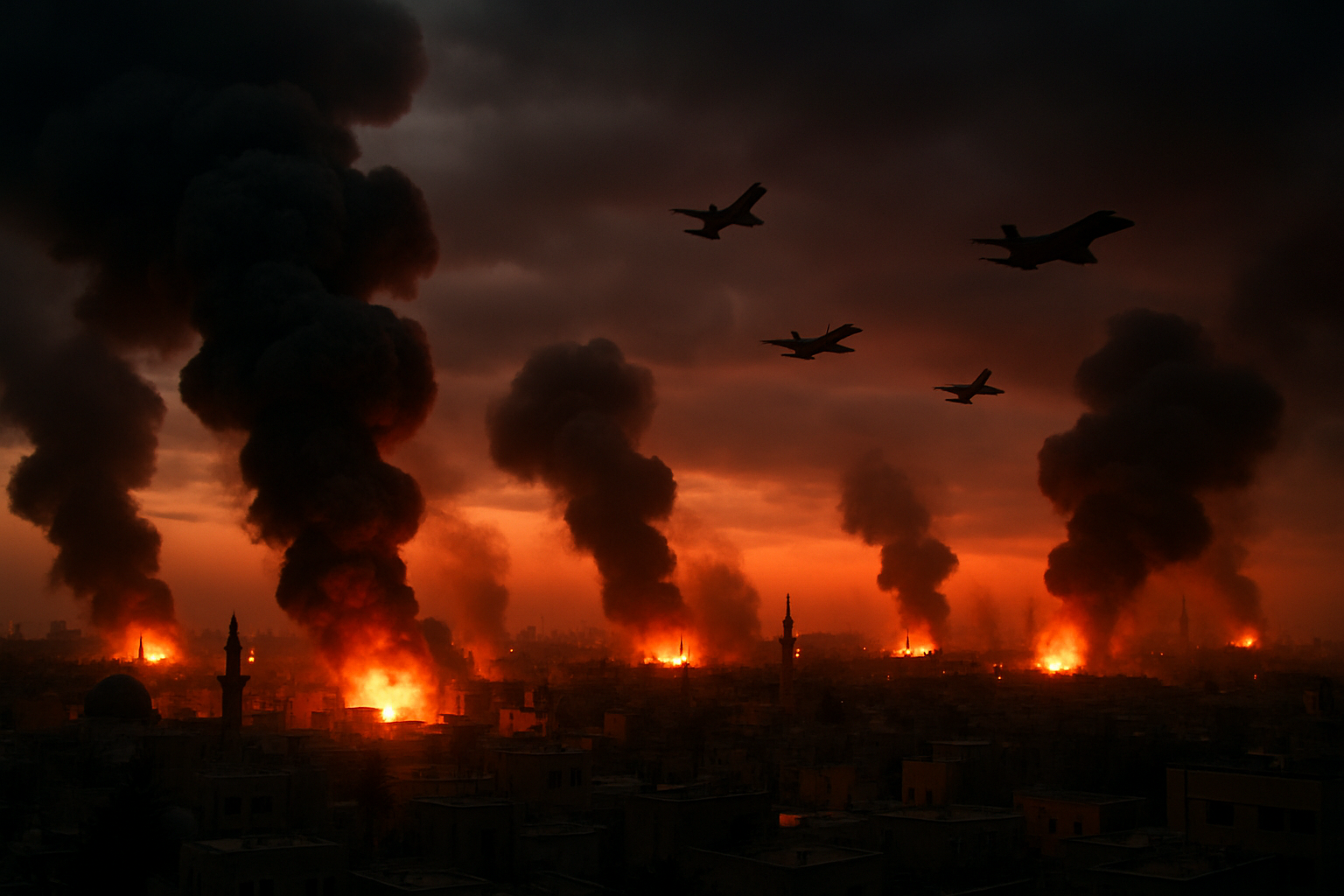
Iran has launched an unprecedented wave of retaliatory strikes across the Middle East targeting US military installations and Gulf state territories, following confirmation of Supreme Leader Ali Khamenei's death in coordinated US-Israeli "Operation Epic Fury" strikes on March 1, 2026.
The Islamic Revolutionary Guard Corps (IRGC) declared "no red lines remain" as it initiated "Operation True Promise 4," systematically targeting American assets and allied nations across the region in what represents the most dangerous military escalation since the Cold War.
Casualties Mount Across Gulf States
Confirmed casualties from Iranian retaliation include at least one civilian killed in Abu Dhabi from missile debris, with 32 foreign nationals injured in Kuwait following drone strikes on the international airport. Qatar's air defense systems intercepted 65 ballistic missiles and 12 drones using Patriot systems, though 8 people were injured by falling fragments.
Dubai International Airport, the world's busiest aviation hub, sustained significant missile damage and has been completely shut down, affecting hundreds of thousands of passengers worldwide. The Bahrain-based US Fifth Fleet headquarters was among the primary targets of Iranian strikes.
"The UAE Ministry of Defense strongly condemned the military targeting, describing it as a blatant act of aggression and a flagrant violation of national sovereignty and international law."
— UAE Defense Ministry Statement
Khamenei Death Officially Confirmed
Iranian state media, including Fars News, Mehr News Agency, and Press TV, officially confirmed the death of 86-year-old Supreme Leader Ayatollah Ali Khamenei, who was killed "at his place of work" in Tehran's leadership compound while "performing official duties." The confirmation came hours after President Trump announced the death via Truth Social, calling Khamenei "one of the most evil people in History."
Family casualties include Khamenei's daughter, son-in-law, and granddaughter, who were also killed during the compound strikes according to multiple Iranian sources. The attack ends Khamenei's 37-year rule since 1989, creating an immediate succession crisis with no clear heir apparent.
Global Aviation Crisis Unprecedented
The conflict has triggered the most extensive aviation disruption since COVID-19, with Iran, Iraq, Israel, UAE, Qatar, Syria, Kuwait, and Bahrain all closing their airspace simultaneously. Over 18,000 flights have been canceled worldwide, with major carriers including Emirates, Air France-KLM, Wizz Air, and Bulgaria Air suspending Middle East operations entirely.
The closure of Middle Eastern airspace particularly impacts Europe-Asia connections, forcing complex international rerouting that affects global travel networks. Airlines face operational crises as the region serves as a critical transit hub for international aviation.
Nuclear Diplomacy Complete Breakdown
The military escalation followed the complete collapse of nuclear negotiations despite achieving what Iranian Foreign Minister Abbas Araghchi called "broad agreement on guiding principles" - the most significant diplomatic progress since the JCPOA collapse in 2018.
The fundamental disagreement that proved insurmountable centered on scope: Iran excluded ballistic missiles and regional proxies as "red lines," demanding nuclear-only talks, while US Secretary Marco Rubio insisted on comprehensive agreements including missiles, armed groups, and human rights issues.
"Iran will never abandon uranium enrichment even if war is imposed."
— Abbas Araghchi, Iranian Foreign Minister
Energy Markets and Economic Impact
Oil prices are surging amid concerns over the Strait of Hormuz, through which 40% of global oil transits. Iran has warned that shipping will "not be allowed" through the strategic waterway, threatening worldwide energy supplies and economic stability.
Natural gas prices have jumped 24% in Europe and 78% in the United States as markets react to the potential for prolonged regional conflict. The crisis threatens to disrupt global supply chains far beyond the immediate Middle Eastern region.
Regional Coalition Under Severe Strain
An unprecedented coalition of Saudi Arabia, UAE, Qatar, and Egypt that had supported diplomatic solutions now faces severe strain as Iranian attacks have directly targeted member territories. Egyptian President Abdel Fattah al-Sisi condemned attacks on "sisterly Arab countries," warning of potential "comprehensive chaos."
Multiple embassy evacuations are underway, with Sweden and Serbia ordering immediate citizen evacuations from Iran citing "extremely uncertain" security conditions. The US has authorized departure of non-essential embassy personnel from Israel.
Constitutional Succession Activated
Iran has activated constitutional protocols, establishing a three-member transitional council consisting of President Masoud Pezeshkian, the judiciary head, and a Guardian Council jurist. The Assembly of Experts, comprising 88 clerics, will select a permanent successor in coming weeks.
Forty days of official mourning have been declared alongside seven days of public holidays. US intelligence sources suggest a Revolutionary Guards member is likely to be chosen as the next Supreme Leader, indicating potential hardline military influence over Iran's future direction.
International Response and UN Emergency Session
The UN Security Council has convened an emergency session following requests from France, China, Russia, Colombia, and Bahrain. Secretary-General António Guterres declared the military actions a "serious threat to international peace and security," warning they could "trigger a chain of events no one can control."
Russia condemned what Foreign Minister Sergey Lavrov called "reckless actions by Washington and West Jerusalem," while emphasizing Moscow's readiness to contribute to resolving the Iran situation through immediate cessation of military operations.
Nuclear Governance Crisis Context
The crisis occurs against the backdrop of broader nuclear governance breakdown, with the New START treaty having expired on February 5 - the first time in over 50 years without US-Russia nuclear constraints. Combined with China's nuclear expansion, UN officials warn that nuclear risks are at their "highest in decades."
The rapid transition from diplomatic framework to military escalation demonstrates the fragility of modern crisis management mechanisms in the multipolar era, with implications extending far beyond the current Middle Eastern conflict.
Template-Setting Moment for 21st Century
The events of March 1, 2026, represent a potential watershed moment in international relations and conflict resolution. Success in containing the escalation could provide a template for managing future nuclear crises, while failure may accelerate military solutions over diplomatic approaches, reshaping geopolitics for decades.
The stakes include regional war prevention, global energy security, nuclear governance credibility, and the fundamental principles of the post-World War II international order. The coming phase will determine whether this remains a contained regional confrontation or escalates into a broader Middle Eastern war with worldwide implications.